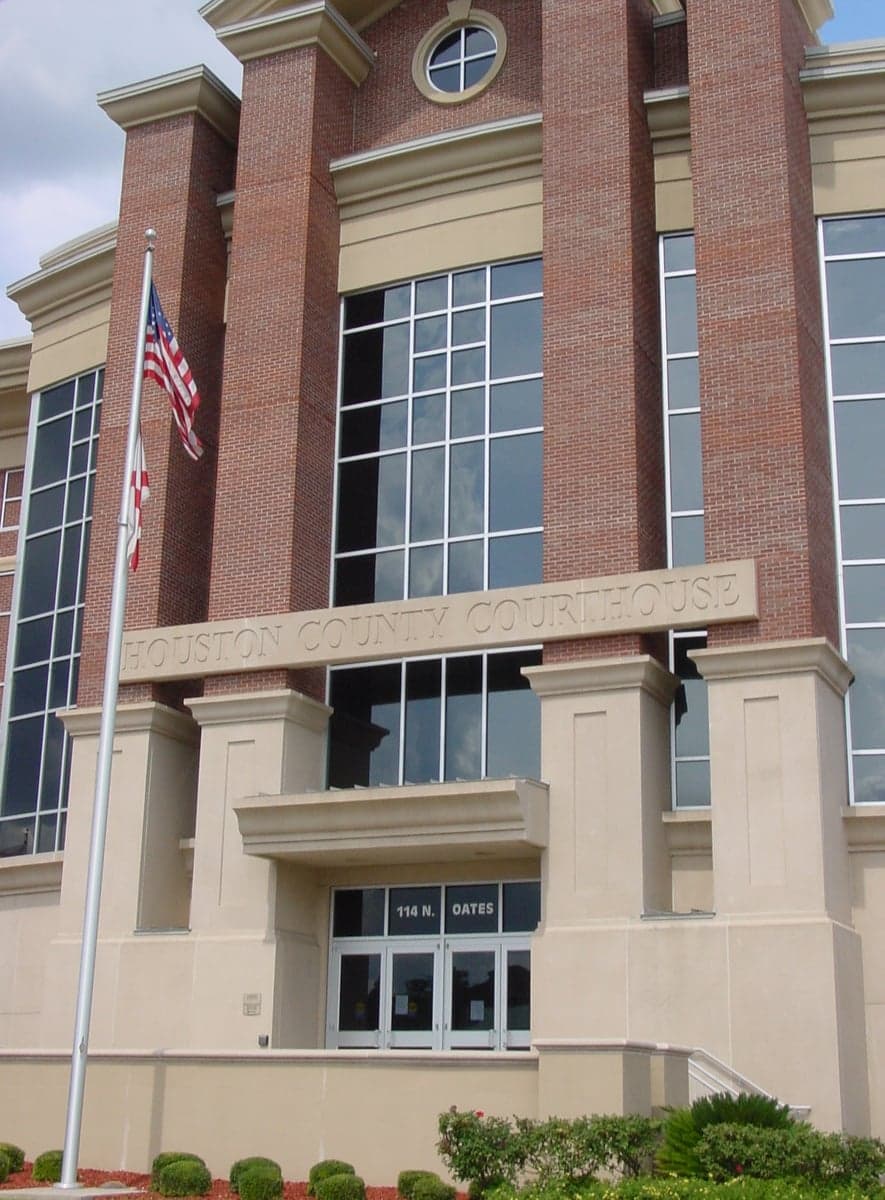
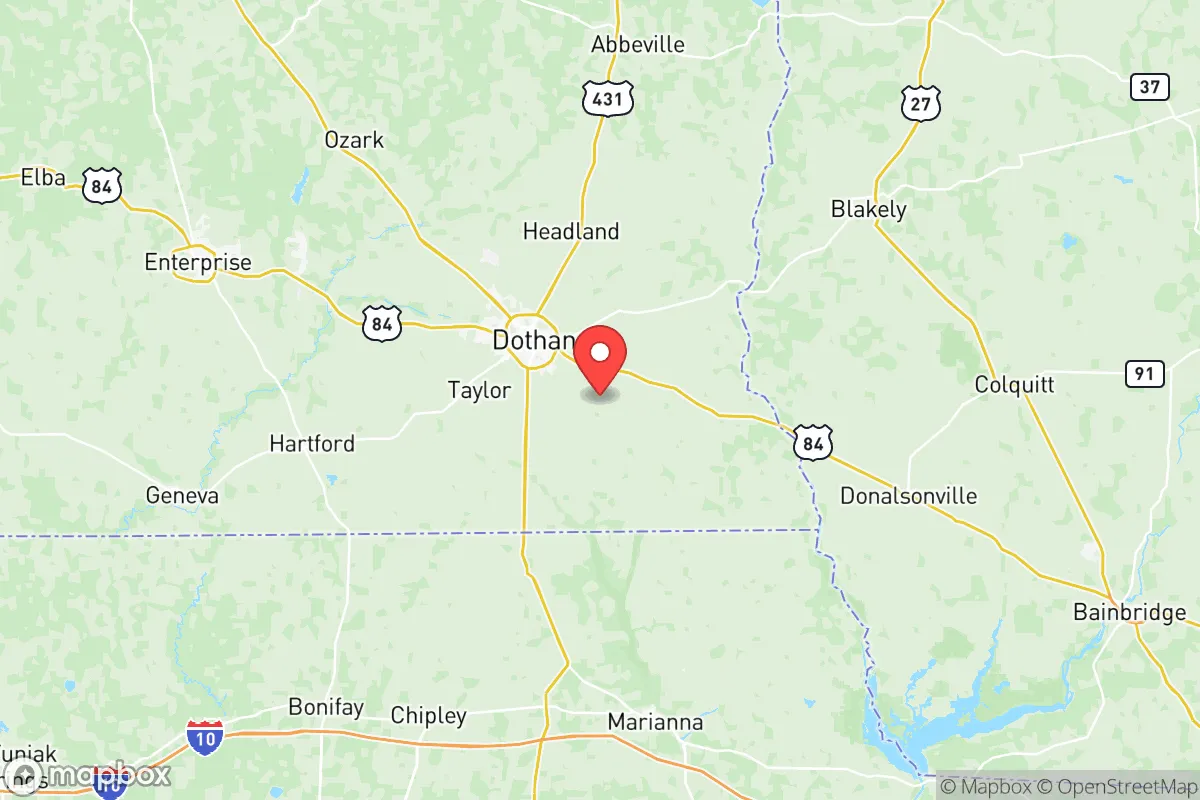
Photo: Wikipedia
Political ClimatePolitical Climate in Houston County
Showing state-level results — no local-only data available.
Local Political AnalysisPolitical Analysis of Houston County
Houston County, Alabama, is about as solidly conservative as it gets, and that’s not changing anytime soon. The county sits in the southeastern corner of the state, anchored by Dothan, and it’s been reliably red for decades. In 2024, Donald Trump carried Houston County with over 68% of the vote, which is a bit more Republican than the state as a whole (Alabama has a Cook PVI of R+14). But if you look closer, you’ll see some interesting variation between the towns and precincts that tells you a lot about where the county is headed.
How it compares
Compared to the rest of Alabama, Houston County is actually a little more conservative than the state average, but it’s not a monolith. The rural areas outside Dothan—places like Ashford, Cottonwood, and Webb—are deep red, often voting 75-80% Republican. Dothan itself is still conservative, but the city’s precincts near the downtown and the medical district (around the Southeast Health campus) are where you’ll find the few blue-leaning pockets. Those areas might hit 35-40% Democratic in a presidential race, mostly from younger professionals and some long-time black neighborhoods. The swing precincts are actually in the newer subdivisions on the north side of Dothan, like those off Ross Clark Circle near the Wiregrass Commons Mall—they’re still red, but they’re trending a bit more purple as new residents move in from other states. Statewide, Alabama’s R+14 rating is driven by places like rural north Alabama and the Black Belt, but Houston County holds its own as a reliably conservative anchor in the Wiregrass region.
What this means for residents
For folks living here, the political climate means you can generally expect local government to stay out of your business. The county commission and city councils in Dothan, Ashford, and Kinsey are dominated by Republicans who prioritize low taxes, minimal regulation, and a “we know what’s best for our community” attitude. That’s a good thing if you value personal freedom—there’s no talk of mask mandates or heavy-handed zoning rules here. But I’ve seen a few concerning shifts over the last five years. The Dothan City Schools board, for example, has had some debates about curriculum content that sound like they’re borrowed from national progressive talking points. And there’s been a push from some local business groups to adopt “diversity, equity, and inclusion” policies that feel like government overreach into private hiring decisions. So far, those efforts have been beaten back by grassroots opposition, but it’s something to keep an eye on. The county’s conservative majority is still strong, but the edges are fraying a bit as Dothan grows and attracts more people from blue states.
Cultural and policy distinctions
One thing that sets Houston County apart from the rest of Alabama is its strong sense of local identity. People here don’t just vote Republican—they live it. The National Peanut Festival, the Wiregrass region’s agricultural roots, and the heavy military presence from nearby Fort Novosel (formerly Fort Rucker) all reinforce a culture of self-reliance and respect for tradition. You won’t find the kind of progressive activism you see in Birmingham or Montgomery. But there’s a quiet worry among long-time residents that the county’s growth—especially the new housing developments around Dothan’s “Midtown” area—could bring in folks who don’t share those values. If you’re looking for a place where the government respects your rights and doesn’t try to micromanage your life, Houston County is still a safe bet. Just keep an eye on the local school board meetings and city council votes—that’s where the real battles over freedom are happening now.

State Political ClimatePolitical Climate in Alabama
State Political AnalysisPolitical Environment in the State
Alabama is a deeply conservative state, with a Cook Partisan Voting Index of R+14, meaning it votes about 14 points more Republican than the national average in presidential elections. The dominant coalition is a mix of rural and suburban conservatives, evangelical Christians, and a growing number of pro-business transplants, while Democrats hold sway only in the Black Belt and a few urban pockets. Over the last 10-20 years, the state has shifted further right, with Republicans now holding supermajorities in both legislative chambers and every statewide office, a trend accelerated by white flight from the Democratic Party after the 2010 midterms and the nationalization of local politics.
Urban vs. rural divide
The political map of Alabama is starkly divided. The state’s largest metro, Birmingham (Jefferson County), is a Democratic stronghold, driven by a large Black population and a liberal-leaning professional class, but its suburbs—like Hoover and Vestavia Hills—vote reliably Republican. Montgomery and the Black Belt counties (e.g., Lowndes County, Greene County) are heavily Democratic, often voting 70-80% for Democrats, due to a legacy of civil rights activism and a predominantly Black electorate. In contrast, the rural north and southeast are solidly red: Huntsville (Madison County) is a fascinating exception—a booming tech and aerospace hub that leans Republican but is more moderate and libertarian-leaning than the rest of the state, with a growing number of out-of-state transplants. The Mobile and Baldwin County areas (Gulf Coast) are also conservative, with Baldwin County being one of the fastest-growing and most reliably Republican counties in the state. The rural “Wiregrass” region (e.g., Dothan) and the Appalachian foothills (e.g., DeKalb County) are deep red, driven by gun culture, low taxes, and social conservatism.
Policy environment
Alabama’s policy environment is among the most conservative in the nation. There is no state income tax on retirement income, and the state’s income tax (2-5%) is relatively low, though sales taxes are high (often 9-10% in cities). The regulatory posture is business-friendly: Alabama is a “right-to-work” state, has no state-level minimum wage above the federal $7.25, and offers generous incentives for manufacturers (e.g., Mercedes, Hyundai, Airbus). Education policy is a flashpoint: the state has a robust school choice program (the Alabama Accountability Act) that provides tax credits for private school tuition, and in 2024, Governor Kay Ivey signed the “CHOOSE Act,” creating education savings accounts (ESAs) for families. However, public schools rank near the bottom nationally, and the state’s ban on critical race theory and DEI programs in public schools (passed in 2022) has drawn both praise and legal challenges. Healthcare is mixed: Alabama did not expand Medicaid under the ACA, leaving many rural hospitals struggling, but the state has some of the strongest pro-life laws in the country, including a near-total abortion ban (the Human Life Protection Act of 2019). Election laws are strict: voter ID is required, and in 2021, the state passed a law banning curbside voting and limiting absentee ballot assistance, which Republicans argue ensures integrity but critics call suppression.
Trajectory & freedom
Alabama is trending more free in many respects, particularly on gun rights and parental rights. In 2022, the state passed constitutional carry (permitless carry of a concealed firearm), making it one of the most gun-friendly states in the country. The “Parental Rights in Education” law (2022) requires schools to notify parents of any changes to a student’s health or well-being, and the “Don’t Say Gay” style law (2022) restricts classroom discussion of sexual orientation and gender identity in K-5. On medical freedom, Alabama was one of the first states to ban COVID-19 vaccine mandates for state employees and contractors (2021). However, there are concerning trends: the state’s medical cannabis program has been mired in legal battles and has yet to issue a single license, a classic case of government overreach and bureaucratic incompetence. Property rights are strong, with no state-level property tax on vehicles and low property taxes (averaging 0.4% of home value), but local zoning in cities like Birmingham and Auburn can be restrictive. The biggest threat to freedom is the state’s heavy reliance on sales taxes, which are regressive and hit low-income residents hardest, and the lack of Medicaid expansion, which effectively traps many working poor in a healthcare no-man’s land.
Civil unrest & political movements
Alabama has a history of civil rights activism, but recent unrest has been more muted than in other states. The Black Lives Matter protests in 2020 were significant in Birmingham and Montgomery, but they were largely peaceful and did not lead to the property destruction seen elsewhere. The state has seen a rise in election integrity activism since 2020, with groups like the Alabama Election Protection Network pushing for tighter laws, though no major fraud has been proven. Immigration politics are less heated than in border states, but the 2011 HB 56 law (one of the strictest anti-immigration laws in the country) was largely gutted by courts, and the state has a small but growing Hispanic population, particularly in Albertville and Russellville (poultry processing towns). There is a visible secessionist undercurrent in some rural areas, with “Alabama Republic” flags and occasional talk of nullification, but it’s fringe. The most visible flashpoint for a new resident would be the confederate monument debates in Montgomery and Birmingham, where local governments have removed statues over state-level legal pushback. Overall, political movements are more about culture war issues (transgender rights, CRT, abortion) than street-level unrest.
Projection
Over the next 5-10 years, Alabama will likely become even more Republican, but with a growing libertarian and moderate wing driven by in-migration to Huntsville and the Gulf Coast. The Huntsville metro is projected to add 100,000+ people by 2030, many from blue states, which could shift the state’s politics toward a more “live and let live” conservatism rather than pure social conservatism. The Black Belt will continue to shrink in population and political influence, while the suburbs of Birmingham and Mobile will become more diverse but still Republican. The biggest wildcard is education: if the ESA program succeeds, it could accelerate a trend toward private and homeschool options, further weakening public schools and deepening the urban-rural divide. Expect more fights over medical cannabis (likely to be legalized in some form by 2028), gambling expansion (a perennial issue), and Medicaid expansion (unlikely under a Republican supermajority). The state’s low taxes and light regulation will continue to attract businesses, but the lack of a skilled workforce and poor healthcare access could become a drag on growth.
Bottom line for a new resident: If you’re a conservative looking for low taxes, strong gun rights, and a culture that respects traditional values, Alabama is a solid bet. You’ll find the most freedom in the Huntsville area (jobs, moderate politics) or the Gulf Coast (retirement, low cost of living). But be prepared for a state that still struggles with poverty, poor public schools, and a healthcare system that leaves many behind. The political climate is stable and rightward, but the real battles are over how much government should be involved in your life—and on that front, Alabama is mostly on the side of personal liberty, as long as you don’t need medical cannabis or a Medicaid card.
* Values derived from national, state, county, city and local statistics and may differ in a specific area. Last updated: 2026-05-08T22:47:32.000Z
Narrative content on this page is AI-generated and may contain mistakes. Verify any details that matter before acting on them.
ReloMaps may earn a commission from affiliate links at no extra cost to you.

