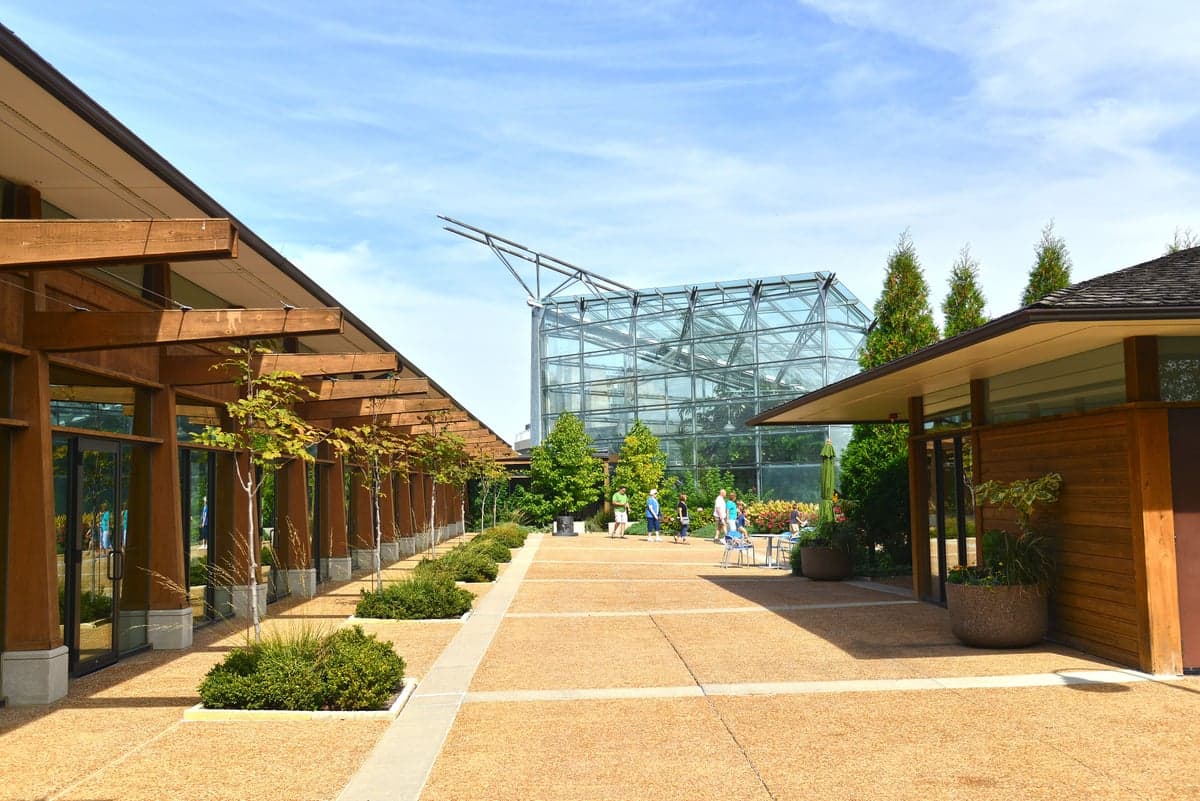
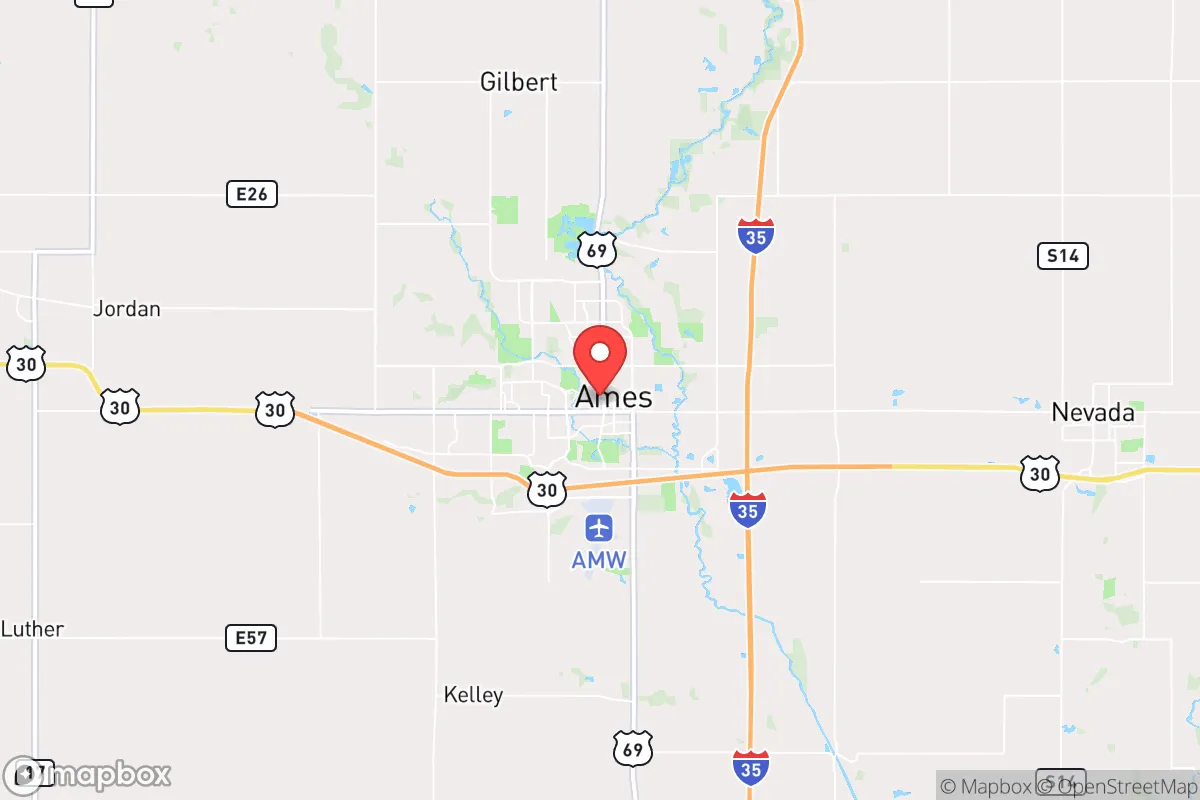
Photo: Wikipedia
Strategic Assessment of Ames, IA
Workable tactical position. Some exposure to population density or targets, but generally defensible in a crisis.
What does the Strategic Assessment tell us?
Our Strategic Assessment grades tactical survivability of an area. Major population centers, military targets, fallout zones, natural disasters, and border exposure all drive risk — lower exposure means a more defensible position in a crisis.
This is heavily inspired by Joel Skousen's Strategic Relocation book. Highly recommended you checkout the book ($)What does this tell us?
Our Strategic Assessment grades tactical survivability of an area. Major population centers, military targets, fallout zones, natural disasters, and border exposure all drive risk — lower exposure means a more defensible position in a crisis.
This is heavily inspired by Joel Skousen's Strategic Relocation book. Highly recommended you checkout the book ($)Strategic Pillars

Key Distances
Regional Safe Places
Below is our recommended "safe zones" in Iowa and the surrounding area based on our strategic heuristics. For most people, it's unrealistic to live in a “safe zone” full-time due to work, family or other personal reasons. They tend to be more rural. However, many of these areas are perfect for second homes and retreat properties that double as a vacation home or even a short-term rental.
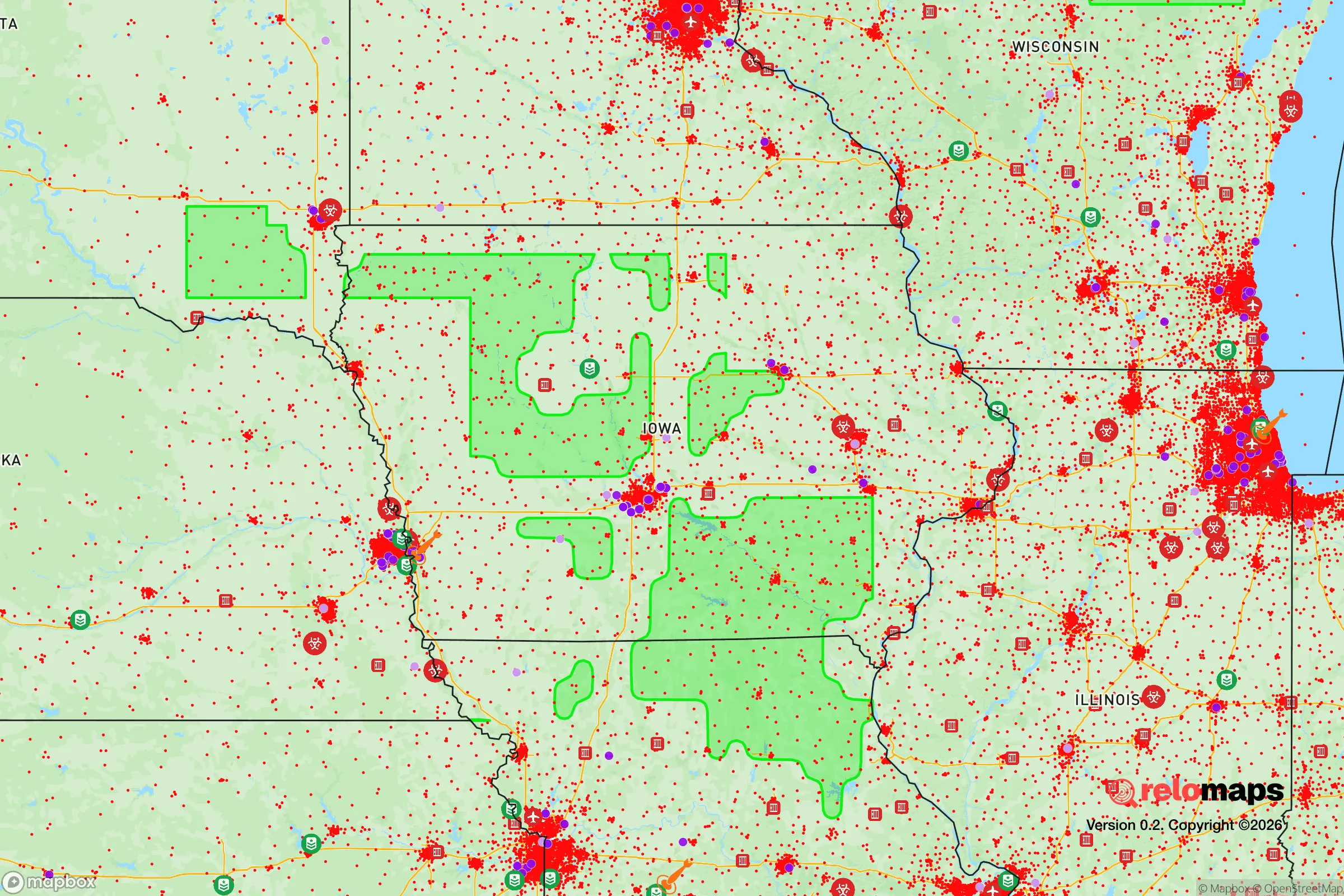
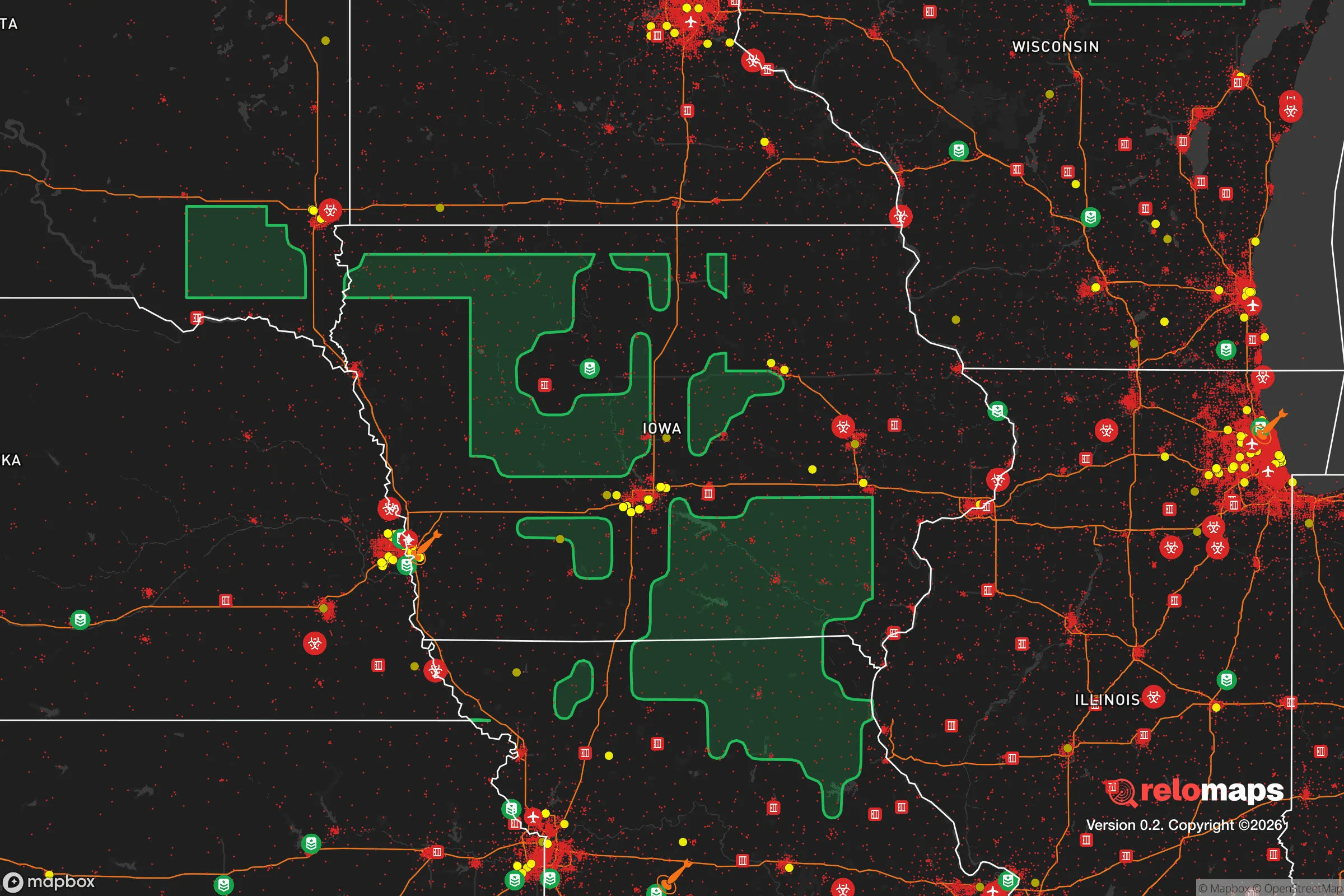


Important Note: For informational purposes only. This does not mean nothing bad ever happens in the green zones. Please use common sense. This is based on public data and modeled with AI. We tried to take a conservative approach but mistakes happen. We update this regularly as new information becomes available.
Solar Generator Recommendations
Backup power matters more here than in safer locations. We've picked three solar generators across budgets and capacity tiers — start with the budget unit if you only need a few essentials, or step up if you want to run a fridge and HVAC for days at a time.

Jackery Portable Power Station Explorer 300
Budget OptionPower on the Go: Weighing only 11 lbs, it's convenient to set up and store with book-sized foldable solar panels

BLUETTI Portable Power Station AC180
Designed for both indoor and outdoor scenarios, AC180 is highly capable as it has a robost capacity and continuous output power.

EF ECOFLOW DELTA Pro Ultra Power Station
Upgraded PickEcoFlow DELTA Pro Ultra is a whole-home energy system designed to grow with your family. Integrated with the Smart Home Panel 2, it scales to meet your evolving energy needs — keeping your home powered, intelligent, and secure through every stage of life.
We earn a commission, at no additional cost to you.
Strategic Assessment Analysis
Ames, Iowa, presents a paradox for the strategic relocator. On one hand, its status as a college town and regional economic hub provides a veneer of normalcy and institutional stability. On the other, its location in the heart of the Midwest, far from coastal chaos and major metropolitan collapse zones, offers a genuine foundation for long-term resilience. For those assessing relocation through a lens of preparedness—anticipating civic unrest, supply chain disruptions, or larger-scale societal fractures—Ames deserves a serious, sober look, not as a bunker, but as a viable base of operations with distinct advantages and equally distinct vulnerabilities.
Geographic position and natural advantages for long-term stability
Ames sits in Story County, roughly 30 miles north of Des Moines, placing it within a comfortable distance of a state capital’s resources without being swallowed by its potential failure. The city is not on a major fault line, is not prone to hurricanes, and experiences no wildfire risk of consequence. The primary natural threats are the standard Midwestern fare: severe thunderstorms, occasional tornadoes, and winter blizzards. These are manageable with proper preparation—a basement, a generator, and a stocked pantry. The surrounding landscape is flat, fertile agricultural land, which is a double-edged sword. It offers excellent visibility and long sightlines, but provides little natural cover or defensible terrain. The Skunk River runs through town, and the area sits atop the Jordan Aquifer, a massive underground water source that supplies the region. This means water security is a genuine asset, not a theoretical one. The soil is some of the richest in the world, meaning that if food production becomes a local necessity, the land can deliver. For a relocator, the key takeaway is that Ames is not a fortress, but it is a place where the basics—water, food-growing potential, and climate stability—are solidly in your favor.
Risks, exposures, and proximity to fallout-relevant landmarks
The most significant strategic liability for Ames is its proximity to a high-value, high-risk target: the Iowa State University campus and its associated research facilities. ISU is a land-grant institution with a major nuclear research reactor (the Mark I TRIGA reactor) on campus, as well as extensive biosafety level 3 labs and agricultural biotechnology research. In a scenario involving state collapse, mass casualty events, or targeted attacks, these facilities become potential points of interest for both state and non-state actors. The reactor itself is low-power and not a nuclear weapon, but any radiological incident—accidental or intentional—would create a localized fallout zone that could affect the immediate area. Additionally, Ames is within a two-hour drive of the Omaha metro area and Offutt Air Force Base, a major strategic command center. In a national emergency, this proximity could mean military traffic, refugee flows, or secondary effects from a strike on that facility. The city’s location along Interstate 35 is another double-edged sword: it provides excellent evacuation routes north to Minnesota or south to Missouri, but it also makes Ames a natural corridor for displaced populations moving away from larger cities like Des Moines or Kansas City. For the prepper, the calculus is clear: Ames is not a primary target, but it is close enough to secondary and tertiary targets that a layered plan—including a rural bug-out location further north or west—is a wise hedge.
Practical resilience for a relocator: food, water, energy, and defensibility
For the individual or family looking to establish a resilient household, Ames offers a mixed but workable environment. The city’s water supply, drawn from the Jordan Aquifer, is deep and protected from surface contamination, making it a reliable source even during prolonged grid-down scenarios. A well on a rural property outside city limits is even better, and the water table is accessible. Food security is strong: the surrounding farmland produces corn, soybeans, and livestock, and local farmers’ markets are robust. The presence of ISU’s agricultural extension services means a wealth of practical knowledge is available for those interested in small-scale farming, food preservation, or livestock management. Energy resilience is more challenging. The grid is typical of the Midwest—aging and vulnerable to ice storms and summer demand spikes. Natural gas is common for heating, but solar with battery backup is a viable investment given the region’s decent sun exposure. Defensibility is the weakest link. Ames is a flat, open city with a dense suburban and urban core. A single-family home on a standard lot offers little in the way of perimeter security. The best strategy is to live on the outskirts or in a small nearby town like Gilbert, Huxley, or Story City, where property lines are larger and neighbors are fewer. Community resilience is a genuine asset: the local culture, while politically mixed, leans toward self-reliance and neighborly mutual aid. There is a strong network of churches, gun clubs, and veteran organizations that form the backbone of a functional mutual-assistance network in a crisis. For the relocator, the practical path is to buy a home with a basement, install a wood stove, dig a well if possible, and get to know your neighbors before the lights go out.
The overall strategic picture for Ames is one of calculated viability. It is not a remote survivalist retreat, nor is it a high-risk urban kill box. It is a middle-ground location that offers genuine advantages in water and food security, institutional knowledge, and community cohesion, while carrying manageable risks from its proximity to research facilities and major transportation corridors. For the conservative-leaning relocator who values order, preparedness, and the ability to live a normal life while maintaining a ready posture, Ames is a strong candidate. The key is to treat it as a base, not a bunker—a place to build a life with one eye on the horizon and a plan for the road out if the horizon darkens. It is a place where you can be part of a community without being dependent on it, and where the land itself gives you a fighting chance. That is more than most locations can honestly claim.

* Values derived from national, state, county, city and local statistics and may differ in a specific area. Last updated: 2026-04-30T06:11:12.000Z
Narrative content on this page is AI-generated and may contain mistakes. Verify any details that matter before acting on them.
ReloMaps may earn a commission from affiliate links at no extra cost to you.

