
Photo: Wikipedia
Political ClimatePolitical Climate in Ames, IA
District shown is the primary district for this city’s centroid. Cities may span multiple districts.
Local Political AnalysisPolitical Analysis of Ames, IA
Ames, Iowa, sits in a county with a Cook PVI of R+15, meaning the area leans heavily Republican in federal elections, but don't let that number fool you into thinking the whole town votes the same way. The reality is that Ames is a classic college town bubble, where the presence of Iowa State University creates a sharp political divide between the permanent residents and the transient student population. Over the last decade, I've watched the local politics shift from a quiet, common-sense conservative baseline to something that feels increasingly like a tug-of-war between the old guard and a wave of progressive activism that's trying to remake the place in a hurry.
How it compares
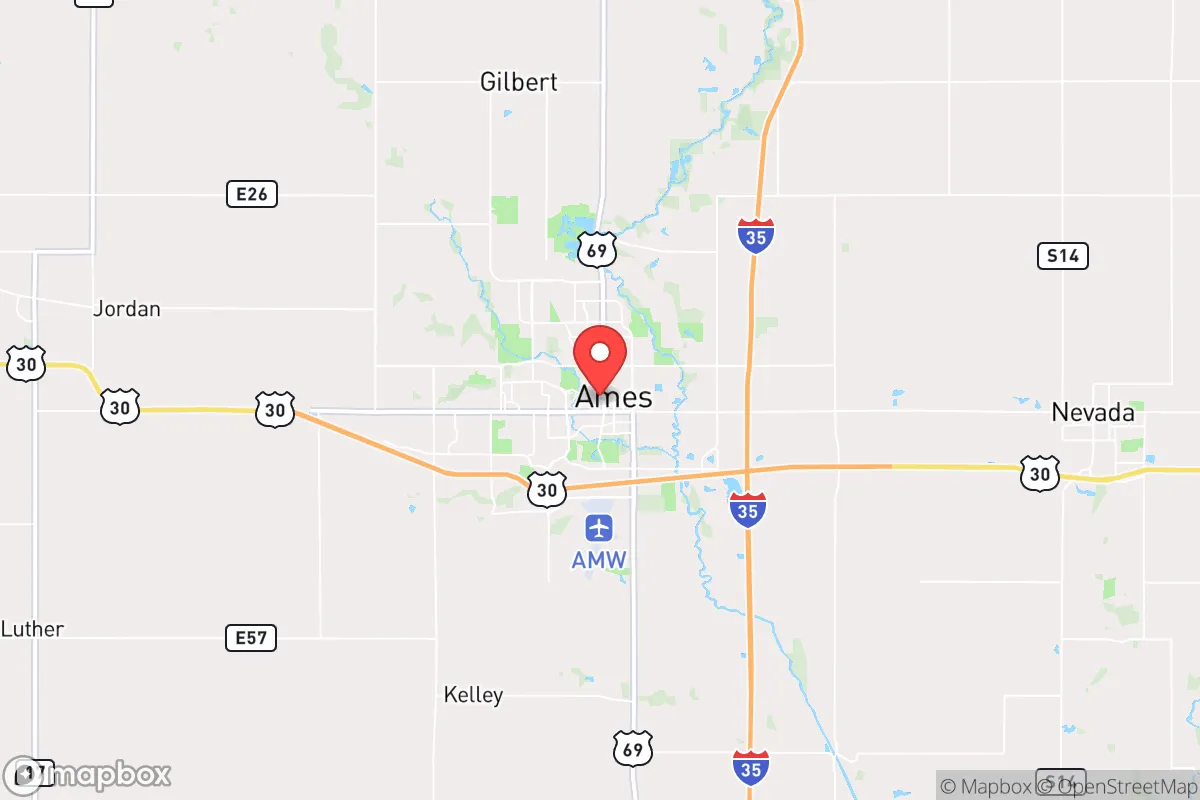
If you drive just 15 minutes north to Nevada or head east to Gilbert, you'll find communities that still vote the way Story County's R+15 rating suggests—solidly red, with folks who care about property rights, low taxes, and keeping government out of their daily lives. But inside Ames itself, the city council and school board races have become battlegrounds. The contrast is stark: while the surrounding towns are holding the line on things like zoning laws and school curriculum, Ames has seen pushes for more government involvement in housing regulations and even discussions about defunding the police, which would have been unthinkable here twenty years ago. The university brings in a rotating population of students and faculty from out of state, many of whom bring a more progressive worldview that doesn't always mesh with the values of the families who've been here for generations.
What this means for residents
For someone like me who's lived here for decades, the biggest concern is how this political drift is affecting our personal freedoms. We're seeing more local ordinances that tell you what you can do with your own property—like stricter rental codes and noise complaints that give the city more say over how you live. There's also a growing push for higher taxes to fund pet projects that benefit a vocal minority, not the whole community. The school board has become a hot spot, with debates over library books and classroom content that feel like government overreach into what parents should decide for their own kids. If you value being left alone to run your life without a bureaucrat's permission slip, the trajectory here is worrying. The long-time residents I know are starting to feel like we're losing the character that made Ames a great place to raise a family—safe, affordable, and free from constant political agitation.
One cultural distinction that stands out is how the university's influence seeps into everything, from the local newspaper's editorial stance to the events the city chooses to fund. You'll see more pride flags and climate activism banners downtown than you will in the surrounding farm towns, and the city government has been quick to adopt symbolic resolutions that signal a progressive identity, even when they don't reflect the majority's views. The real test will be the next few election cycles—if the permanent residents start turning out in force, we might pull things back toward the center. But if the student vote keeps growing, Ames could become a cautionary tale of how a small city can lose its way when it forgets that government's job is to protect your rights, not manage your choices.

State Political ClimatePolitical Climate in Iowa
State Political AnalysisPolitical Environment in the State
Iowa has been a reliably Republican state in presidential elections since 2016, but its political identity is more nuanced than a simple red-state label suggests. The state’s overall partisan lean is roughly R+6, driven by a coalition of rural conservatives, evangelical voters, and a growing number of fiscally conservative suburbanites, though the Des Moines metro area and a handful of college towns keep Democrats competitive at the state level. Over the past 20 years, Iowa has shifted from a classic purple swing state—where it voted for Obama in 2008 and 2012—to a solidly red one, with Republicans now holding all four U.S. House seats, both U.S. Senate seats, and a trifecta in state government. This trajectory accelerated after 2020, when the state’s electoral votes went to Donald Trump by 8 points, and the GOP has since tightened its grip on the legislature and governor’s office.
Urban vs. rural divide
The political map of Iowa is a textbook case of the urban-rural split. The Des Moines metro area, including Polk County and the suburbs of West Des Moines and Ankeny, is the state’s Democratic stronghold, delivering about 60% of its vote to Joe Biden in 2020. However, even within this metro, the suburbs are shifting: Dallas County, just west of Des Moines, flipped from Obama in 2012 to Trump in 2020, reflecting a broader trend of suburban voters moving right on cultural and economic issues. The state’s second-largest city, Cedar Rapids, is more moderate but leans Democratic, while Iowa City (home to the University of Iowa) is a deep-blue enclave driven by academic and younger voters. In contrast, the rural counties in northwest Iowa—like Sioux County and Lyon County—routinely vote 80%+ Republican, fueled by strong evangelical communities and agricultural interests. The Mississippi River counties in the east, such as Dubuque and Clinton, are more mixed, with older industrial towns that have trended Republican in recent cycles due to cultural conservatism and trade concerns.
Policy environment
Iowa’s policy environment is aggressively conservative on most fronts. The state has a flat income tax rate of 3.8% (phased down from 8.5% in 2023), with a goal of reaching 3.5% by 2027, making it one of the most tax-friendly states in the Midwest. Property taxes are relatively low, and there is no estate tax. The regulatory posture is business-friendly, with right-to-work laws and minimal zoning restrictions outside major metros. On education, Iowa passed a universal school voucher program in 2023, allowing any family to use public funds for private or homeschool expenses—a major win for parental rights. The state also enacted a six-week abortion ban in 2023 (the “fetal heartbeat” law), which is currently tied up in court but reflects the legislature’s strong pro-life stance. Election laws have been tightened: voter ID requirements were implemented in 2017, and in 2021, the state reduced early voting days and closed polls earlier, which Republicans argued was necessary for election integrity. Gun rights are expansive: Iowa became a permitless carry state in 2021, allowing any law-abiding adult to carry a concealed firearm without a license.
Trajectory & freedom
Iowa is becoming more free in the sense of limited government and personal liberty, particularly for conservatives. The 2021 permitless carry law (SF 583) eliminated the need for a state-issued permit to carry a firearm, a clear expansion of Second Amendment rights. The 2023 school voucher law (HF 68) gave parents the freedom to choose their children’s education without being tied to a failing district. On medical autonomy, the state banned gender-affirming care for minors in 2023 (SF 538), a move that aligns with parental rights advocates who argue children should not be subjected to irreversible procedures. Property rights have been strengthened by a 2022 law limiting eminent domain for carbon pipeline projects, a response to landowner concerns about CO2 pipelines crossing the state. However, there are concerns about government overreach in other areas: the state’s strict abortion ban, while popular with conservatives, represents a significant restriction on personal medical decisions. Overall, the trajectory is toward more conservative governance, with the legislature actively rolling back what they see as progressive overreach from previous decades.
Civil unrest & political movements
Iowa has seen relatively little civil unrest compared to coastal states, but there have been notable flashpoints. In 2020, Black Lives Matter protests in Des Moines and Iowa City turned violent on a few occasions, with property damage and clashes with police, but these were small-scale compared to other states. The most organized political movements are on the right: the Iowa Firearms Coalition is a powerful lobbying force, and the Family Leader (an evangelical group) has significant influence over the legislature. On the left, the Iowa Democratic Party has struggled to maintain momentum after losing the first-in-the-nation caucus status in 2024, and activist groups like Indivisible have faded. Immigration politics are relatively quiet, as Iowa has a small foreign-born population (about 5%), but there have been localized tensions in meatpacking towns like Storm Lake and Postville, where immigrant labor is essential. Election integrity controversies flared after 2020, with some rural counties passing symbolic resolutions questioning the results, but no major fraud was found. The most visible flashpoint for a new resident would be the constant presence of political yard signs and the intensity of local school board meetings, which have become battlegrounds over curriculum and library books.
Projection
Over the next 5-10 years, Iowa is likely to become more Republican and more conservative. In-migration is modest but tilts right: people moving from Illinois and Minnesota often cite lower taxes and cultural alignment as reasons. The Des Moines metro is growing, but its suburbs are trending redder, while rural areas continue to depopulate. The Democratic base is shrinking as older union voters die off and younger progressives leave for coastal cities. The state’s political trajectory suggests that by 2030, Iowa could be as red as Indiana or Missouri, with a GOP supermajority in the legislature and a governor’s mansion that is safely Republican. However, there are risks: if the state’s abortion ban is fully implemented and enforced, it could galvanize suburban women voters against the GOP, as seen in Kansas and Ohio. The school voucher program may also face backlash if it drains funding from rural public schools. For now, the trend is clear: Iowa is solidifying as a conservative stronghold, and anyone moving in should expect a government that prioritizes low taxes, parental rights, and limited regulation.
For a new resident, the bottom line is that Iowa offers a stable, conservative environment with a government that is actively working to reduce its footprint in your life—whether through tax cuts, school choice, or gun rights. You’ll find a state where your vote matters, where local politics are accessible, and where the culture aligns with traditional values. The trade-off is that you’ll have less diversity of opinion in many areas, and the state’s rural character means fewer amenities than in a major metro. If you’re looking for a place where the government trusts you to make your own decisions, Iowa is a solid bet—just be prepared for cold winters and a lot of cornfields.
* Values derived from national, state, county, city and local statistics and may differ in a specific area. Last updated: 2026-04-30T06:11:12.000Z
Narrative content on this page is AI-generated and may contain mistakes. Verify any details that matter before acting on them.
ReloMaps may earn a commission from affiliate links at no extra cost to you.

