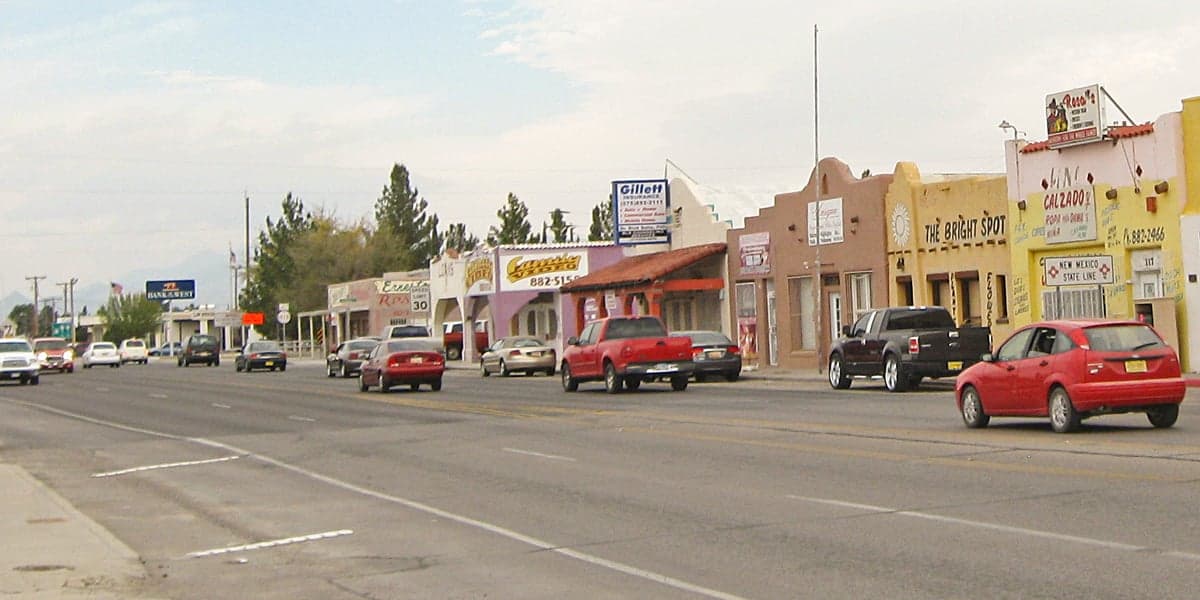
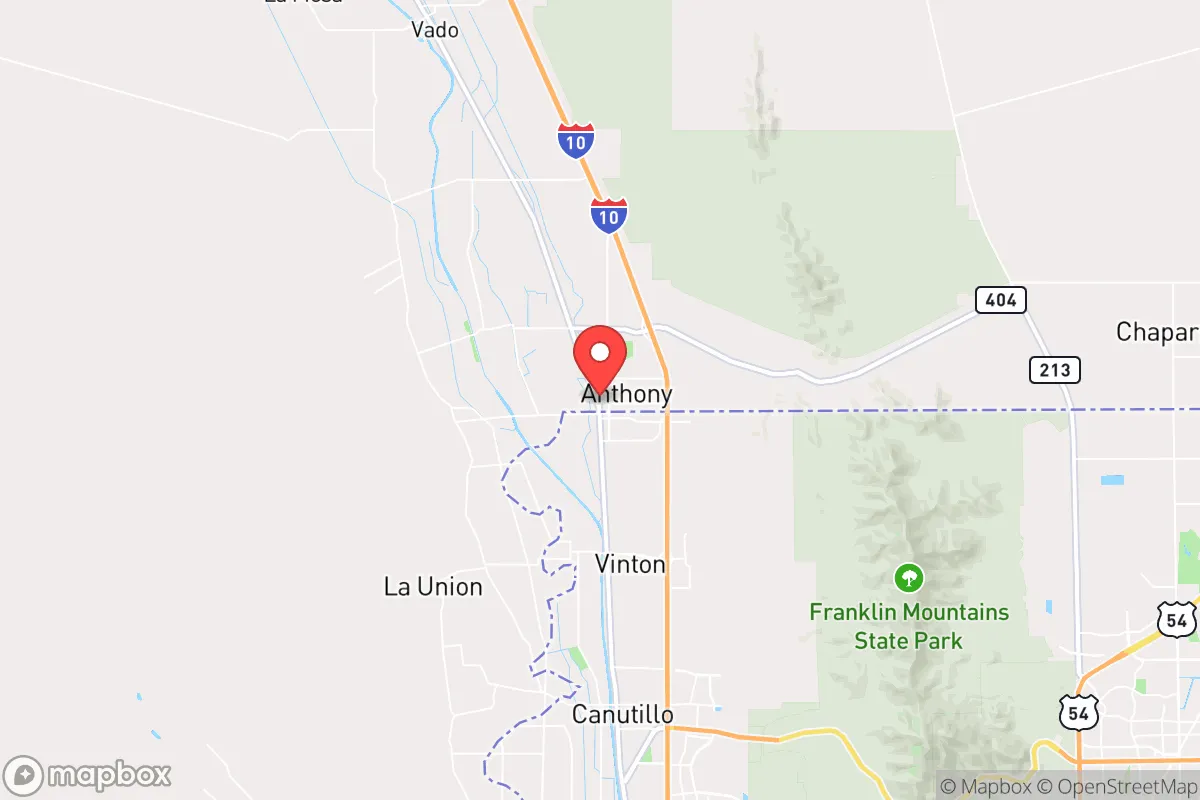
Photo: Wikipedia
Demographics of Anthony, NM
Affluence Level in Anthony, NM
A low-income area with significant economic hardship. Household wealth and educational attainment are well below national averages.
People of Anthony, NM
The people of Anthony, New Mexico, today form one of the most ethnically concentrated communities in the state: 99.6% Hispanic, with a foreign-born population of 13.6% and a college attainment rate of just 8.1%. With 8,701 residents, the city is densely Hispanic, working-class, and family-oriented, shaped by generations of agricultural labor, cross-border ties, and limited economic diversification. Distinctive markers include a strong Catholic presence, Spanish as a primary household language, and a population that is overwhelmingly native-born yet deeply connected to nearby Ciudad Juárez.
How the city was settled and grew
Anthony was founded in the early 20th century as a railroad and farming community along the Southern Pacific line, not as a colonial-era settlement. The original population consisted of Mexican and Mexican-American laborers drawn by irrigated cotton and pecan farming in the Mesilla Valley. The first wave settled in what is now Old Town Anthony, the historic core near the railroad tracks, where adobe homes and small worker cottages still stand. By the 1930s, a second wave of Dust Bowl-era migrants from Texas and Oklahoma arrived, but they were quickly outnumbered by continued Mexican immigration. The Vado Addition neighborhood, platted in the 1940s, absorbed many of these farmworker families, offering small lots near the pecan orchards. The city’s growth remained slow through mid-century, with the population hovering around 2,000 until the 1960s, as the local economy depended almost entirely on agriculture and the nearby Fort Bliss military base.
Modern era (post-1965)
The post-1965 period brought dramatic demographic consolidation. The Hart-Cellar Act of 1965, combined with the Bracero program’s end, shifted immigration patterns from seasonal labor to permanent family reunification. Anthony’s Hispanic share rose from roughly 70% in 1970 to over 95% by 1990, as non-Hispanic white families gradually left for Las Cruces or El Paso suburbs. The Berino Heights subdivision, developed in the 1970s, became a destination for second-generation Mexican-American families seeking newer homes while staying close to extended kin. Meanwhile, the Chaparral Estates area, built in the 1980s and 1990s, attracted younger families priced out of El Paso’s housing market. By 2000, the city was effectively 99% Hispanic, a figure that has held steady since. The foreign-born share peaked at around 18% in 2010 and has since declined to 13.6%, reflecting both reduced immigration from Mexico and the aging of earlier arrivals. No significant Black, Asian, or Indian-subcontinent populations have ever settled in Anthony; the city remains a near-monocultural Hispanic community.
The future
The population trajectory suggests continued ethnic homogeneity but with subtle generational shifts. The foreign-born share is slowly declining as older immigrants age and U.S.-born children form their own households. The Sunland Park Road corridor, a commercial strip straddling the Texas line, is seeing new retail and apartment construction that may attract younger Hispanic families from El Paso’s more expensive east side. However, the city’s low college attainment rate (8.1%) and limited white-collar employment mean that outmigration of educated young adults to Las Cruces or Albuquerque is likely to continue. The population is projected to remain flat or grow modestly (0.5–1% annually) through 2040, driven by natural increase rather than new immigration. There is no evidence of ethnic diversification: Anthony is not attracting non-Hispanic residents, and the few non-Hispanic households that exist are almost entirely transient professionals (teachers, border patrol agents) who do not settle long-term. The city is not tribalizing into enclaves—it is already one enclave—but is slowly aging, with a median age rising toward 35.
For a conservative-leaning individual or family moving in now, Anthony offers a stable, culturally cohesive environment where Spanish is widely spoken, church attendance is high, and property crime is low relative to El Paso. The trade-off is limited economic opportunity and a population that is not diversifying. This is a community that knows what it is and is not changing fast—a fact that appeals to those seeking predictability but may frustrate those looking for upward mobility or broader social options.

* Values derived from national, state, county, city and local statistics and may differ in a specific area. Last updated: 2026-04-19T02:56:29.000Z
Narrative content on this page is AI-generated and may contain mistakes. Verify any details that matter before acting on them.
ReloMaps may earn a commission from affiliate links at no extra cost to you.

