
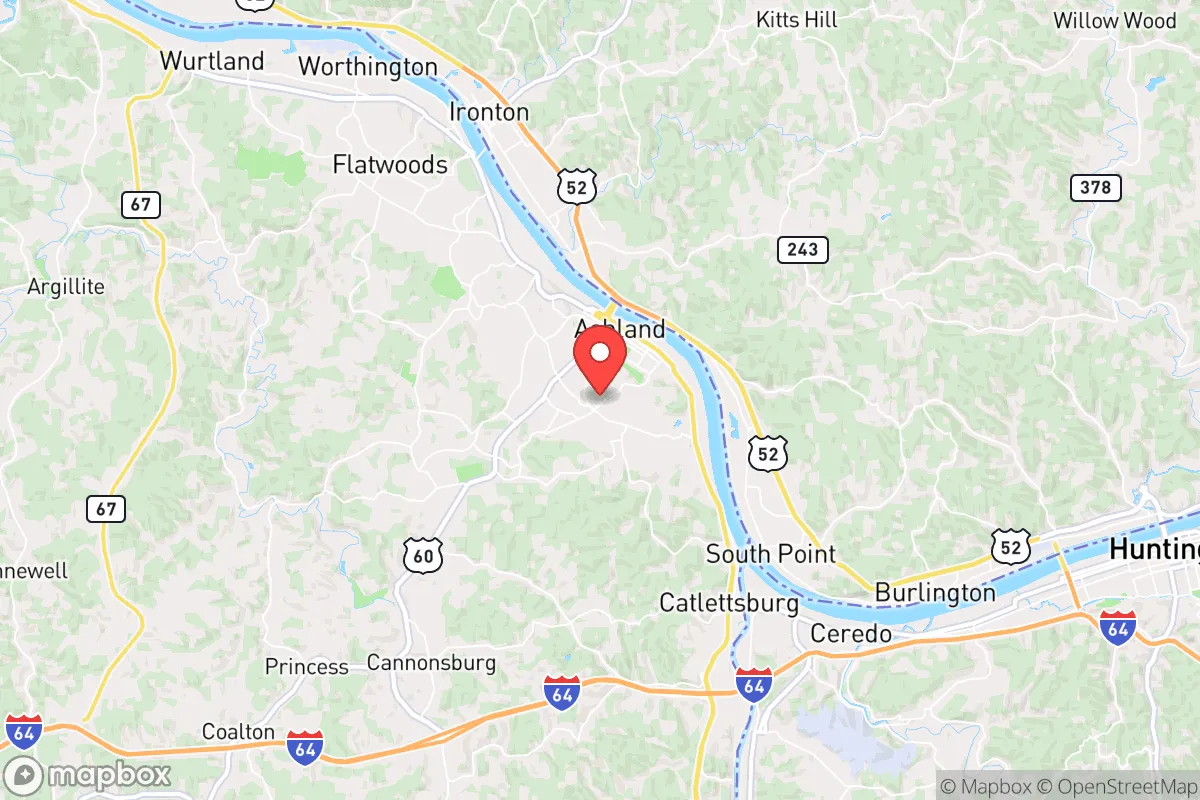
Photo: Wikipedia
Personal Sovereignty in Ashland, KY
Viable for self-reliance. Generally workable, though some barriers may limit total independence.
What does Personal Sovereignty tell us?
Personal Sovereignty measures your capacity for self-reliance and independence with minimal government friction. Higher scores mean fewer barriers between you and the way you want to live... but it assumes you have the space you need and good neighbors.
What does this tell us?
Personal Sovereignty measures your capacity for self-reliance and independence with minimal government friction. Higher scores mean fewer barriers between you and the way you want to live... but it assumes you have the space you need and good neighbors.
State Policy
Energy independence: Importer (60% of energy produced in-state)
Personal Liberty
Homesteading

Personal Liberty Analysis
Ashland, Kentucky offers a notably high degree of personal sovereignty compared to many parts of the country, particularly for those who prioritize minimal government interference in daily life, self-defense, and the ability to live according to one’s own values. Nestled in the northeastern corner of the state along the Ohio River, this small city of roughly 20,000 operates within a state framework that consistently ranks among the most liberty-friendly in the nation. For a single individual or a family approaching relocation from a survivalist or prepper mindset, Ashland presents a strategic balance of low regulatory friction, strong constitutional protections, and a community culture that still values self-reliance over state dependency. The key question is whether the local implementation matches the state’s pro-freedom reputation, and the answer is largely affirmative, though with some practical caveats regarding economic opportunity and infrastructure resilience.
Tax burden and regulatory posture in Ashland and Kentucky
Kentucky’s tax structure is a significant draw for those seeking to maximize personal financial autonomy. The state has been moving toward a flat income tax, currently at 4.5% as of 2026, with a scheduled path to phase out entirely over the coming years. There is no state tax on Social Security benefits, and military pensions are fully exempt, which matters for long-term planning even if you’re not retired yet. Property taxes are among the lowest in the nation, with effective rates in Boyd County (where Ashland sits) typically around 0.80% of assessed value. A $200,000 home would carry an annual tax bill of roughly $1,600. Sales tax is a flat 6%, but groceries and prescription drugs are exempt. More importantly for the prepper mindset, Kentucky has no statewide business inventory tax, no intangible property tax, and no estate or inheritance tax. The regulatory environment in Ashland itself is relatively light. The city does not have overly burdensome zoning codes compared to urban centers, and there is no county-level building permit requirement for many minor structures, though the city does enforce basic codes for new construction. Occupational licensing is less restrictive than in neighboring Ohio or West Virginia, making it easier to start a trade or home-based business without bureaucratic hurdles. The state’s right-to-work law, passed in 2017, further reduces union-related friction for those seeking employment or contracting work. For a person who values keeping more of what they earn and dealing with fewer government forms, Ashland’s tax and regulatory posture is a clear positive.
Self-defense and gun law specifics in Ashland and Kentucky
Kentucky is a constitutional carry state, meaning no permit is required to carry a concealed firearm for anyone legally allowed to possess one. This applies to all residents and non-residents alike, and Ashland’s local law enforcement generally respects this right without the kind of municipal overreach seen in cities like Louisville or Lexington. There is no state-level red flag law, no waiting period for firearm purchases, and no requirement to register firearms. The state preempts local governments from enacting their own gun control ordinances, so Ashland cannot legally impose restrictions stricter than state law. This preemption is critical: it means a city council cannot suddenly ban certain firearms or magazine capacities. Stand-your-ground laws are fully in effect, with no duty to retreat in any place where a person has a legal right to be. Castle doctrine protections extend to vehicles and occupied structures. For the survivalist, this legal framework allows for a robust personal defense posture without fear of prosecution for defending life and property. The only practical consideration is that Ashland is within a few miles of the Ohio and West Virginia borders, so anyone who frequently crosses state lines should be aware of differing laws—Ohio requires a permit for concealed carry, and West Virginia has its own reciprocity rules. But within Kentucky, the legal environment for self-defense is as strong as it gets in the eastern United States.
Self-reliance and homesteading viability in the Ashland area
For those looking to reduce dependence on supply chains and government services, Ashland’s surrounding area offers genuine homesteading potential. Within Boyd County and adjacent Greenup County, it is still possible to find residential lots of one to five acres within a 15-minute drive of downtown, with prices ranging from $10,000 to $40,000 per acre depending on proximity to utilities. Zoning in the unincorporated areas is minimal—no county-wide animal ordinances restrict chickens, goats, or even a small number of livestock on parcels over one acre. The city itself has more restrictive rules on livestock and front-yard gardens, but the rural fringe is permissive. Off-grid feasibility is moderate: the region gets about 45 inches of rain annually, so rainwater catchment is viable, and well water is common on larger lots. Solar potential is decent but not ideal—the area averages about 200 sunny days per year, less than the Southwest, but enough for a supplemental system with battery storage. The biggest challenge is that the local power grid is aging, and outages during winter ice storms are not uncommon, which actually reinforces the need for self-sufficiency. Wood heating is practical, with abundant hardwood forests in the region and firewood permits available on state land for minimal fees. Sewage is typically handled via septic systems in rural areas, with no county inspection requirement for repairs on existing systems. For a prepper, the Ashland area allows for a meaningful degree of food, water, and energy independence without the extreme isolation of more remote locations.
Personal liberties in Ashland: parental rights, medical autonomy, speech, and property
Kentucky has a strong track record on parental rights, with state law explicitly affirming that parents have the fundamental right to direct the upbringing, education, and healthcare of their children. This includes the ability to opt out of public school curriculum without penalty, and the state does not mandate any specific vaccines for school attendance beyond those required by federal law for certain programs. Homeschooling is straightforward: parents need only submit a one-time notice of intent and provide 175 days of instruction annually, with no standardized testing requirement or curriculum approval. Medical autonomy is more mixed. Kentucky has not enacted any broad medical freedom legislation protecting the right to refuse treatments or access unapproved therapies, but there is no state-level vaccine passport mandate, and the state legislature has passed laws limiting emergency powers during health crises, including a ban on mandatory masking in schools. Free speech protections are robust, with no state-level hate speech laws that could chill political or religious expression. Property rights are well-protected by Kentucky’s eminent domain laws, which require a public purpose and just compensation, and the state has no statewide rent control or forced inclusionary zoning. In Ashland specifically, the local government has not attempted to impose the kind of overreach seen in larger cities—no mask mandates, no business closure orders, and no restrictions on religious gatherings during the pandemic era. For someone concerned about government overreach into personal and family decisions, Ashland’s legal environment is reassuringly hands-off.
Overall, Ashland offers a level of personal sovereignty that is increasingly rare in the United States. The combination of constitutional carry, low taxes, minimal zoning in rural areas, strong parental rights, and a state government that has pushed back against federal overreach creates a environment where a self-reliant individual or family can live largely unbothered by the state. The trade-offs are real: economic opportunities are limited compared to growing Sun Belt metros, and the local infrastructure is aging. But for those prioritizing freedom over convenience, Ashland represents a viable base of operations in a region that still remembers how to mind its own business. Compared to the regulatory nightmare of the West Coast or the Northeast, or even the creeping restrictions in parts of the Midwest, Ashland stands out as a place where personal sovereignty is not just a talking point but a lived reality.

* Values derived from national, state, county, city and local statistics and may differ in a specific area. Last updated: 2026-04-21T09:16:49.000Z
Narrative content on this page is AI-generated and may contain mistakes. Verify any details that matter before acting on them.
ReloMaps may earn a commission from affiliate links at no extra cost to you.

