 Popular
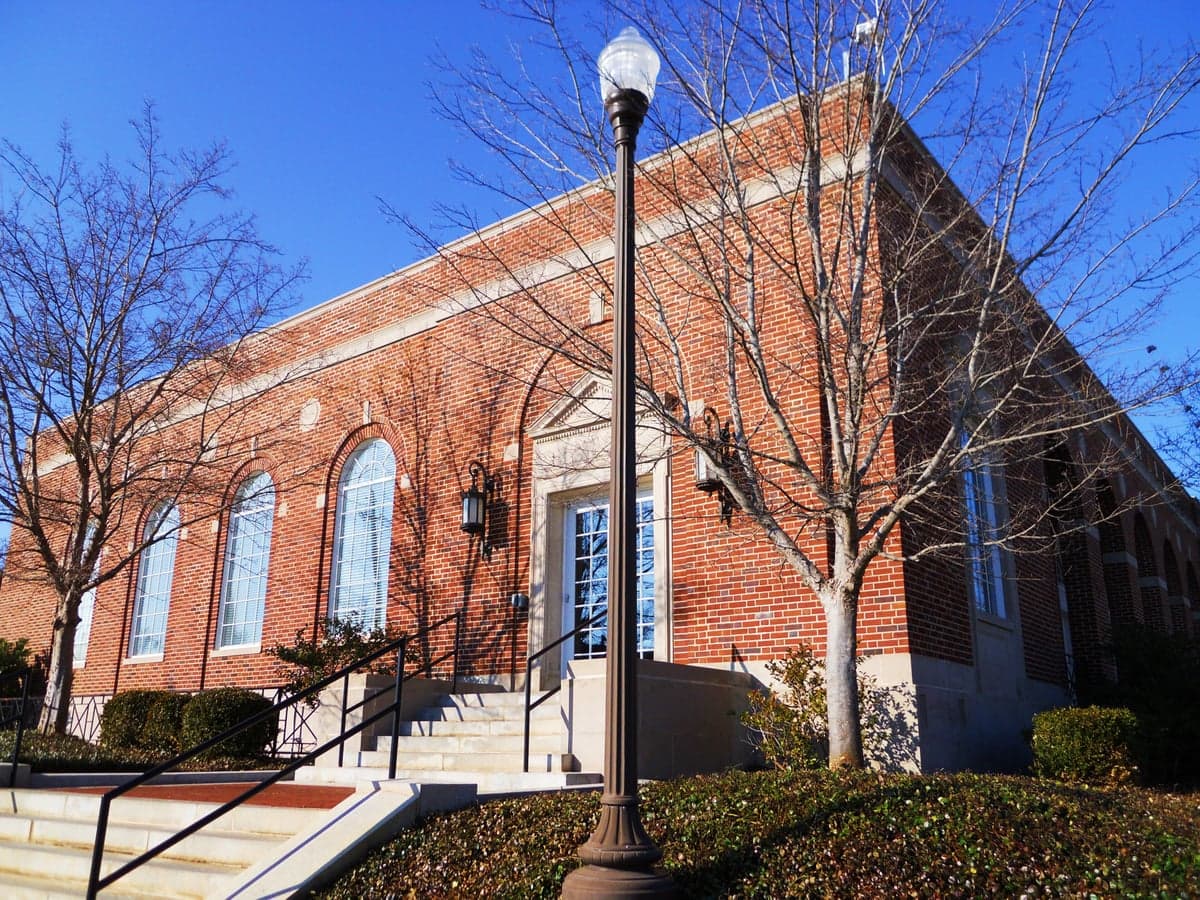
Photo: Wikipedia
Demographics of Auburn, AL
Affluence Level in Auburn, AL
A middle-class area roughly in line with national averages across income, home values, education, and employment.
People of Auburn, AL
The people of Auburn, Alabama, today number 78,738 and form a community defined by a sharp contrast: a highly educated, transient university population layered over a historically rooted, racially diverse Southern town. With 62.8% of adults holding a bachelor’s degree or higher—more than double the national average—Auburn is a knowledge-economy hub where the rhythms of the academic calendar dictate daily life. Yet beneath the surface of game-day crowds and research labs lies a population that is 65.7% White, 18.6% Black, 6.7% East/Southeast Asian, 4.8% Hispanic, and 1.7% Indian (subcontinent), with 6.9% foreign-born, making it a place where tradition and global migration meet in a distinctly Southern setting.
How the city was settled and grew
Auburn’s population story begins not with industry but with education. Founded in 1836 as a small railroad stop, the city’s first major wave of settlers were Anglo-American planters and farmers drawn by the fertile soils of east-central Alabama. The establishment of the East Alabama Male College (now Auburn University) in 1856 transformed the settlement into a college town, attracting faculty, staff, and students from across the South. The original residential core—Historic Auburn, centered around College Street and Magnolia Avenue—was built by these early educators and merchants, with many homes dating to the 1850s-1880s. A second wave came after the Civil War, as freedmen and their families settled in what became West Auburn, a historically Black neighborhood along the railroad tracks, where churches, schools, and small businesses anchored the African American community for generations. By 1900, Auburn’s population hovered around 1,500, overwhelmingly native-born White and Black, with the university as the sole economic engine. The post-World War II G.I. Bill brought a surge of veterans to the university, and the city expanded southward into Woodfield and Lakewood, neighborhoods of modest ranch homes built for the growing faculty and staff. These mid-century subdivisions remain predominantly White and middle-class today.
Modern era (post-1965)
The 1965 Hart-Cellar Act and the Civil Rights movement reshaped Auburn’s population. The university’s desegregation, beginning in the 1960s, slowly increased Black enrollment and faculty presence, though West Auburn remained the core of the Black community. The most dramatic post-1965 shift, however, was the arrival of international students and professionals. Auburn University’s engineering and agriculture programs drew a steady stream of East/Southeast Asian students—particularly from China, South Korea, and Vietnam—who often stayed after graduation. These groups concentrated in newer apartment complexes and subdivisions near the university, especially in The Grove and The Cottages at Auburn, student-heavy areas that now have visible Asian-owned businesses and restaurants. The Indian (subcontinent) population, while smaller at 1.7%, grew rapidly after 2000, driven by graduate students and tech workers in the university’s research parks; they tend to settle in Yarbrough Farms and Ogletree Village, newer master-planned communities on the city’s north side. Hispanic residents, now 4.8% of the population, arrived primarily in the 1990s and 2000s for construction, landscaping, and service jobs tied to the university’s expansion; they are dispersed across the city but have a visible presence in the South College Street corridor. The foreign-born share (6.9%) is modest by national standards but concentrated among the university-affiliated population, giving Auburn a cosmopolitan pocket within a still predominantly native-born Southern city.
The future
Auburn’s population is projected to grow steadily, driven by university enrollment increases and the expansion of research and tech sectors. The city’s demographic future points toward greater diversity, but in a segmented pattern. The East/Southeast Asian and Indian populations are likely to grow fastest, as the university continues to recruit internationally and as graduates stay to work in the growing biotech and engineering firms. Hispanic growth will likely continue at a moderate pace, tied to the service economy. The Black population share has remained stable at roughly 18-19% for two decades, suggesting neither rapid out-migration nor significant in-migration. The White population, while still the majority, is becoming less dominant as the city attracts more international residents. Newer developments—The Mill at Moore’s Mill and Northcutt Village—are drawing a mix of young professionals and families, but these areas remain predominantly White and Asian, while West Auburn remains the historic Black anchor. The cultural identity is evolving from a classic Southern college town into a more globally connected, knowledge-driven community, though the university’s traditions and the region’s conservative values remain strong.
For someone moving in now, Auburn offers a stable, growing community where the population is becoming more diverse but remains anchored by the university and its Southern roots. The city is not undergoing a rapid demographic revolution—rather, it is a place where international migration is adding layers of complexity to a historically Black-and-white Southern town, creating a unique blend of tradition and global influence that is likely to deepen over the next decade.

* Values derived from national, state, county, city and local statistics and may differ in a specific area. Last updated: 2026-09-03T05:09:38.000Z
Narrative content on this page is AI-generated and may contain mistakes. Verify any details that matter before acting on them.
ReloMaps may earn a commission from affiliate links at no extra cost to you.

