 Popular
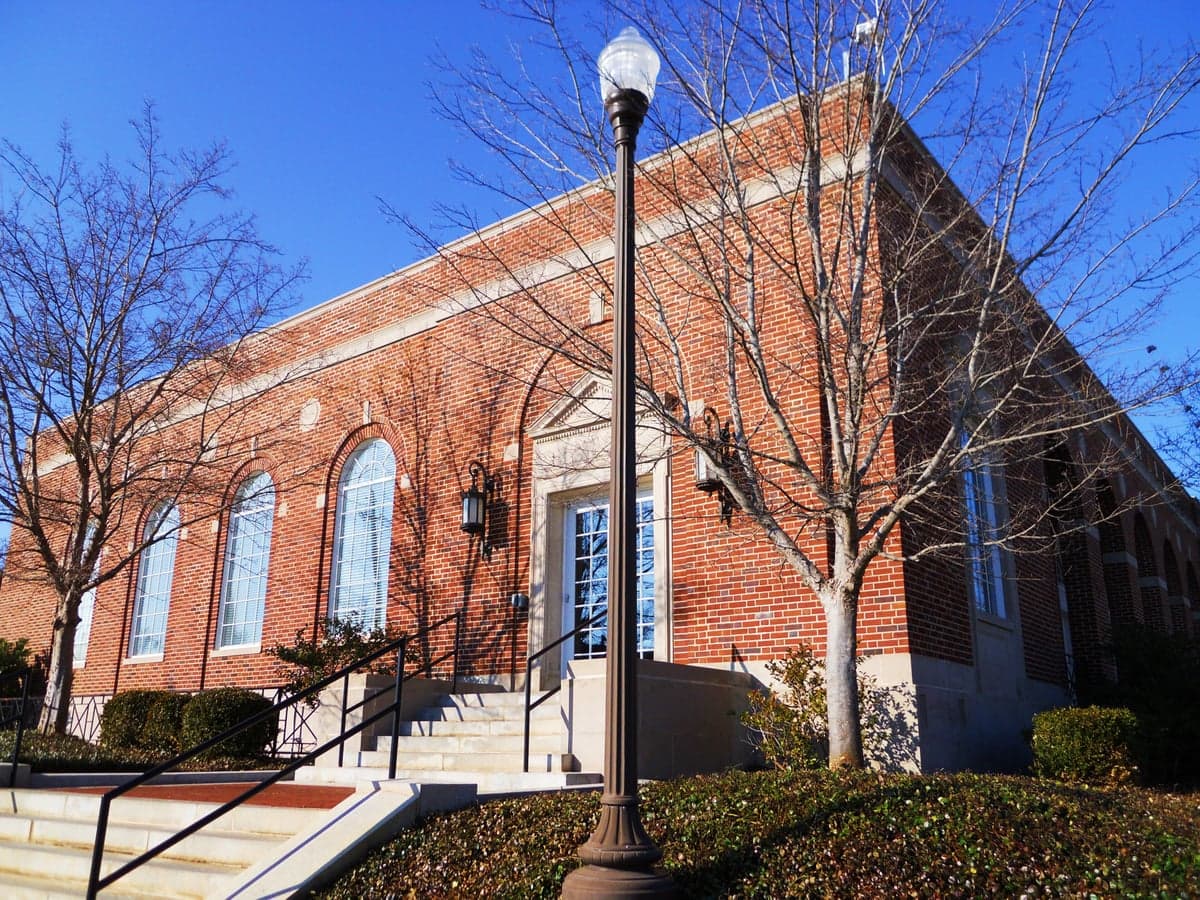
Photo: Wikipedia
Strategic Assessment of Auburn, AL
Workable tactical position. Some exposure to population density or targets, but generally defensible in a crisis.
What does the Strategic Assessment tell us?
Our Strategic Assessment grades tactical survivability of an area. Major population centers, military targets, fallout zones, natural disasters, and border exposure all drive risk — lower exposure means a more defensible position in a crisis.
This is heavily inspired by Joel Skousen's Strategic Relocation book. Highly recommended you checkout the book ($)What does this tell us?
Our Strategic Assessment grades tactical survivability of an area. Major population centers, military targets, fallout zones, natural disasters, and border exposure all drive risk — lower exposure means a more defensible position in a crisis.
This is heavily inspired by Joel Skousen's Strategic Relocation book. Highly recommended you checkout the book ($)Strategic Pillars

Key Distances
Regional Safe Places
Below is our recommended "safe zones" in Alabama and the surrounding area based on our strategic heuristics. For most people, it's unrealistic to live in a “safe zone” full-time due to work, family or other personal reasons. They tend to be more rural. However, many of these areas are perfect for second homes and retreat properties that double as a vacation home or even a short-term rental.
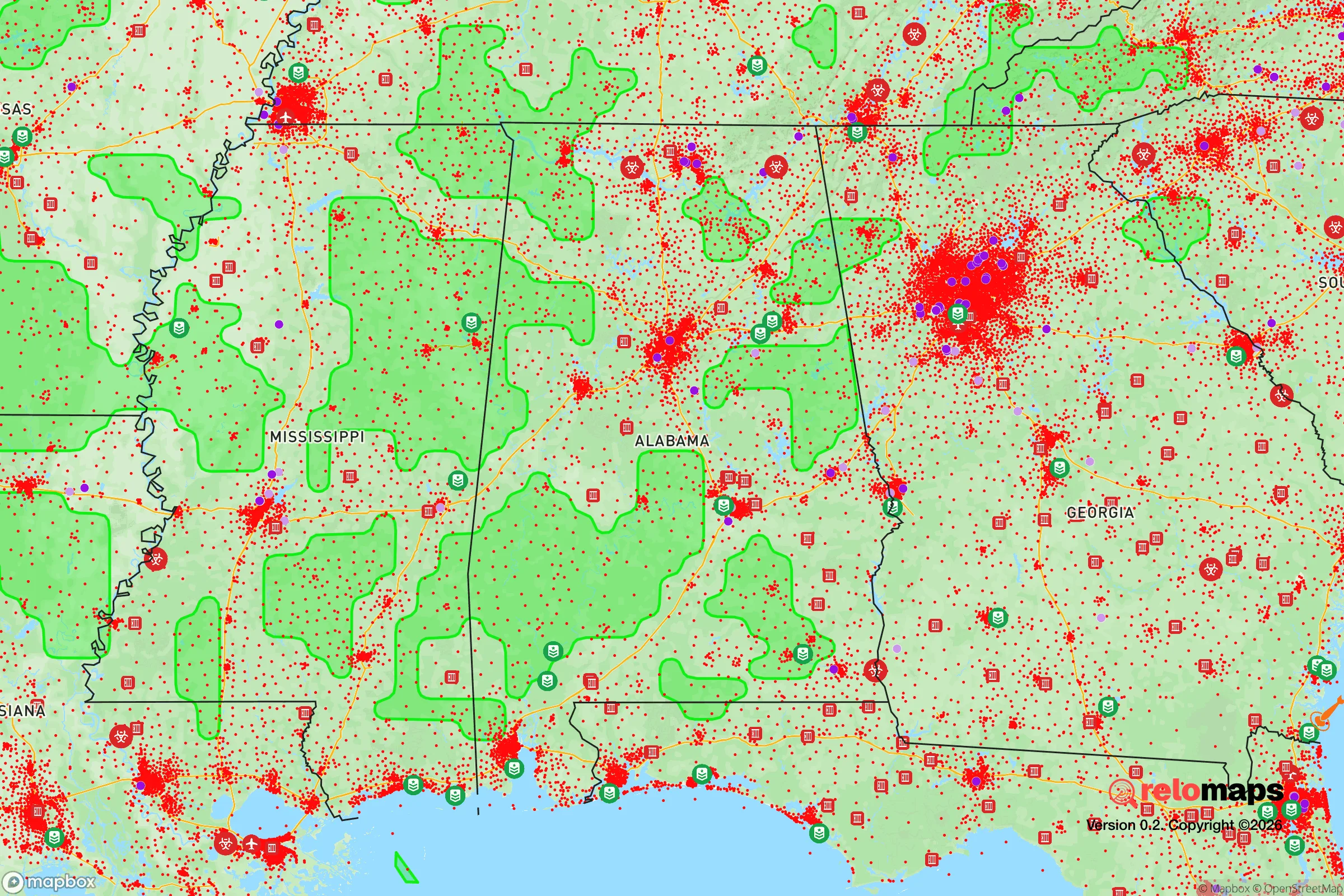
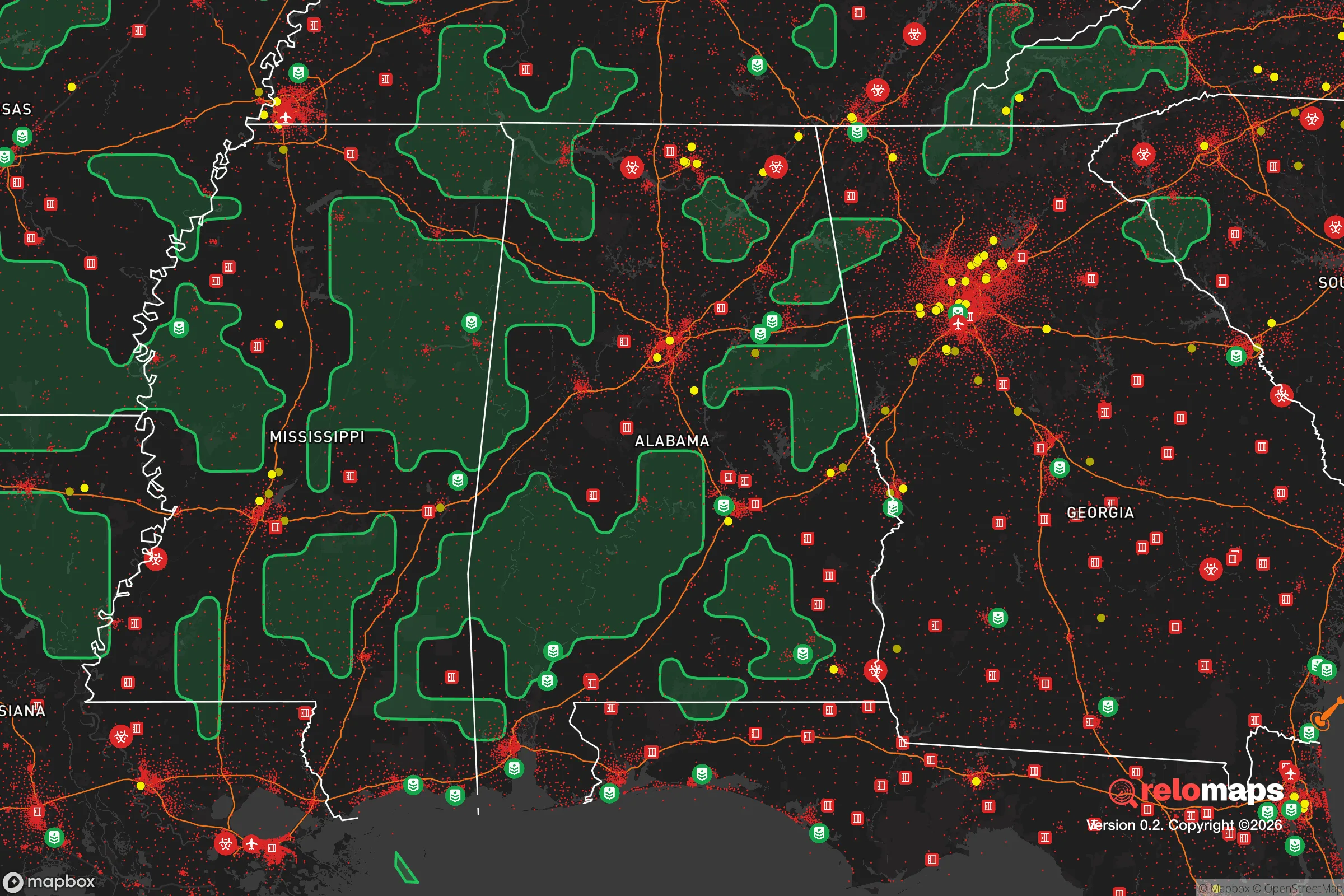


Important Note: For informational purposes only. This does not mean nothing bad ever happens in the green zones. Please use common sense. This is based on public data and modeled with AI. We tried to take a conservative approach but mistakes happen. We update this regularly as new information becomes available.
Solar Generator Recommendations
Backup power matters more here than in safer locations. We've picked three solar generators across budgets and capacity tiers — start with the budget unit if you only need a few essentials, or step up if you want to run a fridge and HVAC for days at a time.

Jackery Portable Power Station Explorer 300
Budget OptionPower on the Go: Weighing only 11 lbs, it's convenient to set up and store with book-sized foldable solar panels

BLUETTI Portable Power Station AC180
Designed for both indoor and outdoor scenarios, AC180 is highly capable as it has a robost capacity and continuous output power.

EF ECOFLOW DELTA Pro Ultra Power Station
Upgraded PickEcoFlow DELTA Pro Ultra is a whole-home energy system designed to grow with your family. Integrated with the Smart Home Panel 2, it scales to meet your evolving energy needs — keeping your home powered, intelligent, and secure through every stage of life.
We earn a commission, at no additional cost to you.
Strategic Assessment Analysis
Auburn, Alabama, occupies a strategic position in the southeastern United States that offers a compelling blend of natural resilience and practical self-sufficiency for those prioritizing disaster readiness. Located roughly 100 miles southwest of Atlanta and 60 miles northeast of Montgomery, the city sits in Lee County on the fall line where the Piedmont plateau meets the Coastal Plain, a geography that provides both defensive depth and resource access. For a relocator weighing long-term stability against exposure to major risks, Auburn presents a balanced profile: it is far enough from major metropolitan centers to avoid the worst of urban collapse scenarios, yet close enough to maintain supply chains and professional networks. The area’s steady population growth—from roughly 53,000 in 2010 to over 80,000 today—reflects its reputation as a stable, well-governed community, but a serious resilience assessment must look beyond growth rates to the hard factors of geography, risk exposure, and practical self-reliance.
Geographic position and natural advantages for long-term stability
Auburn’s location on the southern edge of the Piedmont region gives it a significant natural advantage: the area sits on a foundation of crystalline bedrock and clay soils, which provide excellent drainage and reduce the risk of flooding compared to the Coastal Plain to the south. The city is roughly 700 feet above sea level, with gentle rolling hills that offer natural defensibility without the isolation of mountainous terrain. The nearby Chewacla State Park and the Uchee Creek area provide forested buffer zones that could serve as resource-rich retreat areas if needed. Auburn’s position along Interstate 85 places it on a major east-west corridor, but the city itself is not a transportation hub that would attract strategic targeting. The surrounding Lee County is predominantly rural, with farmland and timberland that offer both food production potential and natural cover. Water resources are a key strength: the city draws from the Saugahatchee Creek watershed and the larger Tallapoosa River basin, both of which are part of the Alabama-Coosa-Tallapoosa river system, providing a reliable surface water supply that is less vulnerable to drought than many western states. The climate is humid subtropical, with an average annual rainfall of about 52 inches, meaning water scarcity is rarely a concern for those with basic catchment or well systems.
Risks, exposures, and proximity to fallout-relevant landmarks
No location is without vulnerabilities, and Auburn’s primary risks fall into two categories: natural hazards and proximity to high-value targets. On the natural side, the area is subject to severe thunderstorms, tornadoes, and occasional hurricanes that weaken as they move inland. Lee County sits in the Dixie Alley tornado zone, and the March 2019 EF-4 tornado that devastated Beauregard—just 10 miles south of Auburn—is a sobering reminder that violent weather is a real, recurring threat. Flooding is generally limited to low-lying areas near creeks, but heavy rain events can cause localized issues. The risk of earthquakes is negligible, and wildfires are rare due to the humid climate. The more serious concern for a resilience-minded relocator is Auburn’s proximity to potential man-made risks. The city is roughly 100 miles from the Hartsfield-Jackson Atlanta International Airport, one of the busiest in the world, and 60 miles from Maxwell Air Force Base in Montgomery. While these are not direct targets for a nuclear first strike—they lack the strategic value of silo fields or major naval bases—they could be secondary targets in a broader conflict. The nearest major nuclear infrastructure is the Browns Ferry Nuclear Plant near Decatur, Alabama, about 180 miles northwest, which is outside the immediate fallout zone but still within a plausible risk radius for a major accident. More practically, Auburn’s location on I-85 means it could be affected by refugee flows from Atlanta in a crisis, though the city’s smaller size and limited highway capacity would likely make it a waypoint rather than a destination for large numbers of evacuees.
Practical resilience for a relocator: food, water, energy, and defensibility
For a family or individual looking to establish a self-sufficient household, Auburn offers a mix of favorable conditions and notable gaps. Food security is a strong point: Lee County is part of Alabama’s agricultural belt, with local farms producing poultry, cattle, soybeans, corn, and cotton. The Auburn Farmers Market operates year-round, and the city’s proximity to rural areas means land for gardening or small-scale livestock is affordable—average farmland in the region sells for $4,000–$6,000 per acre, far less than in the Northeast or West Coast. The presence of Auburn University’s College of Agriculture provides a deep knowledge base and extension services for those serious about food production. Water access is excellent: the city’s municipal water comes from surface sources, but the water table is high enough that private wells are feasible in most parts of the county, with typical depths of 100–200 feet. Rainwater catchment is also practical given the 52 inches of annual rainfall. Energy resilience is a mixed picture: the grid is served by Alabama Power, a subsidiary of Southern Company, which has a relatively reliable infrastructure but is still vulnerable to storm-related outages. Solar potential is moderate—the area receives about 4.5 peak sun hours per day, enough for a well-sized off-grid system but not as favorable as the Southwest. Natural gas is widely available in the city, and propane is common in rural areas. Defensibility is moderate: the rolling terrain and forested areas provide natural cover, but the city itself is not easily defensible due to its open layout and multiple road access points. However, the strong community culture—rooted in the university and local churches—fosters a social resilience that is often overlooked. Neighborhoods like the historic district near downtown and the more rural areas east of town offer better options for those seeking privacy and defensible space, while the dense student-populated areas near campus would be less ideal in a crisis.
The overall strategic picture for Auburn is one of a well-positioned secondary city that balances accessibility with a degree of natural insulation. It is not a hardened bunker location, nor is it a remote wilderness retreat—it is a functioning, growing community with the infrastructure to support a self-reliant lifestyle if approached deliberately. The greatest strengths are the reliable water supply, the agricultural capacity of the surrounding region, and the distance from major strategic targets. The greatest weaknesses are the tornado risk and the potential for refugee pressure from Atlanta in a regional crisis. For a relocator who values community, education, and a lower cost of living while maintaining a serious preparedness posture, Auburn offers a viable base of operations—provided one invests in storm sheltering, backup power, and a network of like-minded neighbors. The key is to treat Auburn not as a final redoubt, but as a resilient hub from which to build long-term security in an uncertain future.

* Values derived from national, state, county, city and local statistics and may differ in a specific area. Last updated: 2026-09-03T05:09:38.000Z
Narrative content on this page is AI-generated and may contain mistakes. Verify any details that matter before acting on them.
ReloMaps may earn a commission from affiliate links at no extra cost to you.

