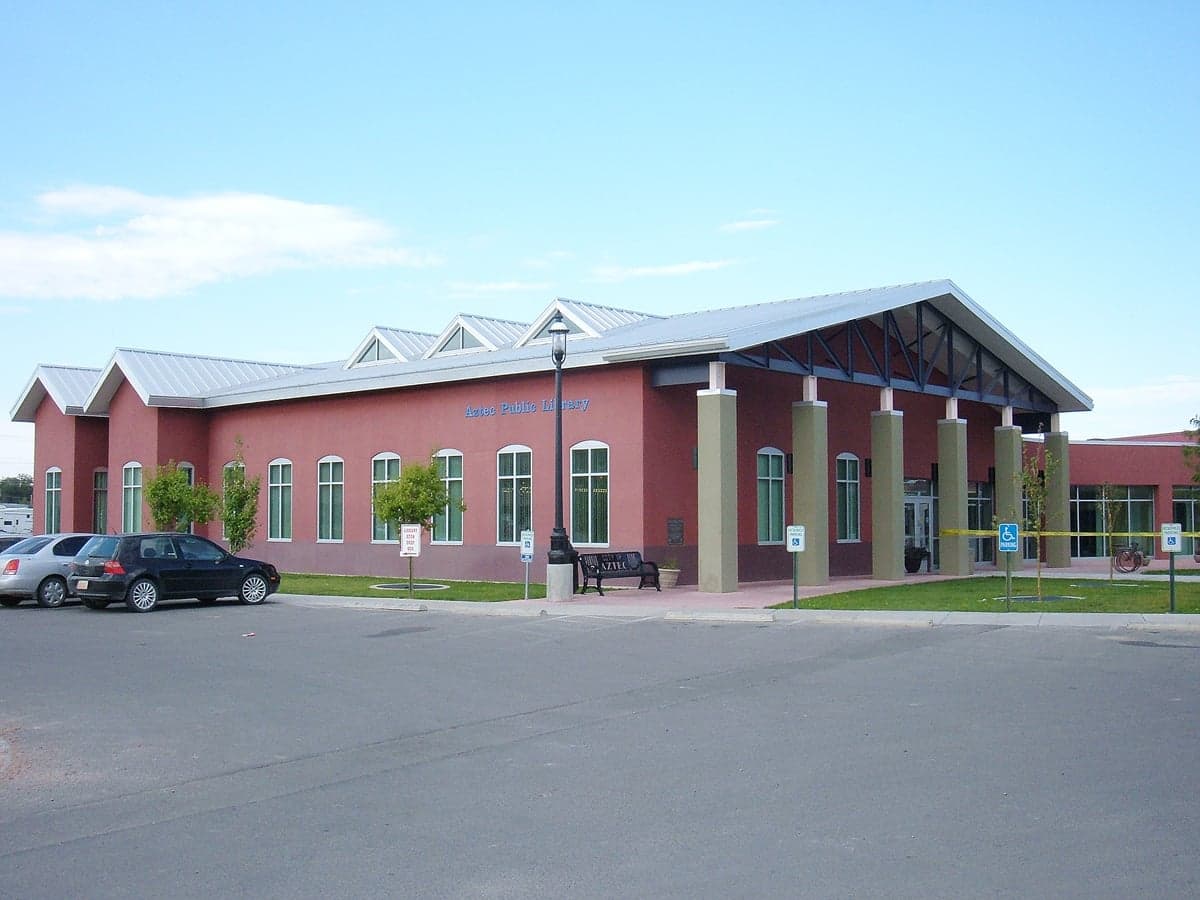
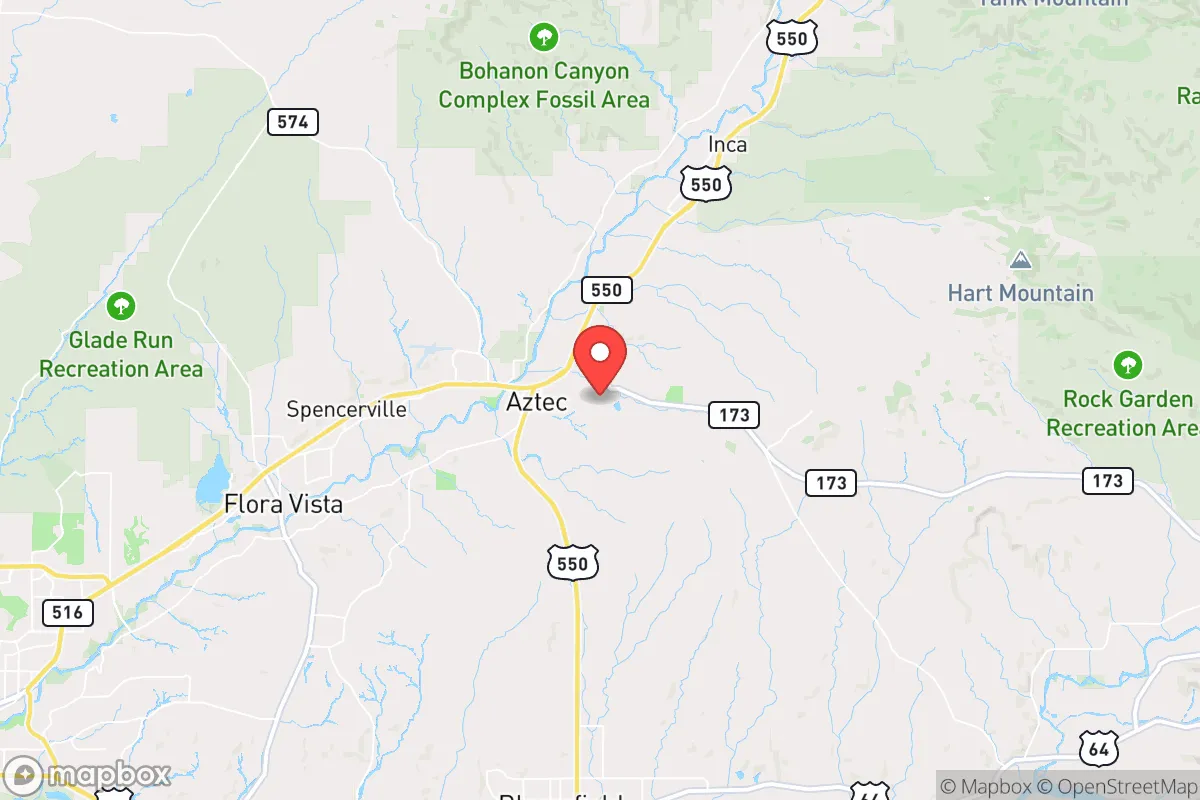
Photo: Wikipedia
Demographics of Aztec, NM
Affluence Level in Aztec, NM
A low-income area with significant economic hardship. Household wealth and educational attainment are well below national averages.
People of Aztec, NM
The people of Aztec, New Mexico, today form a small, predominantly white and Hispanic community of 6,177 residents, marked by a strong local identity rooted in the city’s historic role as a farming and oil-and-gas hub. With a foreign-born population of just 0.4% and a college-educated share of 17.9%, the city is notably homogeneous and less diverse than the national average. Its character is shaped by a mix of longtime families, many of whom trace their roots to early Anglo settlers and Hispanic homesteaders, and a modest influx of workers drawn to the nearby San Juan Basin’s energy sector. Distinct neighborhoods, from the historic downtown core to newer subdivisions, reflect these settlement patterns and the city’s slow but steady demographic evolution.
How the city was settled and grew
Aztec’s human history begins not with Spanish colonization but with the arrival of Anglo-American settlers in the late 19th century, drawn by the promise of irrigated farming along the Animas River. The city was officially founded in 1887 as a railroad stop on the Denver & Rio Grande Western line, which opened the area to homesteaders from the Midwest and Texas. The original population was overwhelmingly white, with a small number of Hispanic families who had lived in the broader San Juan Valley for generations. The Historic Downtown Aztec district, centered on Main Avenue and Aztec Boulevard, became the commercial and social heart for these early settlers, with its brick storefronts and the 1906 Aztec City Hall still standing as landmarks. By the early 1900s, the discovery of natural gas and oil in the San Juan Basin brought a second wave of workers—mostly white men from Oklahoma and Texas—who settled in the North Aztec area, near the railroad tracks and the gas fields. This energy boom solidified Aztec’s economy and population, which grew slowly but steadily through the mid-20th century, reaching about 3,000 by 1960. The West Aztec neighborhood, with its modest ranch-style homes built in the 1950s and 1960s, housed many of these oil-field families, while the East Aztec area remained agricultural, with small farms and orchards.
Modern era (post-1965)
After the 1965 Hart-Cellar Act, Aztec saw virtually no immigration-driven diversification, as the city’s remote location and limited economic base did not attract new foreign-born populations. Instead, domestic in-migration from within New Mexico and neighboring states—particularly Texas and Colorado—continued, driven by the energy sector’s cycles. The Hispanic population grew from a small base to 18.1% today, largely through natural increase and the movement of Hispanic families from nearby rural areas into Aztec’s South Aztec neighborhood, a lower-density area with older mobile homes and single-family houses. The white population, now 60.2%, remains dominant but has declined slightly as younger residents leave for college or jobs in larger cities like Farmington or Albuquerque. The Aztec Heights subdivision, developed in the 1990s and 2000s on the city’s northern edge, attracted middle-class white families seeking newer homes and larger lots, reinforcing the city’s suburban character. East/Southeast Asian residents are virtually absent at 0.1%, and the Indian-subcontinent population is 0.0%, reflecting the city’s lack of high-skilled employment or university anchors that typically draw these groups. The black population is also 0.0%, a figure consistent with the broader Four Corners region’s demographics.
The future
Aztec’s population is likely to remain stable or grow slowly, with the city’s demographic profile homogenizing rather than diversifying. The Hispanic share is expected to increase gradually through higher birth rates and continued in-migration from surrounding San Juan County, where the Hispanic population is larger. The white population will likely continue a slow decline as younger adults leave for urban centers, but the city’s affordable housing and small-town appeal may attract retirees and remote workers from more expensive states. The foreign-born share will probably stay below 1%, as Aztec offers few of the economic or social networks that draw immigrants. The Aztec Country Club area, a newer development on the city’s west side, is attracting some higher-income families, but it remains overwhelmingly white. No significant enclaves of East/Southeast Asian, Indian, or black residents are emerging, and the city is not tribalizing into distinct ethnic neighborhoods—rather, it is becoming more uniformly Hispanic-white, with class divisions between older, working-class areas like South Aztec and newer, more affluent subdivisions like Aztec Heights.
For someone moving to Aztec now, the city offers a stable, low-diversity community where the population is slowly becoming more Hispanic but remains culturally conservative and family-oriented. The lack of foreign-born residents and the dominance of long-established families mean that newcomers—especially those from outside the region—may find a tight-knit but insular social fabric. The city’s future is one of gradual demographic continuity, not transformation, making it a predictable choice for those seeking a quiet, small-town lifestyle in the Southwest.

* Values derived from national, state, county, city and local statistics and may differ in a specific area. Last updated: 2026-05-04T02:38:09.000Z
Narrative content on this page is AI-generated and may contain mistakes. Verify any details that matter before acting on them.
ReloMaps may earn a commission from affiliate links at no extra cost to you.

