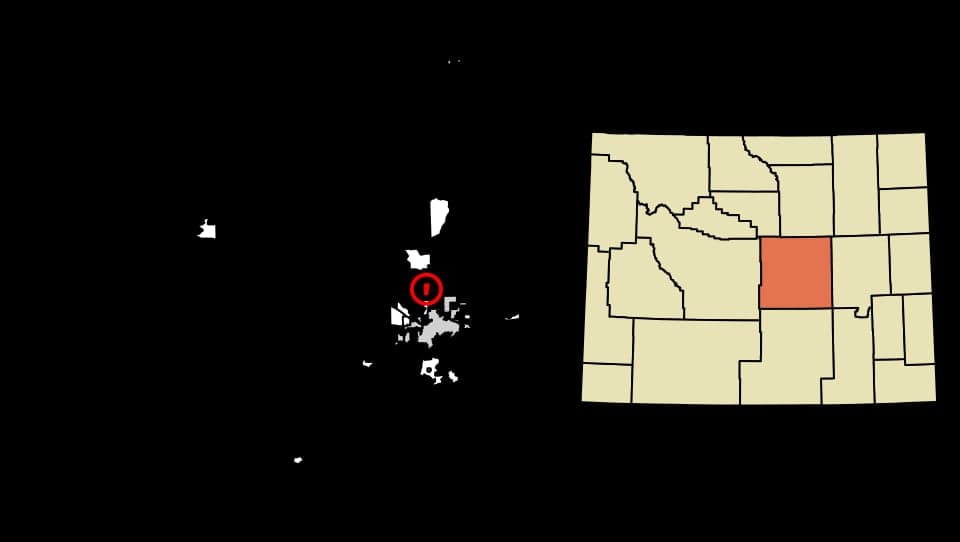
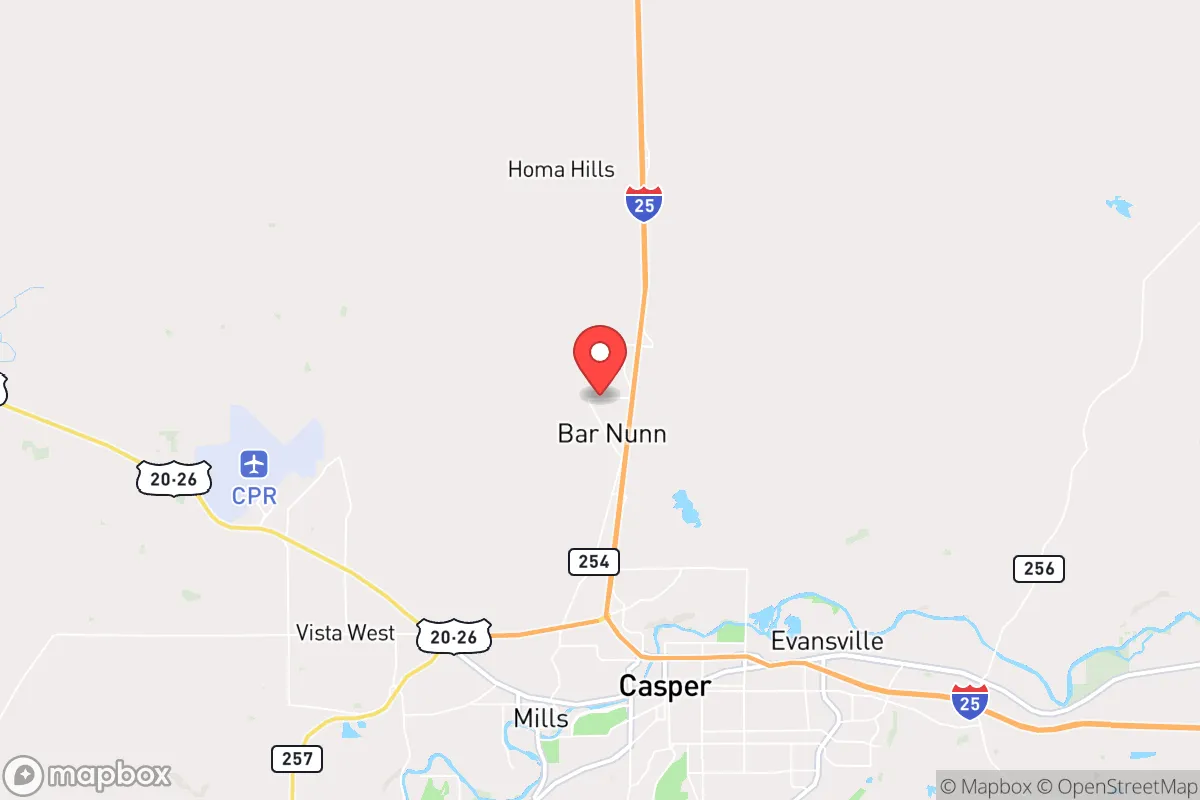
Photo: Wikipedia
Demographics of Bar Nunn, WY
Affluence Level in Bar Nunn, WY
An upper-middle-class area. Household wealth, education levels, and homeownership run ahead of national benchmarks.
People of Bar Nunn, WY
Bar Nunn, Wyoming, is a small, predominantly white working-class community of 2,980 residents, characterized by its low density and a strong blue-collar identity rooted in the energy and transportation sectors. The city’s population is overwhelmingly native-born, with a foreign-born share of just 0.7%, and a Hispanic minority of 10.2% representing the only significant non-white presence. With a college attainment rate of only 15.9%, Bar Nunn is a place where high school education and trade skills dominate, and its residents value self-reliance, affordability, and proximity to Casper’s jobs without the city’s higher costs.
How the city was settled and grew
Bar Nunn was not a pioneer-era settlement but a mid-20th-century product of Wyoming’s oil and gas boom. The town was officially incorporated in 1982, but its growth began in the 1950s and 1960s as workers from the nearby Salt Creek Oil Field and the expanding railroad hub in Casper sought affordable land just outside the city limits. The original population was almost entirely white, drawn from the rural Midwest and Rocky Mountain states—families of roughnecks, truck drivers, and railroad laborers who built modest homes on large lots. The earliest residential cluster, now known as Old Town Bar Nunn (the area around Bar Nunn Road and the original town hall), was where these first wave of oil-field families settled, constructing simple ranch-style houses and mobile homes. A second early pocket, the North 20 (a grid of streets north of the main drag), was developed in the 1960s for workers at the nearby Amoco refinery, creating a tight-knit enclave of company men and their families. No significant immigrant or minority groups were part of this founding wave; the town was, from its start, a homogenous white working-class suburb.
Modern era (post-1965)
The post-1965 era saw Bar Nunn’s population stabilize rather than diversify. The 1980s oil bust slowed growth, but the town’s low land prices attracted a new wave of domestic migrants—young families and retirees from higher-cost parts of Wyoming and the Mountain West. The Hispanic population, now 10.2%, began to appear in the 1990s, primarily as workers in the construction and service sectors supporting Casper’s economy. These families concentrated in the Meadows, a newer subdivision of manufactured homes and starter houses near the town’s southern edge, which today has the highest Hispanic share in Bar Nunn. Meanwhile, the white population remained dominant in the Bluffs, a neighborhood of larger custom-built homes on the town’s western ridge, where long-time residents and newer white-collar commuters to Casper live. The Asian, Black, and Indian populations remain at 0.0%, reflecting the town’s lack of economic pull for these groups and its distance from any significant ethnic enclave. The foreign-born share of 0.7% is almost entirely Hispanic, with no other immigrant community present.
The future
Bar Nunn’s population is likely to remain small and homogenous, with slow growth driven by spillover from Casper’s housing market. The Hispanic share may increase modestly as second-generation families move from Casper’s older neighborhoods into more affordable Bar Nunn, but the town’s lack of rental housing and limited job base will prevent rapid diversification. The white population is aging, with many long-time residents retiring in place, while younger families are drawn to the Prairie View Addition, a new subdivision of entry-level homes on the town’s east side, which is attracting a mix of white and Hispanic first-time buyers. No significant Asian, Black, or Indian growth is projected, as Bar Nunn offers no ethnic infrastructure or employment magnets for these groups. The town will likely homogenize further in terms of income and education, as rising home prices in Casper push lower-middle-class families—predominantly white and Hispanic—into Bar Nunn, while higher-income professionals bypass it for Casper’s west side or outlying ranchettes.
For a conservative-leaning individual or family moving in now, Bar Nunn offers a stable, low-crime, and affordable environment where the population is overwhelmingly native-born, English-speaking, and working-class. The community is not diversifying rapidly, and its future is one of slow, organic growth from within Wyoming’s existing population. New residents will find a place where neighbors know each other, property taxes are low, and the cultural and political character is reliably conservative—a small-town Wyoming experience just minutes from Casper’s amenities.

* Values derived from national, state, county, city and local statistics and may differ in a specific area. Last updated: 2026-04-23T09:36:52.000Z
Narrative content on this page is AI-generated and may contain mistakes. Verify any details that matter before acting on them.
ReloMaps may earn a commission from affiliate links at no extra cost to you.

