
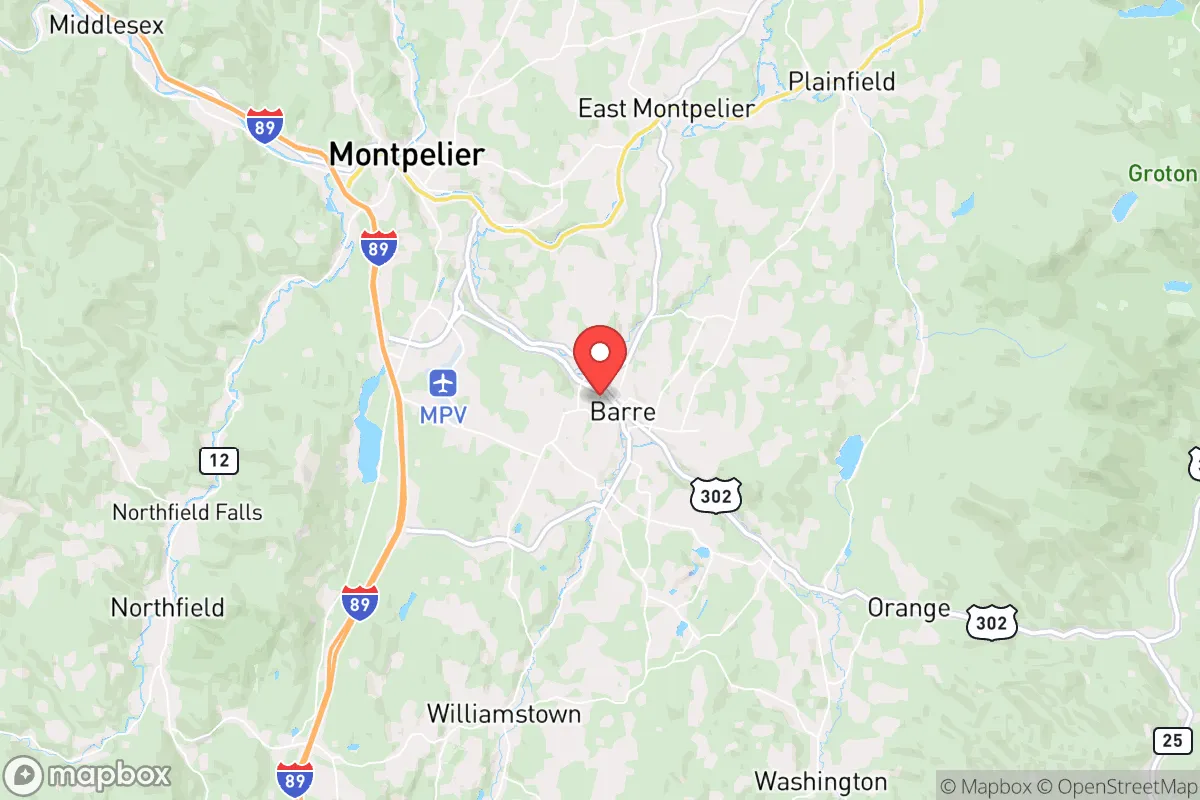
Demographics of Barre, VT
Affluence Level in Barre, VT
A low-income area with significant economic hardship. Household wealth and educational attainment are well below national averages.
People of Barre, VT
The people of Barre, Vermont, today number 8,461, forming a dense, working-class city with a distinctively Central European cultural imprint. The population is overwhelmingly white (92.9%) and native-born (foreign-born residents make up just 0.8%), with a small Hispanic community (2.4%) and tiny East/Southeast Asian (0.7%) and Black (0.3%) populations. What sets Barre apart is its deep-rooted identity as a granite-carving town, where generations of skilled stonecutters from Italy, Scotland, and Scandinavia shaped both the city's neighborhoods and its civic character.
How the city was settled and grew
Barre's human history begins with European settlers arriving in the late 18th century, drawn by land grants following the Revolutionary War. The town was chartered in 1781, but the real transformation came after 1880, when the granite industry exploded. The discovery of high-quality granite in the hills above the city drew waves of immigrant stonecutters: first the Scots, who settled in the North End around what is now North Main Street, then the Italians, who concentrated in the South End near the granite sheds along Granite Street and the current-day Barre City Elementary School. By 1900, Barre was a majority-immigrant city, with Italian, Scottish, and Scandinavian (primarily Swedish and Finnish) enclaves giving each neighborhood a distinct character. The Graniteville district, technically just outside city limits in the town of Barre, became a dense Italian quarter where stonecutters built modest homes within walking distance of the quarries. The East Barre area, more rural, attracted later waves of French-Canadian families who worked both the quarries and the surrounding farms. These ethnic neighborhoods remained remarkably stable through the mid-20th century, with Italian festivals, Scottish Highland games, and French-Canadian Catholic parishes reinforcing separate identities.
Modern era (post-1965)
The post-1965 period brought little demographic change to Barre compared to the national trend. The Hart-Cellar Act's immigration reforms had minimal effect here: the foreign-born share has never risen above 2% since 1970. Instead, the modern era has been defined by domestic out-migration of young adults and a gradual aging of the population. The Downtown district, centered on Main Street and the historic Barre Opera House, has seen a modest revival of small businesses and apartments, attracting some younger professionals and artists, but the city's population has declined from a peak of roughly 10,500 in 1960 to the current 8,461. The South Barre neighborhood, once solidly Italian, has become more mixed as older residents have passed away and their homes have been purchased by younger families from elsewhere in Vermont. The small Hispanic population (2.4%) is concentrated in the Downtown and North End rental stock, working in the service industry and at the nearby Central Vermont Medical Center in Berlin. The East/Southeast Asian community (0.7%) is tiny and dispersed, with no identifiable ethnic enclave. The Indian-subcontinent population (0.1%) is negligible—a handful of professionals at the hospital or at Vermont Technical College in Randolph.
The future
Barre's population is heading toward further homogenization and slow decline. The city's foreign-born share (0.8%) is among the lowest in Vermont and shows no sign of rising; there is no refugee resettlement program, no major employer recruiting international workers, and no ethnic succession in the neighborhoods. The white population (92.9%) is aging, with a median age of roughly 42, and the city loses young adults to Burlington and out-of-state job markets. The Hispanic community is growing slowly from a very small base, but remains a tiny minority. The Graniteville and East Barre neighborhoods are becoming less ethnically distinct as the old Italian and French-Canadian families disperse. Over the next 10-20 years, Barre will likely continue to shrink modestly, becoming older and more uniformly white, with the small Hispanic population assimilating into the broader community rather than forming a separate enclave. The city's future is not one of diversification but of consolidation around its historic granite-working identity, albeit with fewer people to carry it forward.
For someone moving in now, Barre offers a stable, safe, and culturally cohesive community where neighbors share a common heritage and a strong sense of place. The trade-off is demographic stagnation: little ethnic or cultural diversity, a shrinking tax base, and limited economic opportunity outside the granite and healthcare sectors. It is a city that values continuity over change, and newcomers who respect that tradition will find a welcoming, if insular, community.

* Values derived from national, state, county, city and local statistics and may differ in a specific area. Last updated: 2026-04-22T22:58:48.000Z
Narrative content on this page is AI-generated and may contain mistakes. Verify any details that matter before acting on them.
ReloMaps may earn a commission from affiliate links at no extra cost to you.

