
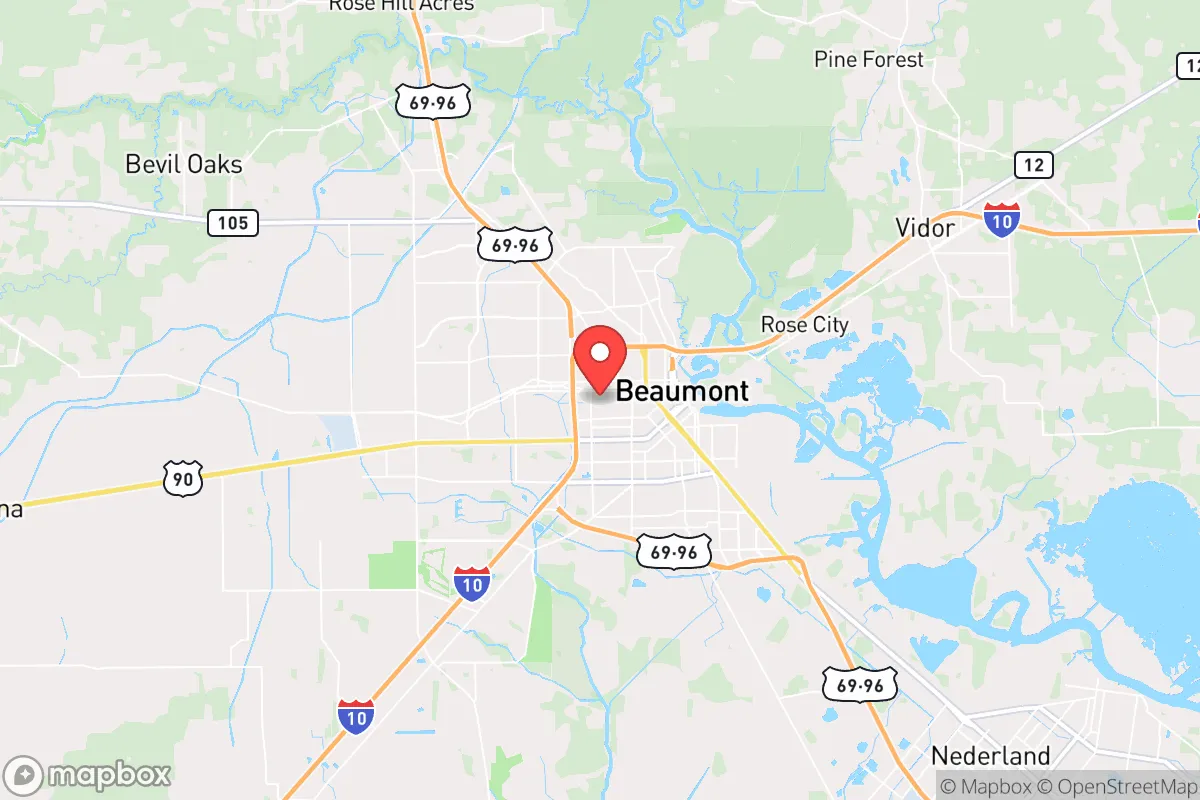
Photo: Wikipedia
Demographics of Beaumont, TX
Affluence Level in Beaumont, TX
A below-average socioeconomic profile. Incomes, home values, and educational attainment trail the U.S., with higher poverty and unemployment.
People of Beaumont, TX
The people of Beaumont, TX today form a majority-minority city of 113,710 residents, defined by a Black plurality (44.7%) and a substantial White minority (28.3%), with a growing Hispanic population (20.8%) and smaller East/Southeast Asian (2.3%) and Indian (1.2%) communities. The city’s identity is rooted in its industrial heritage—oil, petrochemicals, and shipping—which created a blue-collar, family-oriented character that remains dominant. Only 25.2% of adults hold a college degree, reflecting a workforce historically tied to trades and plant operations rather than white-collar professions. Beaumont is a place where deep Southern roots, Cajun-Creole influences from nearby Louisiana, and a steady stream of immigrant labor have layered into a distinct, resilient, and often insular local culture.
How the city was settled and grew
Beaumont’s population history is inseparable from the Spindletop oil discovery of 1901, which transformed a quiet lumber and rice-farming town into a boomtown almost overnight. The original settlers were Anglo-American planters and their enslaved Black laborers, who arrived in the 1830s and 1840s to farm cotton along the Neches River. After the Civil War, freedmen established neighborhoods such as Pear Orchard and South Park, which became the historic heart of Beaumont’s Black community. The 1901 oil boom drew thousands of White workers from the rural South and Midwest, along with a smaller number of Black laborers from East Texas and Louisiana, who settled in areas like North End and West End. By the 1920s, the city’s population had surged past 40,000, with a rigidly segregated housing pattern: Whites in the central and western districts, Blacks in the eastern and southern enclaves. The Great Migration (1910–1970) brought additional Black families from the Deep South, further solidifying Beaumont’s Black plurality, while the city’s oil and petrochemical plants attracted a modest wave of Mexican laborers, who formed the nucleus of what is now the Hispanic Heights neighborhood near the downtown rail yards.
Modern era (post-1965)
The 1965 Hart-Cellar Act opened the door for new immigrant groups, but Beaumont’s foreign-born share remains low at 7.2%, reflecting the city’s limited appeal to high-skilled migration. The most significant post-1965 shift has been the growth of the Hispanic population, which rose from under 5% in 1970 to 20.8% today, driven by Mexican and Central American laborers working in construction, poultry processing, and the petrochemical industry. These families have concentrated in Hispanic Heights and the Downtown area, where older housing stock and proximity to industrial jobs provide affordable entry points. The East/Southeast Asian community (2.3%) is largely Vietnamese and Filipino, arriving after the Vietnam War and settling in the West End near the medical district, where many work in healthcare and hospitality. The Indian community (1.2%) is smaller and more recent, composed of professionals in engineering and medicine, and tends to cluster in newer subdivisions on the city’s western fringe, such as Walden and Lamar Park. Domestically, White flight to suburban Jefferson County and neighboring communities like Lumberton and Sour Lake accelerated after school desegregation in the 1970s, leaving Beaumont’s core increasingly Black and Hispanic. The Black population, once a majority in the 1980s, has declined slightly as middle-class families have moved to suburbs or left the region entirely for Houston or Dallas.
The future
Beaumont’s population is slowly homogenizing along class lines rather than strictly racial ones. The Hispanic share is projected to continue rising, potentially reaching 25–28% by 2040, driven by both natural increase and continued labor migration. The Black population is stabilizing after decades of out-migration, with younger families remaining in established neighborhoods like Pear Orchard and South Park while a small number of professionals move to newer subdivisions. The White population is aging and declining, as younger Whites continue to leave for larger metros or suburban school districts. The East/Southeast Asian and Indian communities are small but stable, with little new immigration expected unless the petrochemical sector attracts specialized engineers. The city is not tribalizing into distinct, hostile enclaves—neighborhoods remain largely segregated by income and race, but daily life in schools, churches, and workplaces forces regular interaction. The biggest demographic wildcard is whether Beaumont can attract and retain college-educated residents, given its low 25.2% degree attainment rate; without that, the population will likely continue to shrink slowly, as it has from a peak of 118,000 in 1980 to 113,710 today.
For someone moving in now, Beaumont is a city where the population is stable but aging, with a strong Black cultural core, a growing Hispanic presence, and small but rooted Asian and Indian communities. The city is not becoming more diverse in the cosmopolitan sense—it is becoming more Hispanic and more working-class, while the White and Black middle classes continue to thin out. New arrivals should expect a place where community ties are strong, but economic opportunity is tied almost entirely to the petrochemical industry, and where the schools and amenities reflect a city that has not fully recovered from the post-oil-boom population decline.

* Values derived from national, state, county, city and local statistics and may differ in a specific area. Last updated: 2026-10-10T16:26:32.000Z
Narrative content on this page is AI-generated and may contain mistakes. Verify any details that matter before acting on them.
ReloMaps may earn a commission from affiliate links at no extra cost to you.

