
Photo: Wikipedia
Political ClimatePolitical Climate in Beaumont, TX
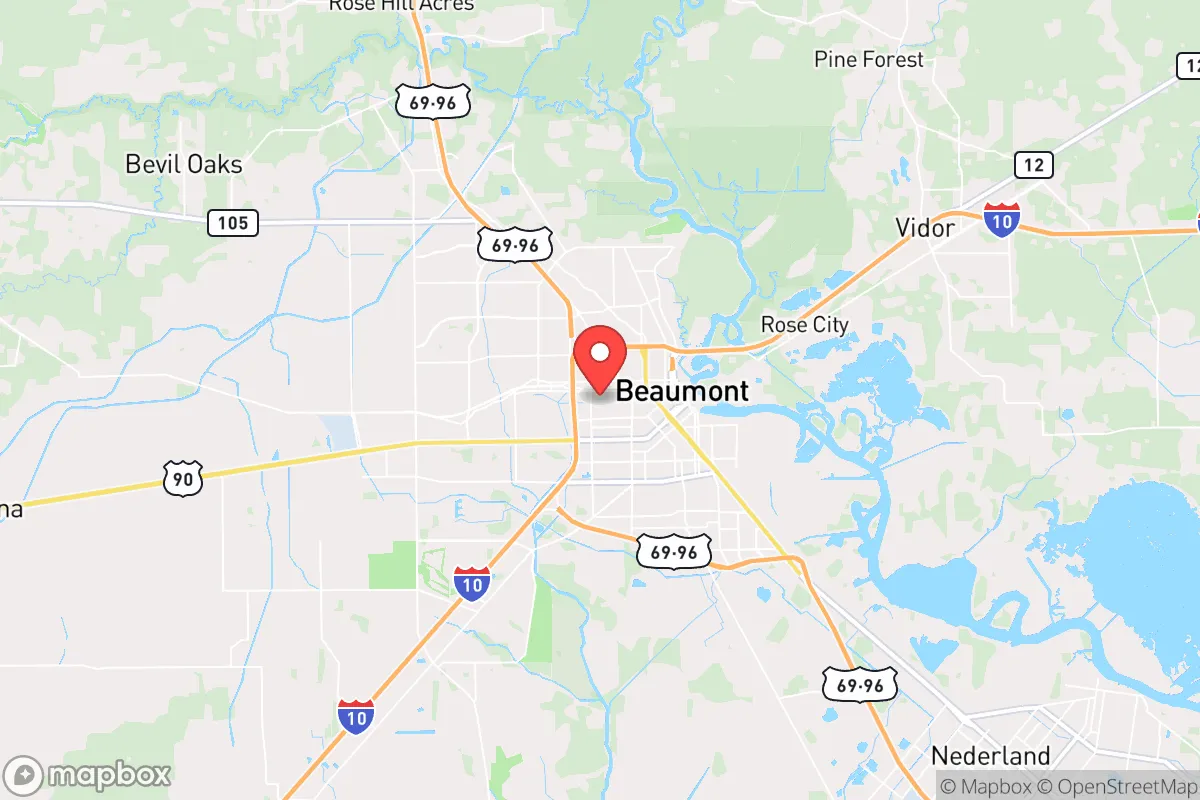
District shown is the primary district for this city’s centroid. Cities may span multiple districts.
Local Political AnalysisPolitical Analysis of Beaumont, TX
Beaumont is deep red country, and it has been for a long time. The Cook PVI of R+18 tells you the math, but it doesn't tell you the feel. This is a place where the old-school, blue-collar, union Democrat vote has been dying off for decades, replaced by a solid, no-nonsense conservative majority that values energy independence, the Second Amendment, and local control. You see it in the county-level results—Jefferson County has been trending reliably Republican in presidential races, even as the state itself shifts. The trajectory is clear: Beaumont is getting redder, not bluer, and the old moderate holdouts are fading fast.
How it compares
Drive thirty miles west to Houston, and you hit a sprawling, diverse metro that votes reliably blue in city and county races. That's a different world. Closer to home, the contrast is even sharper. Head south to Port Arthur, and you'll find a majority-minority city that leans heavily Democratic—it's a stark reminder of how much local demographics drive the vote. Up north, places like Lumberton and Silsbee are even more conservative than Beaumont itself, almost like a rural exurb that's fully committed to the cause. The real political divide in Southeast Texas isn't between parties—it's between the old industrial towns that are holding the line and the coastal cities that are drifting left. Beaumont sits right on that line, but it's firmly on the conservative side.
What this means for residents
For folks living here, the political climate means a government that mostly stays out of your way. Property taxes are a pain, sure, but there's no city income tax, no heavy-handed business regulations that strangle small shops, and no one breathing down your neck about how you run your household. The local school board and city council are still dominated by folks who believe in parental rights and fiscal restraint. You won't see the kind of progressive overreach you get in Austin or Dallas—no defund-the-police movements, no sanctuary city nonsense, no forced zoning changes that wreck neighborhoods. The biggest concern for residents right now is keeping it that way. There's a quiet worry that outside money and transplants from blue states could start shifting the local conversation, but so far, the old guard holds firm. The culture here is still one of self-reliance: you work in the refineries, you hunt and fish on the weekends, and you expect the government to keep the roads paved and the cops funded—nothing more.
One thing that sets Beaumont apart culturally is its deep connection to the oil and gas industry. That's not just an economic fact; it's a political identity. When you hear talk about energy independence or the Green New Deal, it's not abstract—it's about your neighbor's job and your own heating bill. The local paper, the Beaumont Enterprise, still runs editorials that would make a coastal progressive cringe. And the gun culture here is real—open carry is common, and the local gun shows are packed. If you're looking for a place where the government respects your privacy, your property, and your right to defend both, Beaumont is still that place. But you have to keep an eye on the school board meetings and the city council votes, because the fight to keep it that way never really ends.

State Political ClimatePolitical Climate in Texas
State Political AnalysisPolitical Environment in the State
Texas has been a reliably Republican state for decades, with the GOP holding every statewide office and both legislative chambers, but the margin of victory has been shrinking. In 2024, Donald Trump won the state by about 9 points, down from 11 points in 2020 and 16 points in 2016, signaling a slow but steady shift driven by explosive growth in the blue-leaning metros of Austin, Dallas, Houston, and San Antonio. The dominant coalition remains a mix of rural conservatives, suburban moderates, and business-minded fiscal conservatives, but the state is now a genuine battleground at the presidential level, with Democrats banking on in-migration from California and New York to flip it within a decade.
Urban vs. rural divide
The political map of Texas is a stark checkerboard. The big four metros — Houston, Dallas-Fort Worth, San Antonio, and Austin — are increasingly Democratic, with Harris County (Houston) and Dallas County now reliably blue in presidential races. Travis County (Austin) is the bluest in the state, voting for Biden by 50 points in 2020. Meanwhile, the vast rural and exurban counties — places like Lubbock, Midland, and Tyler — vote Republican by 60 to 80 points. The real action is in the suburbs: Collin County (north of Dallas) and Fort Bend County (southwest of Houston) were once GOP strongholds but are now competitive, with Collin going for Trump by only 3 points in 2024. The Rio Grande Valley, a historically Democratic region, has been trending right, with Starr County flipping from +52 Biden in 2020 to +5 Trump in 2024 — a massive shift driven by conservative Hispanic voters and frustration with the border crisis.
Policy environment
Texas has no state income tax, which is the single biggest draw for relocating conservatives. Property taxes are high — averaging about 1.7% of home value — but the state uses a portion of its sales tax revenue to fund schools, keeping the overall tax burden below high-tax states like California or New York. The regulatory posture is famously business-friendly: no state-level minimum wage above the federal $7.25, no state-level paid leave mandate, and a right-to-work law that bans union security agreements. On education, the state has expanded school choice through Education Savings Accounts (ESAs) for special-needs students in 2023, and Governor Greg Abbott has made universal school choice a top priority for 2025. Healthcare policy is limited: Texas refused Medicaid expansion under the ACA, leaving roughly 1.5 million uninsured adults in the coverage gap. Election laws were tightened in 2021 with SB 1, which banned 24-hour and drive-through voting, added ID requirements for mail ballots, and empowered partisan poll watchers — a move that drew national criticism but was popular with the conservative base.
Trajectory & freedom
On personal liberty, Texas has been a mixed bag. The state expanded gun rights in 2021 with permitless carry (HB 1927), allowing adults to carry handguns without a license or training — a clear win for Second Amendment advocates. Parental rights were strengthened in 2023 with the passage of the "Parental Bill of Rights" (HB 900), which requires schools to get parental consent before providing medical care or counseling and restricts sexually explicit content in school libraries. On medical autonomy, Texas passed one of the nation's strictest abortion bans (SB 8 in 2021, effectively outlawing abortion after six weeks, and a near-total ban in 2022 after Dobbs). However, the state has also seen government overreach: Governor Abbott's Operation Lone Star has deployed thousands of National Guard troops to the border, and the state has bused migrants to Democratic-run cities — a policy that conservatives support but that has strained local budgets and drawn lawsuits. Property rights remain strong, with no statewide rent control and a homestead exemption that protects primary residences from forced sale to pay most creditors.
Civil unrest & political movements
The 2020 George Floyd protests in Austin and Dallas were among the largest in the country, with Austin seeing sustained demonstrations that led to the city council cutting the police budget by $150 million — a move that was later partially reversed after a spike in violent crime. The backlash to those protests helped fuel the 2022 election of conservative mayors in San Antonio and Fort Worth. Immigration politics are the dominant flashpoint: the border crisis has made El Paso and the Rio Grande Valley ground zero for political battles, with the state suing the Biden administration over border policies and busing migrants to New York City and Chicago. The "Texas Nationalist Movement" (Texit) has gained some traction, with a 2022 poll showing 18% support for secession, but it remains a fringe idea. Election integrity remains a live issue: the 2020 and 2022 cycles saw lawsuits over mail ballot fraud and voting machine security, though no widespread fraud was proven. A new resident will notice the constant presence of border politics in local news and the occasional protest at the state capitol in Austin.
Projection
Over the next 5-10 years, Texas is likely to become more competitive at the statewide level but remain Republican-leaning. The key demographic driver is in-migration: roughly 1,000 people move to Texas every day, and while many are conservatives fleeing California, a significant share are younger, college-educated professionals who lean left. The suburbs of Dallas, Houston, and Austin will continue to shift blue, while the Rio Grande Valley and West Texas will remain red or trend redder. The state's political future hinges on whether the GOP can hold the suburbs by moderating on issues like school funding and property taxes, or whether the party's hardline stance on abortion and immigration will alienate suburban women and Hispanic voters. Expect continued fights over school choice, property tax reform, and border security. A new resident moving in now should expect to live in a state that is still conservative but increasingly polarized, with local politics varying wildly depending on whether you settle in a blue city like Austin or a red suburb like Keller (north of Fort Worth).
For a conservative relocating to Texas, the bottom line is this: you get low taxes, strong gun rights, and a business-friendly environment, but you also get high property taxes, a growing blue urban core, and constant political battles over the border and education. The state is still a safe bet for conservative values, but the margin for error is shrinking. If you're looking for a place where your vote still counts and your voice is heard, the suburbs of Dallas-Fort Worth or San Antonio are your best bet — just don't expect it to stay this way forever.
* Values derived from national, state, county, city and local statistics and may differ in a specific area. Last updated: 2026-10-10T16:26:32.000Z
Narrative content on this page is AI-generated and may contain mistakes. Verify any details that matter before acting on them.
ReloMaps may earn a commission from affiliate links at no extra cost to you.

