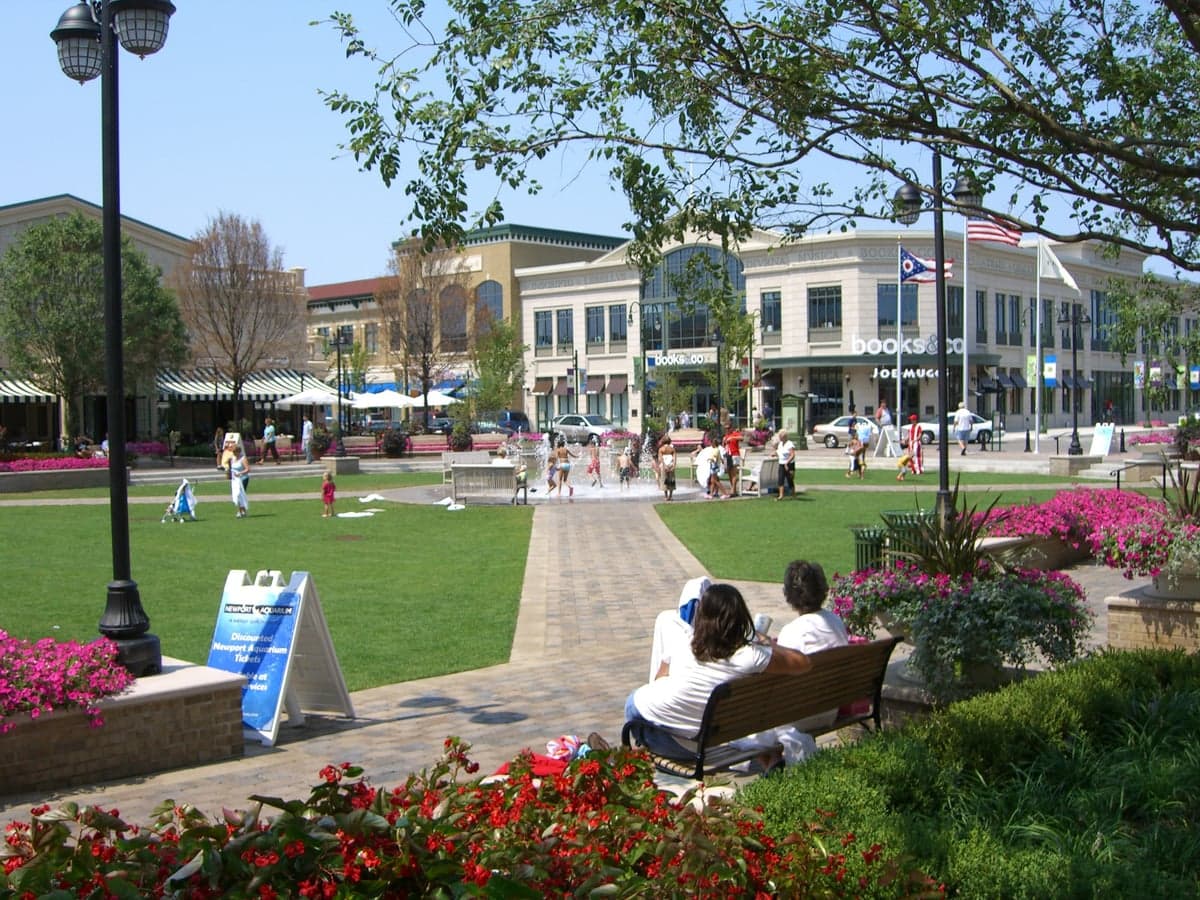
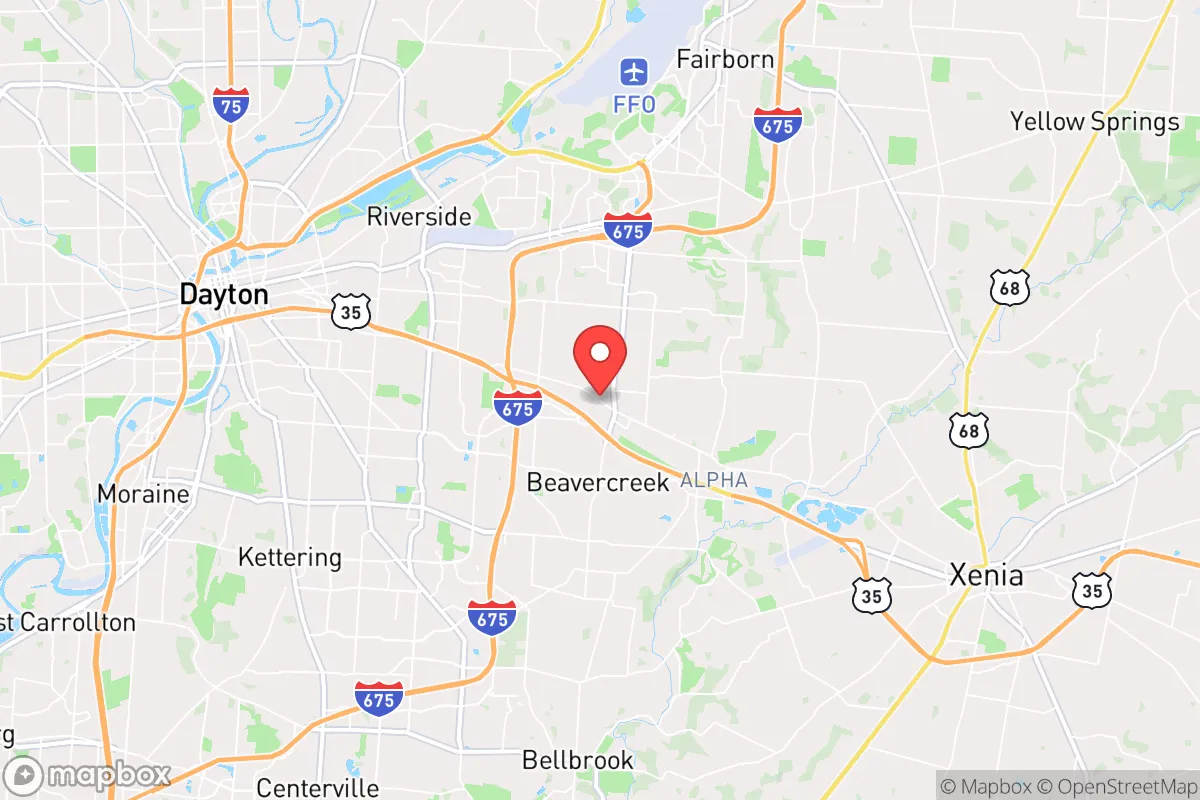
Photo: Wikipedia
Demographics of Beavercreek, OH
Affluence Level in Beavercreek, OH
A middle-class area roughly in line with national averages across income, home values, education, and employment.
People of Beavercreek, OH
The people of Beavercreek, Ohio, today number 46,787, forming a predominantly white (81.6%), highly educated (52.0% college-educated) suburban population with a notably small foreign-born share of just 1.6%. The city is characterized by its strong military and aerospace ties—anchored by Wright-Patterson Air Force Base—and a family-oriented, middle-to-upper-middle-class identity that sets it apart from the more transient populations of nearby Dayton. Beavercreek is a place where generational stability meets professional relocation, creating a community that values schools, safety, and civic engagement over urban amenities.
How the city was settled and grew
Beavercreek’s population history is not one of colonial-era settlement but of steady, post-industrial suburban expansion. The area was originally part of Beavercreek Township, a rural farming community settled in the early 1800s by families of German and English descent who cleared land for agriculture along the Little Beaver Creek. The first wave of concentrated growth came in the 1950s and 1960s, driven by the expansion of Wright-Patterson Air Force Base during the Cold War. This brought a surge of military personnel, civilian defense contractors, and aerospace engineers—many from the Midwest and Northeast—who built homes in the North Beavercreek neighborhoods near the base, such as the area around Grange Hall Road and Dayton-Xenia Road. These early subdivisions, like Beavercreek Estates and Pebble Creek, were designed for young families and remain stable, older neighborhoods with mature trees and ranch-style homes. A second wave in the 1970s and 1980s saw the development of Knollwood and Stonebridge, attracting white-collar professionals from Dayton’s manufacturing sector as the city incorporated in 1980 to manage its own growth. By 1990, Beavercreek’s population had swelled to over 30,000, almost entirely white and native-born, with a strong sense of local identity centered on the Beavercreek City School District.
Modern era (post-1965)
After the 1965 Hart-Cellar Act, Beavercreek saw minimal direct immigration, unlike many U.S. suburbs. The foreign-born population today is just 1.6%, far below the national average, and the city’s demographic shifts have been driven almost entirely by domestic migration. The most notable change has been the growth of East/Southeast Asian and Indian communities, each at 2.6% and 2.1% of the population respectively. These groups are overwhelmingly tied to Wright-Patterson Air Force Base and the nearby Wright State University, with many families settling in newer developments in southern Beavercreek—particularly around the Treasure Island and Hickory Ridge subdivisions, built in the 1990s and 2000s. These neighborhoods offer larger homes on cul-de-sacs and are popular among base-affiliated professionals who value proximity to the base and the highly rated Beavercreek schools. The Black population remains small at 2.8%, and the Hispanic share is 4.3%, with most Hispanic families concentrated in the Fairfield Commons area near the mall and along North Fairfield Road, where rental apartments and townhomes provide more affordable entry points. The city’s racial and ethnic landscape is not one of enclaves but of dispersed, professional-class integration—most minority residents live in the same subdivisions as their white neighbors, reflecting the base’s meritocratic culture.
The future
Beavercreek’s population is heading toward slow, steady homogenization rather than rapid diversification. The foreign-born share is unlikely to rise significantly given the city’s high housing costs (median home value above $300,000) and lack of immigrant-service infrastructure. The East/Southeast Asian and Indian communities are expected to plateau as base assignments rotate, with families often moving away after retirement. The Hispanic population may grow modestly through service-sector employment in retail and hospitality around The Greene Town Center and Fairfield Commons, but this growth will likely be absorbed into existing neighborhoods rather than creating distinct ethnic enclaves. The white population, while still dominant, is aging—Beavercreek has a median age of 40.5, and many long-time residents are empty-nesters. The next 10-20 years will likely see a gradual influx of younger families from the Dayton metro area seeking better schools, as well as continued military relocations. The city is not tribalizing into distinct enclaves; rather, it is becoming a more uniform, professional-class suburb where income and education level matter more than ethnicity.
For someone moving in now, Beavercreek offers a stable, low-diversity, high-opportunity environment where the population is defined by its connection to the base, its schools, and its suburban lifestyle. The city is not becoming a melting pot—it is becoming a well-educated, predominantly white, and increasingly affluent community that values continuity over change. New residents, especially those from military or professional backgrounds, will find a place where their neighbors look and think much like them, and where the demographic trajectory favors stability over transformation.

* Values derived from national, state, county, city and local statistics and may differ in a specific area. Last updated: 2026-04-21T20:39:43.000Z
Narrative content on this page is AI-generated and may contain mistakes. Verify any details that matter before acting on them.
ReloMaps may earn a commission from affiliate links at no extra cost to you.

