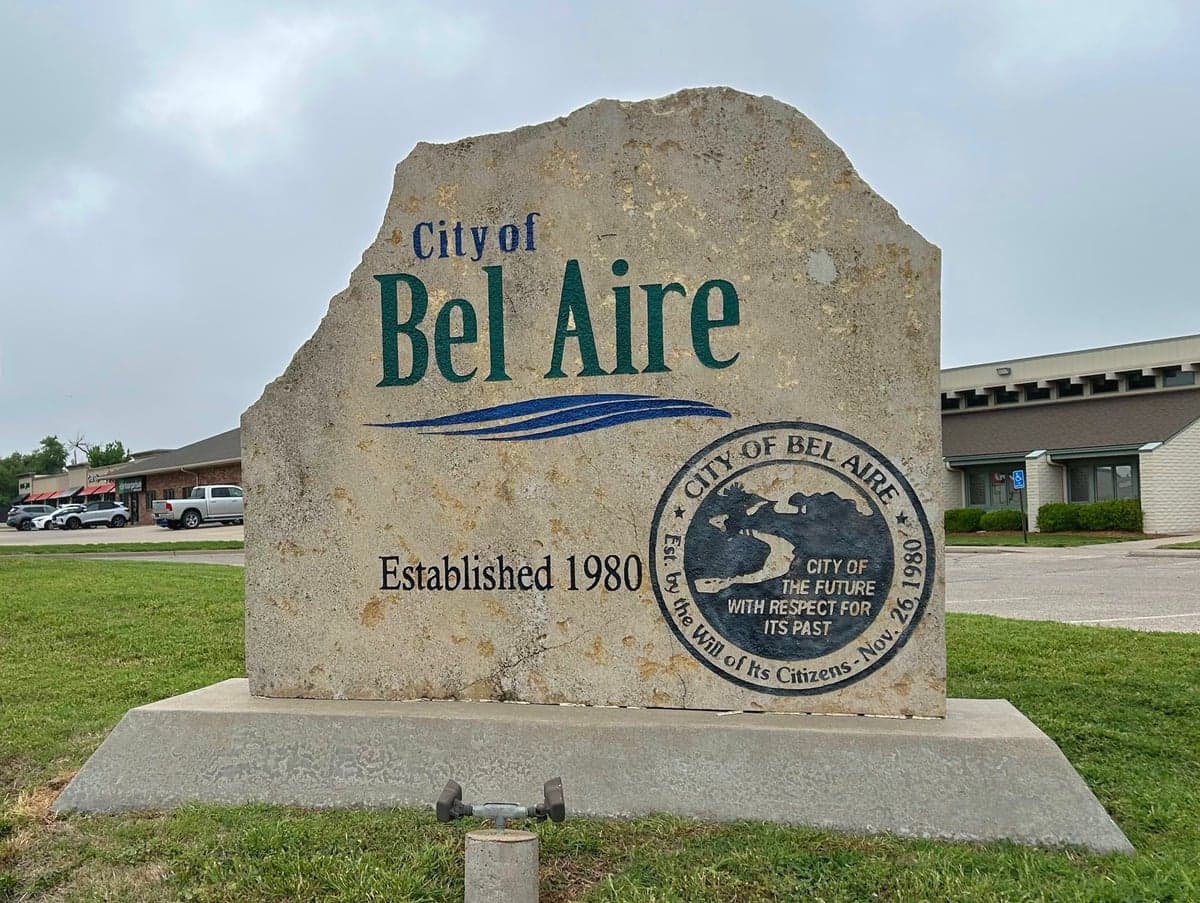
Photo: Wikipedia
Demographics of Bel Aire, KS
Affluence Level in Bel Aire, KS
A middle-class area roughly in line with national averages across income, home values, education, and employment.
People of Bel Aire, KS
The people of Bel Aire, Kansas, today number 8,654 and form a predominantly white, college-educated suburb with a growing Hispanic and East/Southeast Asian presence. The city is family-oriented and politically conservative, with 47.8% of adults holding a bachelor's degree or higher, a figure well above the national average. Its identity is shaped by post-war suburban expansion and a steady influx of families seeking larger lots and newer homes within commuting distance of Wichita, while retaining a small-town feel. The population is 68.2% white, 13.2% Hispanic, 9.1% Black, 6.1% East/Southeast Asian, and 0.3% Indian subcontinent, with 4.7% foreign-born.
How the city was settled and grew
Bel Aire was incorporated in 1955, making it a pure product of the post-World War II suburban boom. The original settlers were overwhelmingly white, middle-class families moving north from Wichita, drawn by cheap land and the promise of new schools and low-density living. The earliest homes went up in the Central Avenue corridor, near the original town center, and in the 53rd Street North area, where ranch-style houses on half-acre lots defined the landscape. No colonial or 19th-century settlement preceded this; the land was agricultural until the 1950s. The city's growth accelerated in the 1960s and 1970s as Wichita's aircraft manufacturing and oil industries expanded, pulling in workers from across the Midwest. These early waves built the neighborhoods of Bel Aire Estates and the Woodlawn corridor, which remain predominantly white and older in housing stock today.
Modern era (post-1965)
After the 1965 Hart-Cellar Act reshaped U.S. immigration, Bel Aire began a slow diversification that accelerated after 2000. Domestic in-migration from other Kansas cities and the broader Midwest continued, but the city also attracted new residents from Latin America and East/Southeast Asia. Hispanic families settled notably in the 53rd Street and Woodlawn area, where newer apartment complexes and townhomes offered entry points. East/Southeast Asian communities—primarily Vietnamese and Filipino—concentrated in The Vineyard subdivision, built in the 2000s, and in the Cottages at Bel Aire development near 37th Street North. The Black population, at 9.1%, is dispersed but has a visible presence in the central district around Central Avenue, where older duplexes and rental properties provide affordable housing. The Indian subcontinent population remains tiny at 0.3%, with no distinct enclave. The foreign-born share of 4.7% is modest but growing, driven largely by Hispanic and Asian immigration rather than refugee resettlement.
The future
Bel Aire is slowly diversifying but not tribalizing into rigid ethnic enclaves. Hispanic and East/Southeast Asian communities are growing through both immigration and natural increase, while the white population is aging and slightly declining in share. The city's college-educated rate of 47.8% suggests continued attraction for professional families, which may accelerate assimilation among newer groups. Over the next 10–20 years, the population is likely to become more Hispanic and Asian, but Bel Aire will remain a predominantly white, conservative suburb. The biggest demographic shift may be generational: younger families are replacing retirees in neighborhoods like The Vineyard and Bel Aire Estates, while the 53rd Street corridor sees infill development of townhomes and apartments that could attract a more diverse, younger base. No single group is likely to become a majority other than white, and the city's character as a safe, school-focused suburb will persist.
For someone moving in now, Bel Aire offers a stable, low-crime environment with strong schools and a conservative civic culture. The population is becoming more diverse at a measured pace, but the city remains overwhelmingly family-oriented and middle-class. New arrivals will find a place where neighborly familiarity still matters, and where demographic change is gradual enough to avoid the friction seen in faster-growing suburbs.

* Values derived from national, state, county, city and local statistics and may differ in a specific area. Last updated: 2026-05-14T18:57:24.000Z
Narrative content on this page is AI-generated and may contain mistakes. Verify any details that matter before acting on them.
ReloMaps may earn a commission from affiliate links at no extra cost to you.

