 Popular
Photo: Wikipedia
Demographics of Bella Vista, AR
Affluence Level in Bella Vista, AR
A middle-class area roughly in line with national averages across income, home values, education, and employment.
People of Bella Vista, AR
The people of Bella Vista, Arkansas, today number 30,935, forming a predominantly white (83.8%), highly educated (37.8% college degree) community with a distinctly low foreign-born share of just 0.9%. The city’s identity is shaped by its origins as a planned retirement and recreation community, giving it an older, quieter character than much of Northwest Arkansas, though it is increasingly drawing younger families priced out of Bentonville and Fayetteville. With a Hispanic population of 6.1% and tiny Black (0.1%), East/Southeast Asian (0.7%), and Indian (0.3%) shares, Bella Vista remains one of the least ethnically diverse cities in the region, a demographic reality rooted in its founding and subsequent growth patterns.
How the city was settled and grew
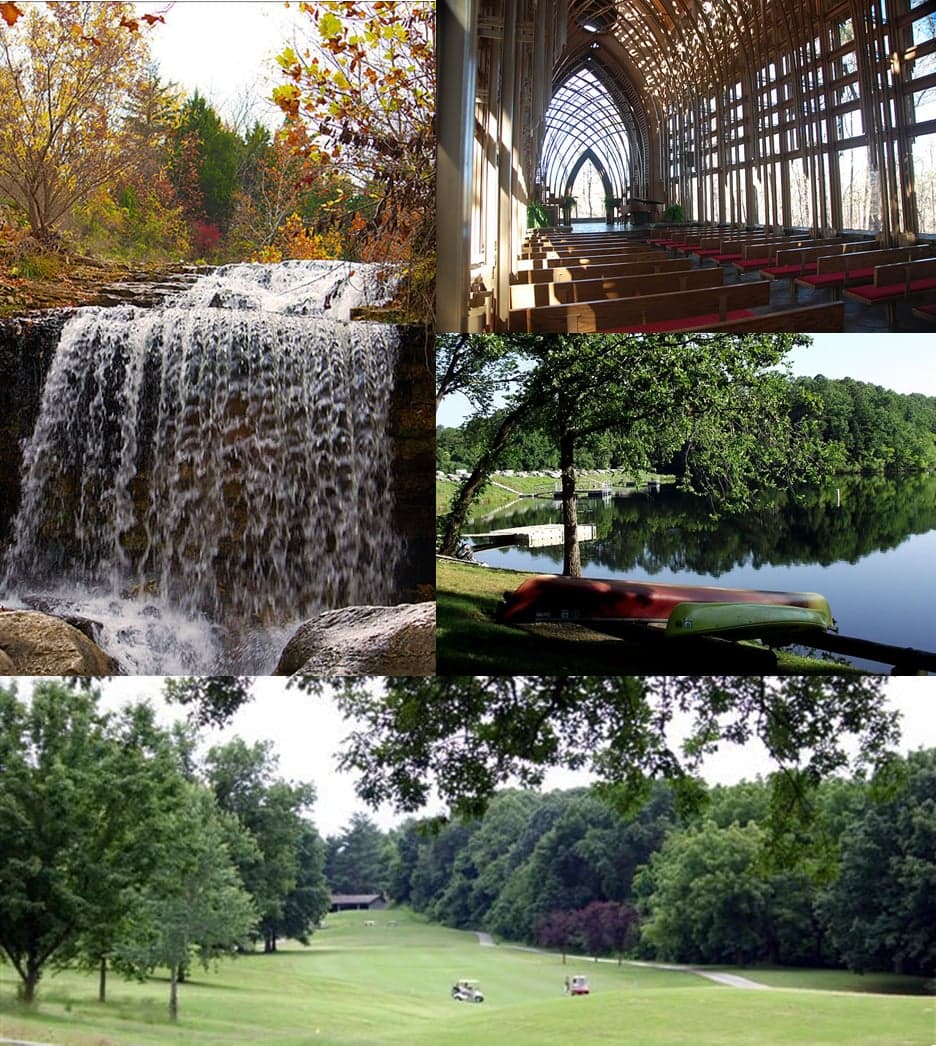
Bella Vista did not exist as a town until the early 20th century. The area was originally part of the Ozark wilderness, sparsely populated by subsistence farmers of Scots-Irish and English descent. The turning point came in 1915 when the Linebarger brothers, developers from Texas, purchased 1,600 acres and began marketing the land as a summer resort and retirement haven for Midwesterners. This was a planned community from the start, not an organic settlement. The original wave of buyers—mostly retired farmers, business owners, and professionals from Kansas, Missouri, Iowa, and Illinois—built modest cabins and cottages around the newly created lakes. The historic core of this early settlement is Lake Bella Vista and the adjacent Bella Vista Village area, where the original clubhouse and town center still stand. These neighborhoods remain the most established, with older homes and a higher concentration of long-term residents. By the 1960s, the population had only reached a few thousand, almost entirely white and native-born.
Modern era (post-1965)
The post-1965 era saw no major shift in Bella Vista’s ethnic composition, largely because the city’s growth engine remained domestic retirement migration rather than immigration or industrial recruitment. The 1970s and 1980s brought a second wave of retirees, again from the Midwest and Plains states, drawn by the low cost of living, golf courses, and lakes. These newcomers settled in newer subdivisions such as Highlands and Briarwood, which offered larger homes and more modern amenities. The city’s population doubled between 1970 and 1990, but the demographic profile barely changed: white, older, and native-born. The 1990s and 2000s saw a modest influx of younger families, many employed by Walmart’s corporate headquarters in nearby Bentonville or by the University of Arkansas in Fayetteville. These families, still overwhelmingly white, gravitated toward neighborhoods like Cooper Estates and Trailside, which offered newer construction and better school access. The Hispanic population, now 6.1%, began to grow in the 2000s, concentrated in the Bella Vista Village rental stock and service-sector housing near the city’s southern edge. However, the Black population remains negligible at 0.1%, and East/Southeast Asian and Indian communities are tiny, reflecting the city’s lack of the professional-class diversity seen in Bentonville or Rogers.
The future
Bella Vista’s population is heading toward modest diversification, but the pace is slow. The city is not homogenizing or tribalizing into distinct ethnic enclaves; rather, it is experiencing a gradual, low-level increase in Hispanic and, to a lesser extent, East/Southeast Asian residents, driven by service-sector and construction jobs in the broader Northwest Arkansas economy. The Indian subcontinent population (0.3%) is likely to remain small, as most Indian professionals in the region settle in Bentonville or Fayetteville, closer to tech and corporate jobs. The foreign-born share (0.9%) is among the lowest in Arkansas and is not expected to rise sharply, as Bella Vista lacks the rental housing stock and public transit that attract new immigrants. Over the next 10–20 years, the city will likely become slightly more Hispanic (perhaps reaching 10–12%) and slightly more diverse in its Asian-origin population, but it will remain overwhelmingly white and native-born. The bigger demographic shift will be age-related: as the large retiree cohort ages out, younger families—still predominantly white—will replace them, drawn by relatively affordable housing compared to Bentonville. Neighborhoods like Cooper Estates and Trailside will see the most turnover, while Lake Bella Vista and Highlands will retain older, longer-term residents.
For someone moving in now, Bella Vista is becoming a quieter, more affordable alternative to the booming Bentonville corridor—a place where the population is slowly, but not dramatically, diversifying. The city’s future is one of gradual generational replacement rather than rapid ethnic change, making it a stable, predictable choice for conservative-leaning families and individuals who prioritize low crime, good schools, and a homogenous social environment. The trade-off is limited exposure to the cultural and economic dynamism that diversity brings, a reality reflected in the city’s demographic data and its trajectory.

* Values derived from national, state, county, city and local statistics and may differ in a specific area. Last updated: 2026-04-23T02:29:47.000Z
Narrative content on this page is AI-generated and may contain mistakes. Verify any details that matter before acting on them.
ReloMaps may earn a commission from affiliate links at no extra cost to you.

