Photo: Wikipedia
Demographics of Belle Fourche, SD
Affluence Level in Belle Fourche, SD
A middle-class area roughly in line with national averages across income, home values, education, and employment.
People of Belle Fourche, SD
The people of Belle Fourche, South Dakota, today form a small, predominantly white, and culturally rooted community of 5,741 residents, characterized by a strong ranching and agricultural identity. With a foreign-born population of just 0.1% and a white share of 88.6%, the city remains one of the least ethnically diverse in the region, though a Hispanic population of 5.5% represents a modest and growing presence. The city’s identity is deeply tied to its role as the geographic center of the nation and as a hub for the surrounding cattle industry, giving it a distinctively Western, self-reliant character. For a conservative-leaning individual or family, Belle Fourche offers a tight-knit, low-density environment where community ties are strong and demographic change is slow.
How the city was settled and grew
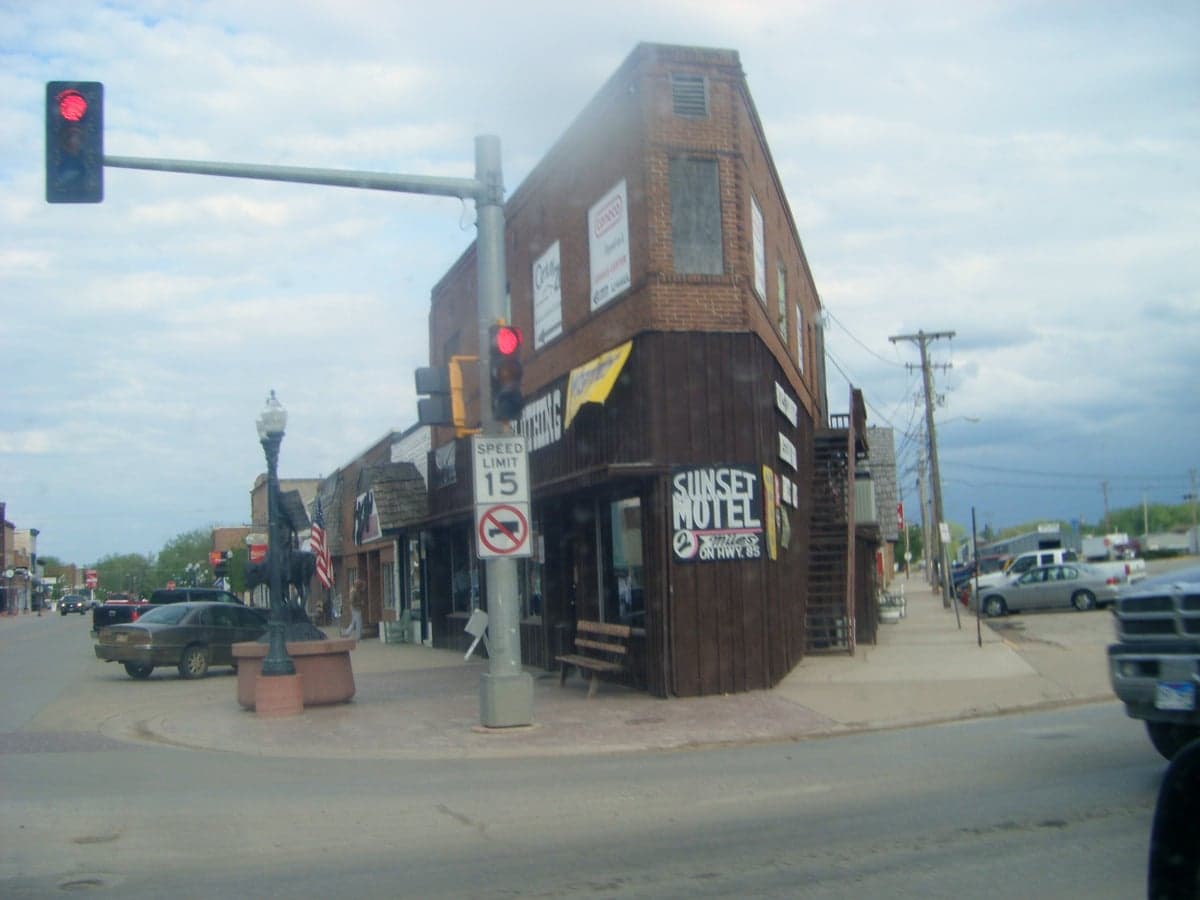
Belle Fourche was founded in the 1880s as a railroad town on the Chicago and North Western Railway, which arrived in 1889 and immediately transformed the area from open range into a commercial center. The original settlers were predominantly of Northern European stock—German, Scandinavian, and Irish homesteaders drawn by the promise of cheap land under the Homestead Act and the opportunity to supply the booming Black Hills gold mining camps. The first wave of ranchers and merchants built homes in what is now the Original Townsite district, centered around State Street and the railroad depot, where many of the city’s oldest commercial buildings still stand. A second wave of farmers arrived in the early 1900s, settling the North Belle Fourche area, which developed as a working-class neighborhood of small homes and grain elevators. The city’s growth was steady but modest, reaching about 2,000 residents by 1940, with the population remaining almost entirely white and native-born through the mid-20th century.
Modern era (post-1965)
After the 1965 Hart-Cellar Act, Belle Fourche experienced virtually no immigration-driven diversification, as the city’s remote location and limited industrial base offered few pull factors for foreign-born populations. Instead, the post-1965 period saw domestic in-migration from rural areas of the Great Plains, as small family farms consolidated and displaced residents moved into town. This wave settled primarily in the Southside neighborhood, a post-1970s subdivision of ranch-style homes and newer construction along Highway 85. The Hispanic population, now 5.5%, began to grow in the 1990s and 2000s, driven by labor demand in the cattle feedlots and meatpacking plants in the broader region, including the nearby city of Sturgis. These families have concentrated in the West Belle Fourche area, a lower-cost residential zone near the industrial corridor, though the community remains small and integrated rather than forming a distinct ethnic enclave. The East/Southeast Asian and Indian-subcontinent populations remain at 0.0% and 0.3%, respectively, reflecting the city’s continued lack of attraction for professional or tech-driven migration.
The future
Belle Fourche’s population is heading toward slow, incremental homogenization rather than rapid diversification. The white share, while still dominant at 88.6%, is likely to decline slightly as the Hispanic population grows through natural increase and continued labor migration, potentially reaching 8-10% by 2040. The Belle Fourche Heights subdivision, a newer development on the eastern edge of town, is absorbing most new construction and attracting younger families, many of whom are white and native-born, reinforcing the city’s overall demographic stability. The foreign-born share is expected to remain below 1%, as the city lacks the economic magnets—large universities, tech employers, or refugee resettlement programs—that drive diversity elsewhere. The Indian and East/Southeast Asian populations will likely stay negligible, as the city’s economy is dominated by agriculture and small-scale retail, not the professional sectors that attract these groups. The city is not tribalizing into distinct enclaves; rather, it is slowly becoming slightly more Hispanic while remaining overwhelmingly white and culturally conservative.
For someone moving in now, Belle Fourche is a place where demographic change is measured in decades, not years. The community remains deeply rooted in its ranching and railroad heritage, with a population that is stable, aging slightly, and unlikely to see significant ethnic or cultural disruption in the next generation. New residents will find a city where the social fabric is still woven from long-standing family ties, and where the pace of life and population change alike are slow and predictable.

* Values derived from national, state, county, city and local statistics and may differ in a specific area. Last updated: 2026-10-10T16:26:34.000Z
Narrative content on this page is AI-generated and may contain mistakes. Verify any details that matter before acting on them.
ReloMaps may earn a commission from affiliate links at no extra cost to you.

