Photo: Wikipedia
Political ClimatePolitical Climate in Belle Fourche, SD
District shown is the primary district for this city’s centroid. Cities may span multiple districts.
Inherited from parent state — no local data available.
Local Political AnalysisPolitical Analysis of Belle Fourche, SD
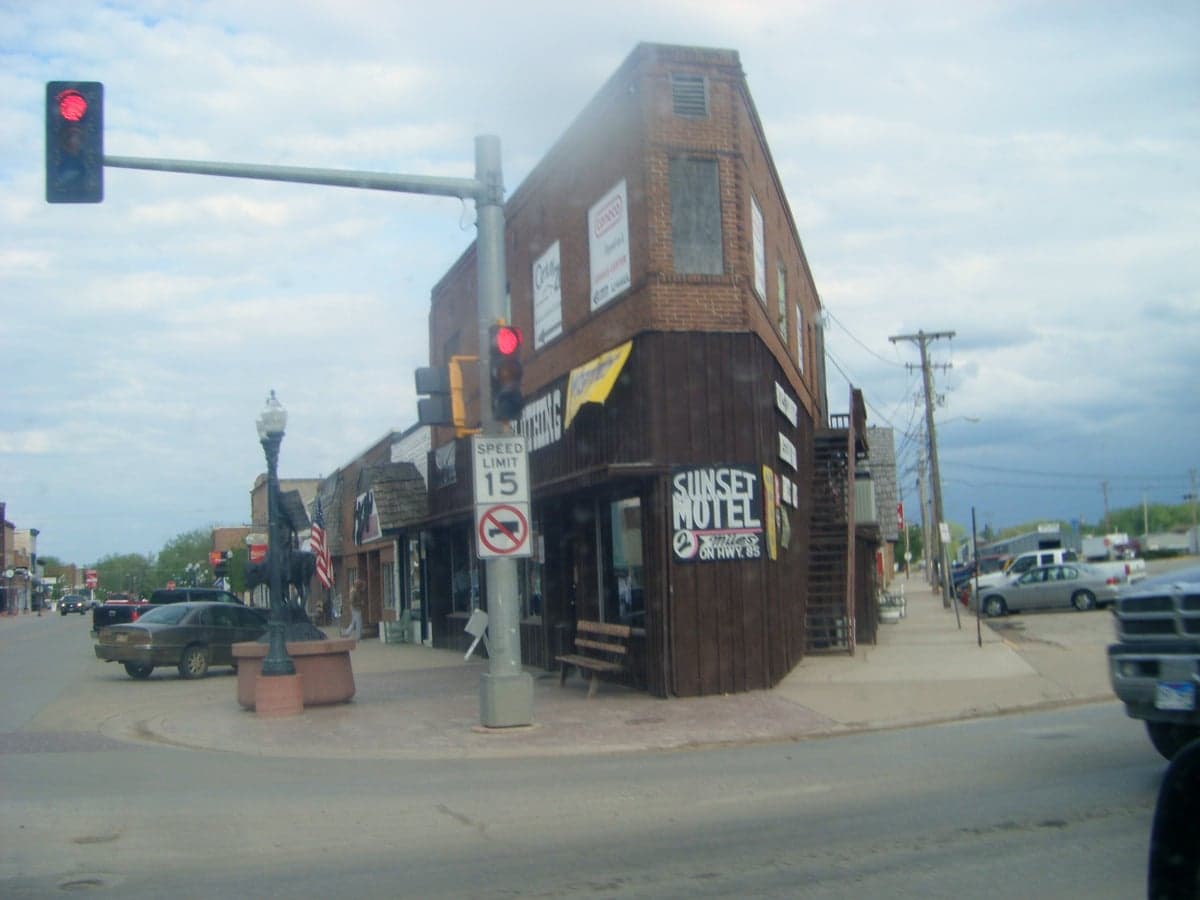
Belle Fourche is about as solidly conservative as it gets in western South Dakota, and that's not changing anytime soon. The Cook PVI of R+15 tells the story, but living here, you feel it in the way folks talk about government, taxes, and personal responsibility. This area has always leaned hard right, and while the national winds have shifted a bit, Belle Fourche has stayed the course—maybe even dug in deeper. You don't see the kind of progressive drift you might catch in Rapid City or even Spearfish; here, it's still very much a "leave us alone" kind of place.
How it compares
Drive an hour south to Rapid City, and you'll notice a different vibe—more transplants, more tourism money, and a growing number of folks who don't share the local values. Spearfish, just 45 minutes west, has that college-town feel with Black Hills State University, and it's starting to show some blue streaks, especially among younger residents. But Belle Fourche? It's the real deal. The surrounding Butte County is ranching and farming country, and those folks don't have much patience for big government or social experiments. Compared to places like Sturgis or Deadwood, which have their own unique cultures, Belle Fourche is more grounded, more traditional. You won't find many yard signs for progressive candidates here, and the local elections tend to be decided on who's more committed to cutting taxes and protecting Second Amendment rights.
What this means for residents
For anyone moving here, the political climate means you can expect a government that mostly stays out of your business. Property taxes are low, zoning is minimal, and there's a strong cultural pushback against any kind of overreach—whether it's from Pierre or Washington D.C. That said, it's not a free-for-all. The community is tight-knit, and there's an unspoken expectation that you'll pull your own weight. If you're looking for a place where your personal freedoms—like how you raise your kids, what you do on your land, or how you run your business—are respected, this is it. The downside? If you're hoping for progressive policies on things like renewable energy mandates or strict land-use regulations, you'll be disappointed. The local leadership is skeptical of any new rules that might tie up ranchers or small business owners in red tape.
One thing that stands out about Belle Fourche is how the culture reinforces the politics. The annual Black Hills Roundup rodeo isn't just a celebration; it's a statement of values. The local schools still teach traditional American history without apology, and the churches are full on Sundays. There's a quiet but firm resistance to the kind of social engineering you see in bigger cities. If you're worried about government overreach into your personal life—whether it's health mandates, speech restrictions, or property rights—Belle Fourche offers a refuge. The trajectory here is steady: conservative, independent, and wary of any change that feels like it's coming from outside. Long-term, as long as the ranching economy holds and people keep moving here for the same reasons, I don't see that changing. It's a place where you can still live free, and that's getting harder to find.

State Political ClimatePolitical Climate in South Dakota
State Political AnalysisPolitical Environment in the State
South Dakota is a deeply conservative state, with Republicans holding a supermajority in the legislature and a 2024 presidential margin of roughly +30 points for Donald Trump. Over the past 20 years, the state has shifted further right, driven by an influx of conservative-leaning transplants from California and the Midwest, while the Democratic Party has collapsed outside of a few Native American reservations and the college town of Brookings. The dominant coalition is a mix of rural agricultural interests, evangelical Christians, and libertarian-leaning small business owners, all united by a suspicion of federal overreach and a commitment to low taxes.
Urban vs. rural divide
The political map is starkly divided between a handful of small urban centers and the vast, sparsely populated countryside. Sioux Falls, the state's largest city, is a Republican stronghold in its suburbs (like Harrisburg and Tea) but shows a slight purple tint in its core, with a growing professional class that leans moderate. Rapid City and the Black Hills region are reliably red, driven by military retirees and tourism workers. The true blue dots are Brookings (home to South Dakota State University) and the Pine Ridge and Rosebud reservations, where Democrats can win 70-80% of the vote. However, these areas are small enough that they don't shift the statewide outcome. The rural counties—like Harding, Perkins, and Jones—routinely vote 85-90% Republican, making the state one of the most geographically polarized in the nation.
Policy environment
South Dakota's policy environment is a model of limited government. There is no state income tax, no corporate income tax, and no personal property tax on vehicles or business inventory. The sales tax is 4.5%, with local options pushing it to 6.5% in some cities. The regulatory posture is aggressively pro-business: permit approvals for construction or energy projects are typically measured in weeks, not months. Education policy is dominated by school choice—the state has a robust voucher program and a growing charter school sector, with Sioux Falls leading the way. Healthcare is a mixed bag: the state expanded Medicaid under Trump-era waivers, but the system remains market-driven, with no state-level mandates for insurance coverage. Election laws are among the most secure in the nation: voter ID is required, same-day registration is not allowed, and absentee voting requires an excuse. The legislature has consistently rejected mail-in ballot expansions, citing fraud concerns.
Trajectory & freedom
South Dakota is becoming more free in almost every measurable category, especially when compared to its neighbors. In 2023, Governor Kristi Noem signed a law banning COVID-19 vaccine mandates by private employers, a first in the nation. The state also passed a constitutional carry law in 2019, allowing permitless concealed carry for residents 18 and older. Property rights were strengthened with the passage of a "takings" law requiring compensation for any regulation that reduces property value by more than 10%. On the parental rights front, the state passed a "Parents' Bill of Rights" in 2022, giving parents explicit authority over their children's medical decisions and school curriculum. The only area of concern is a slight uptick in property taxes—driven by rapid home value appreciation in Rapid City and Sioux Falls—which has led to calls for a property tax cap. So far, the legislature has resisted, but it's a growing issue.
Civil unrest & political movements
South Dakota has seen remarkably little civil unrest compared to other states. The Dakota Access Pipeline protests in 2016-2017 were the largest flashpoint, with activists from across the country converging on Standing Rock (just across the border in North Dakota). In-state, the protests were largely contained to the reservation and drew heavy law enforcement presence, but they did not spill into mainstream South Dakota life. More recently, the state has seen a rise in election integrity activism, with groups like the South Dakota Freedom Caucus pushing for hand-counting of ballots and paper-only voting systems. The legislature passed a bill in 2024 requiring all ballots to be hand-counted in counties with fewer than 500 voters, a move that was praised by conservatives and criticized by election officials. There is no sanctuary city movement—in fact, the state passed a law in 2019 requiring all law enforcement to cooperate with federal immigration authorities. The only visible political flashpoint is the ongoing debate over Native American voting rights, with the ACLU suing the state over voter ID requirements that they claim disproportionately affect reservation residents.
Projection
Over the next 5-10 years, South Dakota will likely become even more conservative, driven by two demographic trends. First, the state is attracting a steady stream of migrants from California, Colorado, and the Pacific Northwest, who are fleeing high taxes and progressive policies. These new residents tend to be libertarian-leaning and reinforce the existing political culture. Second, the Native American population is growing but remains politically marginalized due to low turnout and geographic isolation. The biggest wildcard is the Sioux Falls metro area, which is growing rapidly and attracting a younger, more diverse workforce. If that growth continues, the city could shift from deep red to light purple within a decade, but it would take a massive demographic change to flip the state. The legislature will likely continue to push the envelope on school choice, gun rights, and tax cuts, while resisting any federal overreach on environmental or labor regulations.
For a new resident, the bottom line is this: South Dakota offers one of the highest levels of personal freedom in the country, with low taxes, minimal regulation, and a government that actively protects individual rights. The trade-off is a sparse social infrastructure—limited public transit, few cultural amenities outside of the two major cities, and a climate that demands self-reliance. If you value being left alone to live your life without government interference, this is one of the best places in America to do it. Just be prepared for long winters and a 45-minute drive to the nearest grocery store if you settle in the rural counties.
* Values derived from national, state, county, city and local statistics and may differ in a specific area. Last updated: 2026-10-10T16:26:34.000Z
Narrative content on this page is AI-generated and may contain mistakes. Verify any details that matter before acting on them.
ReloMaps may earn a commission from affiliate links at no extra cost to you.

