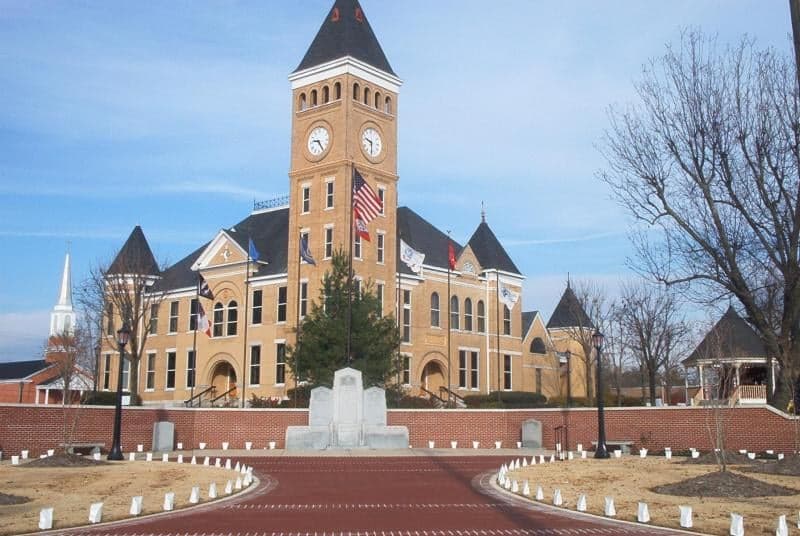
Photo: Wikipedia
Demographics of Benton, AR
Affluence Level in Benton, AR
A middle-class area roughly in line with national averages across income, home values, education, and employment.
People of Benton, AR
The people of Benton, Arkansas today form a predominantly white, family-oriented community of roughly 36,000, with a notably low foreign-born share of just 2.0% and a modest college attainment rate of 28.6%. The city’s character is shaped by its role as a stable, middle-class Saline County hub — more rooted and less transient than Little Rock suburbs closer to the interstate. Distinctive markers include a strong local government and school system identity, a visible but not dominant Hispanic minority at 6.7%, and a Black population of 9.6% that is concentrated in older, established neighborhoods rather than newer subdivisions.
How the city was settled and grew
Benton’s original population arrived in the 1830s and 1840s, drawn by the promise of fertile farmland along the Saline River and the construction of the Cairo and Fulton Railroad (later the Missouri Pacific). The city was formally incorporated in 1836 and named after Missouri Senator Thomas Hart Benton. The earliest settlers were largely Anglo-American farmers from Tennessee, Kentucky, and the Upper South, who established homesteads in what is now the Historic Downtown Benton district and along the river bottoms near Riverwood. A small number of enslaved African Americans were brought by these families, and after the Civil War, freedmen formed a community in the South Street area, near the railroad tracks. Through the early 1900s, Benton remained a small agricultural trade center, with its population hovering around 1,500. The first significant growth wave came after World War II, when returning veterans and workers from the Little Rock Ordnance Plant settled in new subdivisions like Briarwood, drawn by affordable land and the opening of Interstate 30 in the 1960s.
Modern era (post-1965)
The post-1965 period saw Benton transform from a sleepy farm town into a bedroom suburb of Little Rock, driven by white flight from the capital city and the expansion of manufacturing along the I-30 corridor. The 1970s and 1980s brought a wave of domestic in-migration — mostly white families from Pulaski County — who built homes in master-planned subdivisions such as Lakewood and Foxwood, which remain predominantly white and middle-to-upper-middle-class today. The Black population, which had been concentrated in the South Street and East End neighborhoods since the early 1900s, grew modestly but remained residentially clustered, with little new Black in-migration to the newer subdivisions. Hispanic growth began in the 1990s, driven by construction and poultry processing jobs in nearby counties; today, the 6.7% Hispanic share is dispersed across the city but has a visible presence in the Springhill Road area and in apartment complexes near I-30. The Asian population (East/Southeast Asian, 1.5%) is small and largely professional, with families drawn by the school system and settling in newer developments like Bent Creek. The Indian-subcontinent population is effectively zero (0.0%), reflecting the city’s lack of tech or medical anchor employers that typically attract that group.
The future
Benton’s population is projected to continue growing at a moderate pace — likely reaching 42,000–45,000 by 2040 — driven by continued domestic in-migration from Little Rock and out-of-state retirees seeking lower taxes and slower growth. The city is not homogenizing into a single monoculture; rather, it is tribalizing into distinct enclaves. The newer subdivisions on the west side (Lakewood, Foxwood, Bent Creek) are overwhelmingly white and affluent, while the older east-side neighborhoods (South Street, East End) remain more diverse, with a mix of Black, white, and Hispanic residents. The Hispanic share is likely to grow slowly, reaching perhaps 10–12% by 2040, but will remain concentrated in rental housing rather than owner-occupied subdivisions. The Black share is stable, with little new in-migration expected. The foreign-born share will remain very low (under 5%), as Benton lacks the industrial or agricultural base that attracts large immigrant populations. The city is becoming more economically stratified — a solid upper-middle-class west side and a working-class east side — but remains overwhelmingly native-born and English-speaking.
For someone moving in now, Benton offers a predictable, low-diversity environment with strong schools and a conservative civic culture. The population is stable, family-oriented, and unlikely to undergo rapid demographic change. New arrivals will find a city where neighborhoods are clearly defined by income and race, and where the social fabric is built around church, school, and local government rather than ethnic or immigrant institutions.

* Values derived from national, state, county, city and local statistics and may differ in a specific area. Last updated: 2026-04-30T02:11:08.000Z
Narrative content on this page is AI-generated and may contain mistakes. Verify any details that matter before acting on them.
ReloMaps may earn a commission from affiliate links at no extra cost to you.

