 Popular
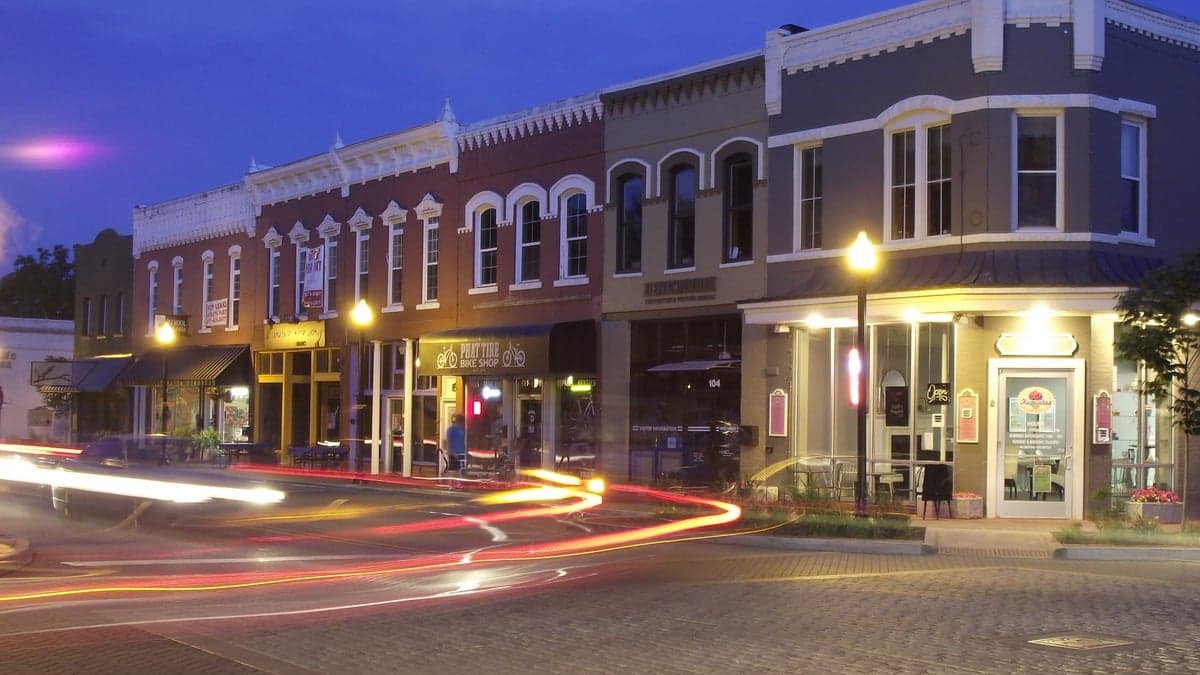
Photo: Wikipedia
Demographics of Bentonville, AR
Affluence Level in Bentonville, AR
An upper-middle-class area. Household wealth, education levels, and homeownership run ahead of national benchmarks.
People of Bentonville, AR
Bentonville, Arkansas, is a rapidly growing city of 56,326 residents that has transformed from a quiet Ozark town into a global corporate hub, creating a population unlike any other in the state. Its character is defined by a stark contrast: a white, native-born majority (58.5%) living alongside one of the highest concentrations of Indian-subcontinent professionals (10.8%) in the American South, drawn overwhelmingly by a single employer. The city is young, highly educated (53.7% hold a college degree), and increasingly diverse, with a foreign-born population of 12.1% that is reshaping its neighborhoods and schools.
How the city was settled and grew
Bentonville’s original population was built by white settlers of Scotch-Irish and English descent who moved into the Ozarks in the 1830s and 1840s, drawn by cheap land and the promise of subsistence farming. The town was formally established in 1836 as the seat of Benton County, and its early economy revolved around agriculture, small-scale milling, and the regional timber trade. The arrival of the St. Louis–San Francisco Railway in the 1880s connected Bentonville to national marketshare, but growth remained slow and homogeneous through the first half of the 20th century. The historic Downtown Square area, with its courthouse and brick storefronts, was the center of this early community, settled by families whose surnames still appear on local roads and cemeteries. The city’s population barely topped 3,000 by 1950, and it remained a deeply insular, white-majority farming town with no significant immigrant presence.
Modern era (post-1965)
The modern demographic revolution in Bentonville began not with the 1965 Immigration Act, but with the rise of Walmart. Sam Walton opened his first store in nearby Rogers in 1962, but it was the company’s relocation of its corporate headquarters to Bentonville in the 1970s and its explosive growth through the 1980s and 1990s that fundamentally rewrote the city’s population story. Walmart’s need for specialized talent—logistics experts, data analysts, supply-chain managers, and executives—created a pipeline of domestic and international professionals that no other force in Arkansas could match. The first major wave of newcomers were white-collar Americans from the Midwest, Texas, and the East Coast, who settled in master-planned subdivisions like Bella Vista (technically its own town but functionally a Bentonville bedroom community) and Pinnacle Hills, a corridor of upscale homes and apartments near the corporate campus.
The most dramatic shift came after 2000, when Walmart began aggressively recruiting engineers and IT specialists from India. This created a self-reinforcing migration chain: early Indian hires sponsored family members, and a dense professional network formed. Today, the Indian-subcontinent population stands at 10.8%—roughly 6,000 people—making it the largest non-white group in the city. These families concentrated in newer, higher-density neighborhoods close to the Walmart headquarters, particularly Southwest Bentonville around the intersection of Walton Boulevard and Southwest Regional Airport Boulevard, and in the Apple Blossom area, a collection of mid-2000s subdivisions with large homes and top-rated schools. East and Southeast Asian communities (2.0%) and Hispanic residents (10.7%) also grew during this period, with Hispanic families settling more in the Downtown area and along the Highway 72 corridor, often working in construction, hospitality, and the service sector that supports the corporate workforce. The Black population (3.4%) remains small but has grown modestly, concentrated in the Old Town neighborhoods east of the square.
The future
Bentonville’s population is heading toward greater stratification by income and origin, not homogenization. The Indian-subcontinent community is likely to continue growing as Walmart and its supplier ecosystem (Tyson Foods, J.B. Hunt, and dozens of vendor offices) recruit globally, but this growth may plateau as other Sun Belt cities compete for the same talent. The white native-born population is aging and declining as a share, though it remains the majority. Hispanic growth is steady but slower than in neighboring Rogers, where a larger working-class base exists. The city is not tribalizing into hostile enclaves—interaction is high in schools and workplaces—but distinct residential patterns are hardening: Indian professionals in the newer southwest subdivisions, white families in the older northwest and Bella Vista areas, and Hispanic households in the central and eastern corridors. The next decade will likely see Bentonville become more Asian-Indian and more college-educated, with the foreign-born share potentially reaching 18-20% by 2035. The city’s school district, already one of the best in Arkansas, will continue to be a major draw for immigrant families.
For a conservative-leaning individual or family moving to Bentonville today, the bottom line is this: you are entering a city where traditional Ozark culture coexists with a globally connected, highly educated professional class. The public schools are strong, the economy is resilient, and crime is low. But the social landscape is increasingly defined by the gap between long-time residents and newcomers, and between the Walmart-affluent and the service-sector workforce. It is a place of opportunity, but also of rapid change—and the pace of that change shows no sign of slowing.

* Values derived from national, state, county, city and local statistics and may differ in a specific area. Last updated: 2026-04-29T02:30:17.000Z
Narrative content on this page is AI-generated and may contain mistakes. Verify any details that matter before acting on them.
ReloMaps may earn a commission from affiliate links at no extra cost to you.

