Photo: Wikipedia
Demographics of Bloomfield, NM
Affluence Level in Bloomfield, NM
A below-average socioeconomic profile. Incomes, home values, and educational attainment trail the U.S., with higher poverty and unemployment.
People of Bloomfield, NM
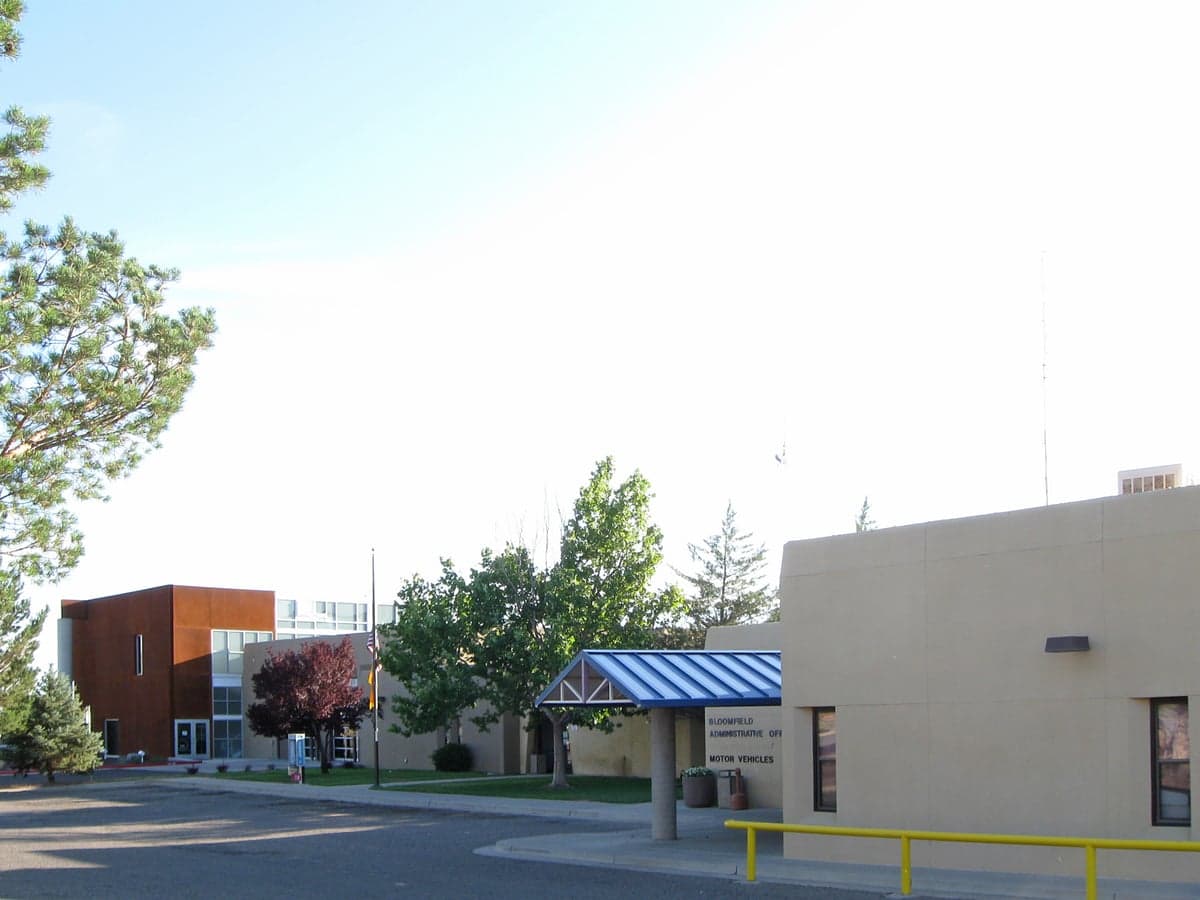
Bloomfield, New Mexico, is a small city of 7,391 residents where a near-even split between White (40.0%) and Hispanic (36.6%) populations defines its character, alongside a very low foreign-born share of 2.6%. The city’s identity is rooted in energy extraction and agriculture, with a blue-collar, family-oriented feel and a notably low college attainment rate of 14.3%. Unlike many New Mexico towns with deep Spanish colonial roots, Bloomfield is a 20th-century creation, shaped by the oil, gas, and coal booms that drew workers from the surrounding region and the broader Southwest.
How the city was settled and grew
Bloomfield was officially founded in the 1880s as a farming and ranching supply point along the narrow-gauge Denver & Rio Grande Railroad, but its population remained tiny until the mid-20th century. The first significant wave came in the 1920s and 1930s, when Anglo homesteaders and Hispanic families from the nearby San Juan Basin moved in to work the irrigated farms along the Animas River. These early residents clustered in the Old Town district, centered around the original railroad depot and Main Street, where modest wood-frame houses and small adobe homes still stand. The discovery of oil and natural gas in the San Juan Basin in the 1950s triggered Bloomfield’s first real boom. Workers from Texas, Oklahoma, and the Four Corners region—mostly White and Hispanic—flooded in, settling in the Westside Addition and North Bloomfield neighborhoods, which grew rapidly with ranch-style homes and mobile home parks to house the influx of roughnecks and pipeline crews. By 1960, the population had reached roughly 2,500, and the city’s character as a working-class energy hub was set.
Modern era (post-1965)
After the 1965 Hart-Cellar Act, Bloomfield saw very little new immigration—its foreign-born population today is just 2.6%, almost entirely from Mexico. Instead, the post-1965 story is one of domestic migration tied to the energy industry’s boom-and-bust cycles. The 1970s oil crisis drove a second major wave, as high crude prices spurred drilling across the San Juan Basin. New subdivisions like Sunset Mesa and Pinon Hills were built on the city’s southern and eastern edges to house incoming families, many of whom were White transplants from the Permian Basin and Gulf Coast. The Hispanic population grew steadily through natural increase and continued migration from rural New Mexico and northern Mexico, concentrating in Old Town and the Southside corridor along U.S. Highway 64. The 1980s oil bust stalled growth, but a coal-bed methane boom in the 1990s and early 2000s brought a third wave, this time including a small number of East/Southeast Asian workers (0.8% today) employed in engineering and technical roles. These newcomers settled mostly in Pinon Hills, which became the city’s most diverse and affluent pocket. The Black population has remained negligible at 0.2%, and there is no measurable Indian subcontinent community. The city’s racial geography remains largely defined by class: older, lower-income Hispanic and White families in the central and western neighborhoods, and newer, more mixed-income White and Asian households in the southern subdivisions.
The future
Bloomfield’s population is slowly homogenizing along ethnic lines, with the White share declining from over 50% in 2000 to 40% today, while the Hispanic share has risen from roughly 28% to 36.6% over the same period. This shift is driven primarily by higher Hispanic birth rates and continued domestic in-migration from other parts of the Southwest, rather than by new immigration. The East/Southeast Asian community, though tiny, is stable and concentrated in professional roles tied to energy and healthcare. The city is not tribalizing into distinct ethnic enclaves—neighborhoods like Sunset Mesa and Pinon Hills are increasingly mixed—but economic stratification is deepening. The low college attainment rate (14.3%) and heavy reliance on the volatile energy sector mean that Bloomfield’s future population growth will hinge on whether the San Juan Basin can sustain production in a decarbonizing economy. If energy jobs decline, the city may see out-migration of younger families, leaving an older, more Hispanic, and more economically stagnant population. If renewable energy or manufacturing fills the gap, Bloomfield could stabilize or grow modestly, but it is unlikely to attract significant new immigrant communities given its remote location and limited job diversity.
For someone moving in now, Bloomfield is a stable, working-class community where the population is becoming more Hispanic and slightly older, with little racial or ethnic tension but real economic fragility. The city offers affordable housing and a tight-knit, family-oriented atmosphere, but the low educational attainment and energy-dependent economy mean that long-term demographic trends point toward gradual decline unless new industries take root. It is a place for those who value quiet, low-cost living and are comfortable in a culturally blended, blue-collar environment—not for those seeking rapid growth or cosmopolitan diversity.

* Values derived from national, state, county, city and local statistics and may differ in a specific area. Last updated: 2026-05-01T08:09:31.000Z
Narrative content on this page is AI-generated and may contain mistakes. Verify any details that matter before acting on them.
ReloMaps may earn a commission from affiliate links at no extra cost to you.

