Photo: Wikipedia
Demographics of Boerne, TX
Affluence Level in Boerne, TX
An upper-middle-class area. Household wealth, education levels, and homeownership run ahead of national benchmarks.
People of Boerne, TX
The people of Boerne, Texas today number 19,509, forming a predominantly White (64.5%) community with a substantial Hispanic minority (29.3%) and small but present East/Southeast Asian (0.6%) and Indian-subcontinent (0.6%) populations. The city is notably well-educated, with 47.0% of adults holding a college degree, and has a relatively low foreign-born share of 6.6%. Boerne’s identity is that of a historically German-Texan Hill Country town that has absorbed significant suburban growth from San Antonio, creating a blend of old ranching families, newer professional commuters, and a stable Hispanic community with deep local roots.
How the city was settled and grew
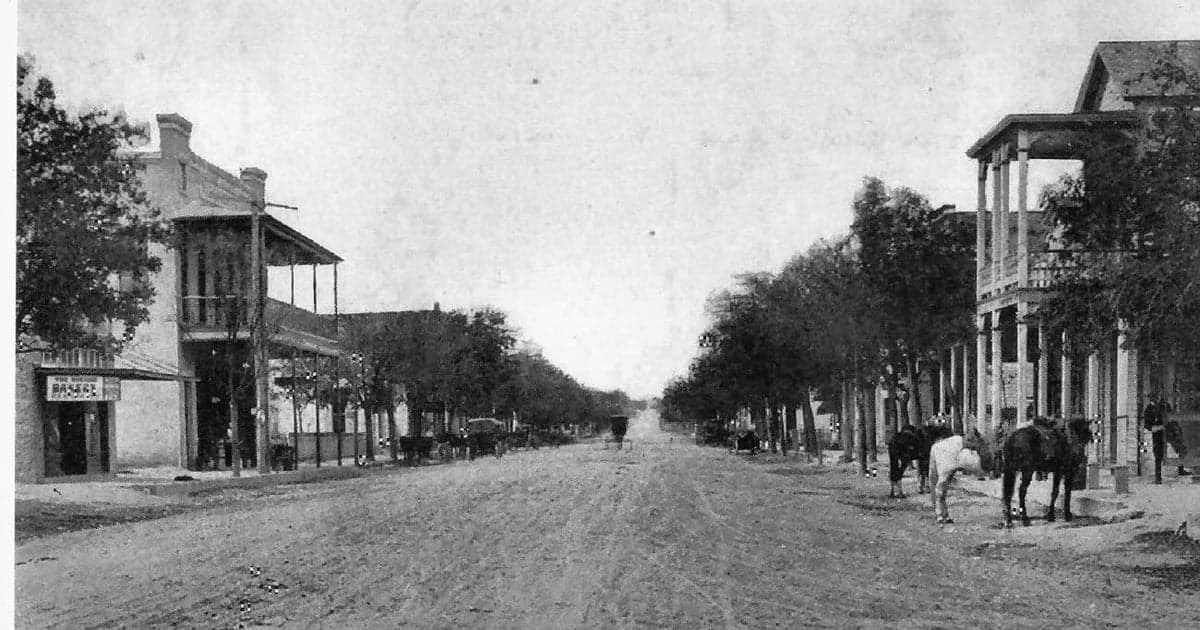
Boerne was founded in 1849 by German immigrant farmers and craftsmen, part of the broader wave of German settlement in the Texas Hill Country. The original settlers were drawn by the Adelsverein (Society for the Protection of German Immigrants in Texas), which granted land along Cibolo Creek. These families built the town around what is now the Historic Main Street District, erecting limestone homes and churches that still define the city’s core. The German-speaking population remained insular through the late 19th century, establishing farms and ranches in areas like Cibolo Crossing and the Fair Oaks Ranch vicinity (though the latter was largely undeveloped until the mid-20th century). By 1900, Boerne was a small, homogeneous German enclave of roughly 1,000 people, with little non-European immigration until after World War II.
Modern era (post-1965)
The 1965 Immigration and Nationality Act had minimal direct effect on Boerne, as the city remained overwhelmingly White and native-born through the 1970s. The major demographic shift came from domestic in-migration beginning in the 1980s, as San Antonio’s suburban sprawl reached Kendall County. New subdivisions such as Esperanza and The Dominion at Boerne attracted Anglo professionals and retirees seeking larger lots and lower taxes. The Hispanic population, which had been present in small numbers since the early 1900s as ranch laborers, grew steadily through natural increase and some immigration from Mexico. By 2020, the Hispanic share had reached 29.3%, concentrated in older neighborhoods like River Road and the Boerne Lake area, as well as in mobile-home parks along I-10. The Black population remains tiny (1.3%), largely limited to military-affiliated families stationed at nearby Fort Sam Houston. East/Southeast Asian and Indian-subcontinent residents (0.6% each) are almost entirely recent arrivals, working in San Antonio’s healthcare and tech sectors and living in newer subdivisions like Herff Farm.
The future
Boerne’s population is projected to continue growing at 2-3% annually, driven by San Antonio’s northward expansion and the city’s reputation for good schools and low crime. The White share is slowly declining (from ~70% in 2010 to 64.5% in 2024) as Hispanic natural increase and some immigration offset Anglo out-migration to more rural areas. The Hispanic population is not tribalizing into a separate enclave; rather, it is dispersing across the city, with second- and third-generation families moving into previously Anglo-dominated subdivisions. The foreign-born share (6.6%) is unlikely to rise sharply, as Boerne lacks the low-wage job base that attracts large immigrant flows. East/Southeast Asian and Indian communities are growing from a tiny base but remain niche, concentrated in professional households. The next 10-20 years will likely see Boerne become slightly more diverse but remain predominantly White and politically conservative, with a Hispanic population that is increasingly assimilated and middle-class.
For a mover today, Boerne offers a stable, family-oriented community where the old German-Texan character is fading but the suburban, conservative ethos is strengthening. The city is not becoming a melting pot in the traditional sense, but rather a place where a growing Hispanic middle class is integrating into a predominantly White, college-educated, and politically conservative social fabric. New arrivals should expect a low-crime, high-amenity environment with limited racial or ethnic tension, but also limited diversity beyond the White-Hispanic binary.

* Values derived from national, state, county, city and local statistics and may differ in a specific area. Last updated: 2026-04-19T07:20:34.000Z
Narrative content on this page is AI-generated and may contain mistakes. Verify any details that matter before acting on them.
ReloMaps may earn a commission from affiliate links at no extra cost to you.

