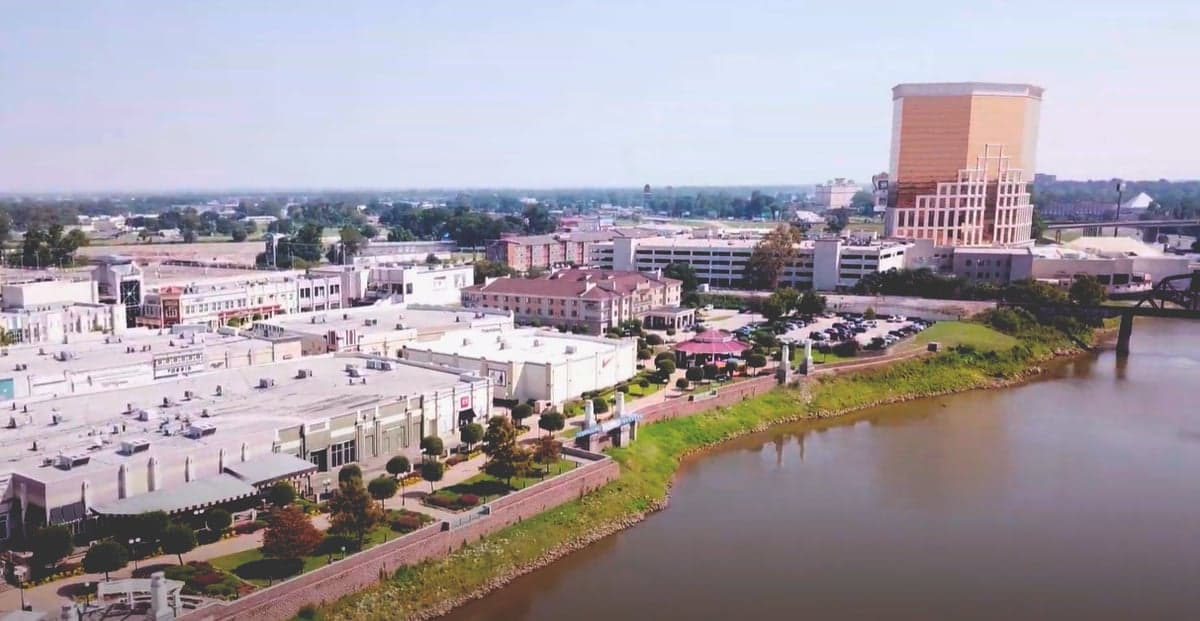
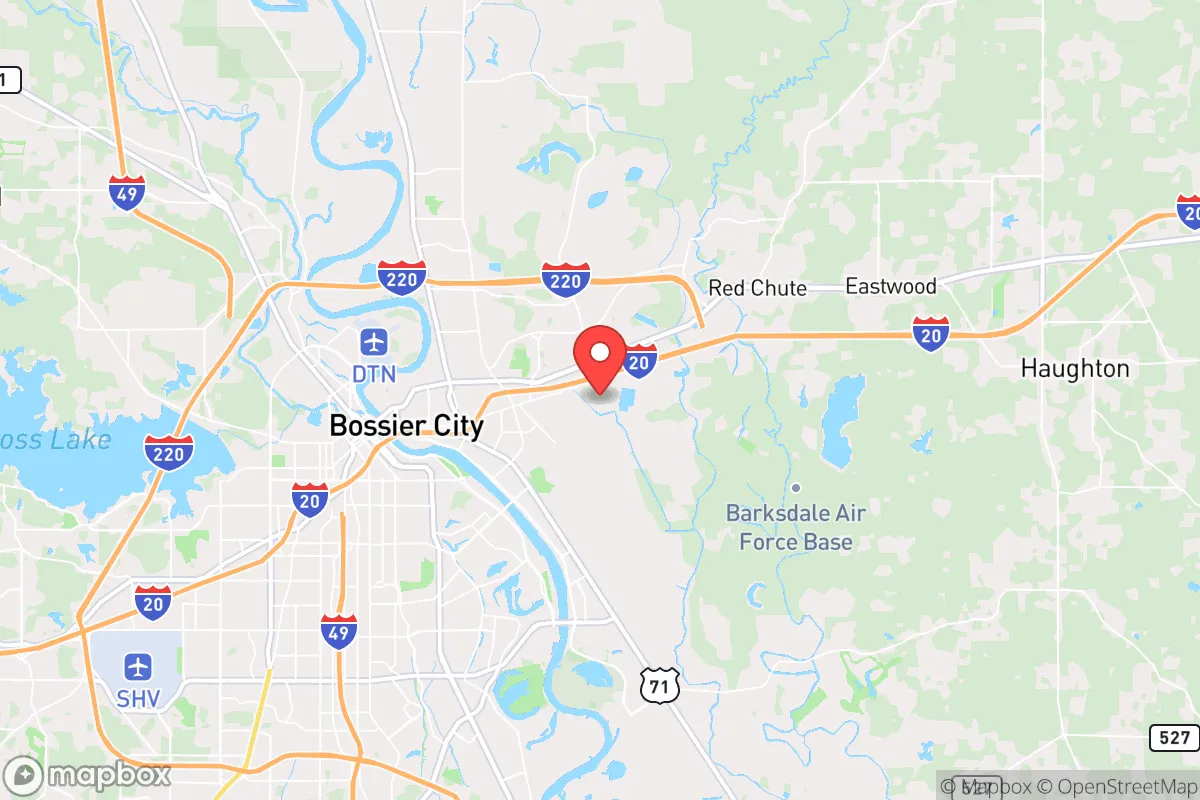
Photo: Wikipedia
Demographics of Bossier City, LA
Affluence Level in Bossier City, LA
A below-average socioeconomic profile. Incomes, home values, and educational attainment trail the U.S., with higher poverty and unemployment.
People of Bossier City, LA
The people of Bossier City, Louisiana, today number 62,832, forming a majority-white (55.0%) community with a substantial Black minority (26.5%) and a growing Hispanic population (12.2%). The city is a relatively young, post-World War II boomtown shaped by military expansion, the oil and gas industry, and riverboat gaming, giving it a pragmatic, working-to-middle-class character distinct from its older sister city, Shreveport, across the Red River. With only 3.1% foreign-born and a 24.4% college-educated rate, Bossier City remains a predominantly native-born, blue-collar hub where family ties and military service are common identity markers. Its population density is moderate, and the city’s identity is closely tied to Barksdale Air Force Base, which has been the primary demographic engine since the 1930s.
How the city was settled and grew
Bossier City’s population history is almost entirely a 20th-century story. The area was sparsely settled plantation land through the 1800s, with no real town until the arrival of the railroad in the 1880s. The first significant wave of settlers were white farmers and merchants from the Deep South, who established a small commercial core around what is now the Bossier City Historic District along Barksdale Boulevard. The real demographic turning point came in 1933 with the establishment of Barksdale Air Force Base (then Barksdale Army Airfield). The base drew thousands of military personnel and civilian support workers from across the United States, many of whom settled in the Barksdale Addition and Sun City neighborhoods directly adjacent to the base. These early arrivals were overwhelmingly white, with a smaller number of Black workers who lived in segregated areas near the base’s periphery. The post-World War II boom accelerated growth: between 1940 and 1960, Bossier City’s population more than tripled, fueled by the base’s permanent presence and the expansion of the oil and gas industry in the Ark-La-Tex region. The Greenacres Place neighborhood, developed in the 1950s, became a classic middle-class suburb for white families working at the base or in the oil fields.
Modern era (post-1965)
The post-1965 period saw Bossier City’s population diversify, though more slowly than many Southern cities. The 1970s and 1980s brought a second wave of white in-migration from the Rust Belt and other parts of the South, drawn by the base’s stability and the oil boom. These newcomers settled in newer subdivisions like Stockwell Place, a large master-planned community that began development in the 1990s and remains a predominantly white, upper-middle-class enclave. The Black population, which had historically been concentrated in the East Bossier area near the base and in older sections of the city, grew steadily through natural increase and some migration from rural Louisiana. By 2020, Black residents made up 26.5% of the population, a share that has remained relatively stable over the past two decades. The Hispanic population, now 12.2%, began to grow noticeably in the 2000s, driven by construction and service jobs tied to the riverboat casino industry and the base’s civilian workforce. Most Hispanic residents have settled in the Barksdale Boulevard corridor and in newer apartment complexes near the Louisiana Boardwalk shopping district. The East/Southeast Asian population (2.4%) is small but visible, largely composed of Vietnamese and Filipino families connected to the military or healthcare sectors, with a cluster near the base. The Indian-subcontinent population (0.4%) is minimal and largely professional, often affiliated with the base’s medical or engineering units.
The future
Bossier City’s population is heading toward modest diversification, but the pace is slow. The white share has declined from roughly 65% in 2000 to 55% today, a trend likely to continue as older white residents age out and younger, more diverse families move in. The Hispanic share is the fastest-growing segment, projected to reach 15-18% by 2035, driven by both natural increase and continued migration for construction and hospitality jobs. The Black population is expected to remain stable at around 25-27%, as the city lacks the economic pull to attract significant Black in-migration from other regions. The foreign-born share (3.1%) is low and likely to remain so, as Bossier City does not have the established immigrant networks or urban job base that drive higher immigration rates. The city is not tribalizing into sharply distinct enclaves; rather, it is slowly homogenizing into a more mixed, but still majority-white, suburban environment. Newer developments like Stockwell Place and the Benton Road corridor are attracting a mix of white and Hispanic families, while older neighborhoods near the base remain more racially stratified. For a newcomer, this means Bossier City is becoming a slightly more diverse but still culturally conservative place, where the military and family values remain the dominant social glue.
Bossier City is becoming a slowly diversifying, military-anchored suburb where the white majority is shrinking but remains the demographic and cultural center. The city’s future is one of gradual change, not rapid transformation, making it a stable but not particularly dynamic destination for those seeking a traditional, family-oriented Southern community. For a conservative-leaning mover, the key takeaway is that Bossier City offers a predictable, low-immigration environment with a strong military presence and a growing Hispanic workforce, but little in the way of cosmopolitan diversity or high educational attainment.

* Values derived from national, state, county, city and local statistics and may differ in a specific area. Last updated: 2026-04-23T05:00:50.000Z
Narrative content on this page is AI-generated and may contain mistakes. Verify any details that matter before acting on them.
ReloMaps may earn a commission from affiliate links at no extra cost to you.

