
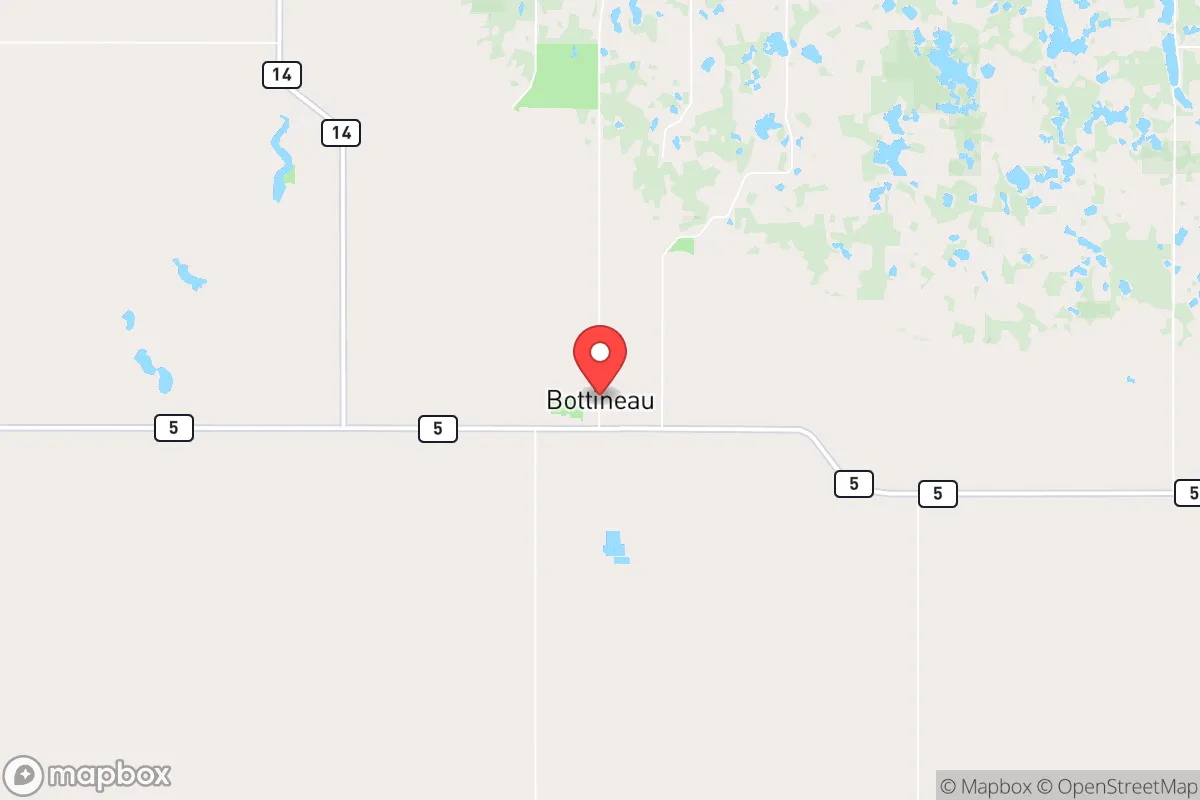
Photo: Wikipedia
Demographics of Bottineau, ND
Affluence Level in Bottineau, ND
A middle-class area roughly in line with national averages across income, home values, education, and employment.
People of Bottineau, ND
The people of Bottineau, North Dakota today number 2,063, forming a tight-knit community that is 84.2% white and notably older than the national median, with a strong Norwegian-German cultural imprint. The city functions as a regional service hub for the surrounding agricultural and energy sectors, with a foreign-born population of 3.9% and a college-educated rate of 29.1%. Distinctive identity markers include a deep-rooted sense of self-reliance, a visible presence of Lutheran and Catholic congregations, and a local economy anchored by Turtle Mountain Community College and the nearby Peace Garden.
How the city was settled and grew
Bottineau’s original population was drawn by the promise of free land under the Homestead Act of 1862 and the extension of the Great Northern Railway in the 1880s. The first major wave consisted of Norwegian and German immigrants, who arrived between 1880 and 1910, establishing the city as a farming and trading center. These settlers built the Historic Downtown Bottineau district, where the original wood-frame commercial buildings still stand, and the East Bottineau neighborhood, which became the core of the Norwegian community with its own Lutheran church and social halls. A smaller but significant wave of German-Russian immigrants from the Black Sea region arrived in the 1890s, settling primarily in the West Bottineau area, where they built St. John’s Catholic Church and established a distinct farming enclave. By 1920, the population had reached roughly 1,200, and the city’s character was firmly set as a white, Protestant, agrarian community with a strong work ethic and low tolerance for crime.
Modern era (post-1965)
After the 1965 Hart-Cellar Act, Bottineau saw very little direct immigration from new source countries. The foreign-born population today stands at just 3.9%, and the city’s racial composition has remained overwhelmingly white, with only 1.3% Hispanic, 1.3% Black, and 1.6% East/Southeast Asian residents. The most notable demographic shift since the 1970s has been domestic out-migration of young adults seeking jobs in larger cities, balanced by in-migration of retirees and workers in the oil and gas fields of the Bakken region to the west. The North Bottineau neighborhood, developed in the 1970s and 1980s, absorbed most of the new arrivals—primarily white families from other parts of North Dakota and Minnesota. The South Bottineau area, near the Turtle Mountain Community College campus, has seen a modest increase in East/Southeast Asian residents, many of whom are faculty or staff at the college or work in healthcare at the local hospital. The Indian subcontinent population is 0.0%, and there is no identifiable Arab community. The city remains highly homogeneous, with no significant ethnic enclaves forming; instead, the small non-white populations are dispersed throughout the existing neighborhoods.
The future
Bottineau’s population is projected to remain stable or decline slightly over the next decade, as the aging white population (median age roughly 45) continues to shrink through natural decrease, while the small Hispanic and Asian populations grow slowly through low-level recruitment by local employers. The city is not homogenizing further—it is already at a demographic plateau—but it is also not tribalizing into distinct enclaves. The 1.3% Hispanic and 1.6% East/Southeast Asian residents are largely assimilated into the existing social fabric, attending the same schools and churches as their white neighbors. The Lake Metigoshe area, a recreational district just north of town, is attracting a small number of out-of-state retirees and second-home owners, but this is not altering the city’s core demographics. Over the next 10-20 years, Bottineau will likely remain a predominantly white, older, and culturally conservative community, with a modest but stable non-white presence that is integrated rather than segregated.
For someone moving in now, Bottineau offers a safe, predictable, and community-oriented environment where nearly everyone knows their neighbors and the pace of life is slow. The city is not diversifying rapidly, and newcomers should expect a population that is overwhelmingly white, Christian, and politically conservative, with a strong Norwegian-German cultural heritage. The small non-white communities are present but not large enough to create distinct cultural districts, so integration is the norm. This is a place for those seeking stability, low crime, and a close-knit social structure, rather than demographic dynamism or urban amenities.

* Values derived from national, state, county, city and local statistics and may differ in a specific area. Last updated: 2026-04-19T05:46:48.000Z
Narrative content on this page is AI-generated and may contain mistakes. Verify any details that matter before acting on them.
ReloMaps may earn a commission from affiliate links at no extra cost to you.

