Photo: Wikipedia
Demographics of Bradenton, FL
Affluence Level in Bradenton, FL
A middle-class area roughly in line with national averages across income, home values, education, and employment.
People of Bradenton, FL
Bradenton, Florida, is a mid-sized city of 56,289 residents where a solidly white, native-born majority (59.4%) coexists with a fast-growing Hispanic community (20.7%) and a stable Black population (13.5%). The city feels more working-class and less transient than its coastal neighbors, with a college attainment rate of 27.7% and a foreign-born share of just 8.2% that signals a population rooted in domestic migration rather than international arrivals. Distinct neighborhoods still carry the imprint of the waves that built them, from early fishing villages to postwar subdivisions.
How the city was settled and grew
Bradenton was founded in the 1840s as a trading post on the Manatee River, drawing its first permanent settlers from the U.S. South and Midwest who came for cattle ranching, citrus, and fishing. The original core, now the Old Southeast neighborhood, was built by these Anglo-American families and remains a historic district of early 20th-century bungalows. A second wave arrived in the 1910s and 1920s, when the railroad and the land boom brought Midwestern retirees and speculators, who settled west of the river in what is now West Bradenton, an area of modest frame houses and small commercial strips. The city's Black population dates to the same period: African American laborers, many from Georgia and Alabama, came to work in the phosphate mines and citrus groves, establishing the Bradenton Heights and 13th Avenue corridor as the historic Black neighborhoods. These areas remain predominantly Black today, though they have experienced significant population loss since 2000.
Modern era (post-1965)
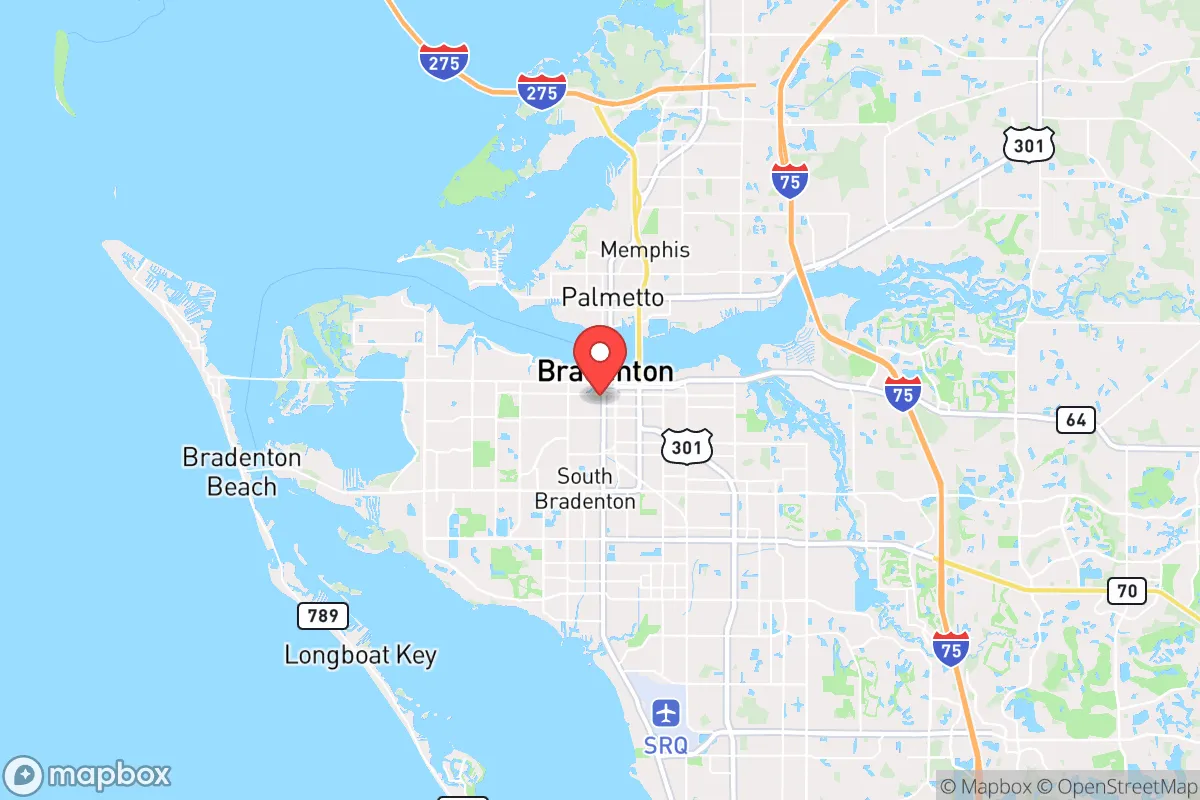
The post-1965 period reshaped Bradenton's demographics in two key ways. First, the Immigration and Nationality Act opened the door to a modest but steady Hispanic influx, primarily Puerto Ricans and Mexicans who came for agricultural and construction work. They concentrated in the Palmetto area just north of the river and in the East Bradenton corridor along U.S. 301, where Hispanic-owned businesses now line the commercial strips. Second, domestic in-migration accelerated after 1980 as retirees and families from the Northeast and Midwest sought lower costs and warmer winters. These newcomers filled the postwar subdivisions of West Bradenton and the newer master-planned communities near the Manatee River, reinforcing the city's white majority. The Black population, which peaked at roughly 18% in the 1990s, has declined to 13.5% as younger families have moved to suburban Manatee County or out of state. East/Southeast Asian residents (1.3%) and Indian-subcontinent residents (0.5%) are small but visible in the medical and tech sectors, with no single ethnic enclave; they are dispersed across West Bradenton and the newer developments near Lakewood Ranch.
The future
Bradenton's population is trending older and more Hispanic. The Hispanic share has risen from roughly 12% in 2000 to 20.7% today, driven by both immigration and higher birth rates, and is projected to reach 25-28% by 2035. This growth is concentrated in East Bradenton and Palmetto, creating a more distinct ethnic geography than the city has seen in decades. The white population, while still the majority, is aging in place, and the city's under-18 population is now majority-minority. The Black population is stable but not growing, and the small Asian and Indian communities are likely to remain niche groups tied to specific employers like Blake Medical Center. The city is not homogenizing; rather, it is tribalizing into a white, native-born west side and a younger, Hispanic east side, with the historic Black neighborhoods shrinking in between. For a newcomer, this means choosing a neighborhood that matches not just budget but cultural comfort zone.
Bradenton is becoming a more diverse, more Hispanic city, but at a slower pace than much of Florida. The low foreign-born share and modest college attainment rate suggest a place that remains grounded in domestic, working-class roots. For a conservative-leaning mover, the city offers a stable, family-oriented environment where the demographic changes are gradual enough to feel manageable, and where the historic neighborhoods still tell the story of who built them.

* Values derived from national, state, county, city and local statistics and may differ in a specific area. Last updated: 2026-05-14T13:31:05.000Z
Narrative content on this page is AI-generated and may contain mistakes. Verify any details that matter before acting on them.
ReloMaps may earn a commission from affiliate links at no extra cost to you.

