Photo: Wikipedia
Political ClimatePolitical Climate in Bradenton, FL
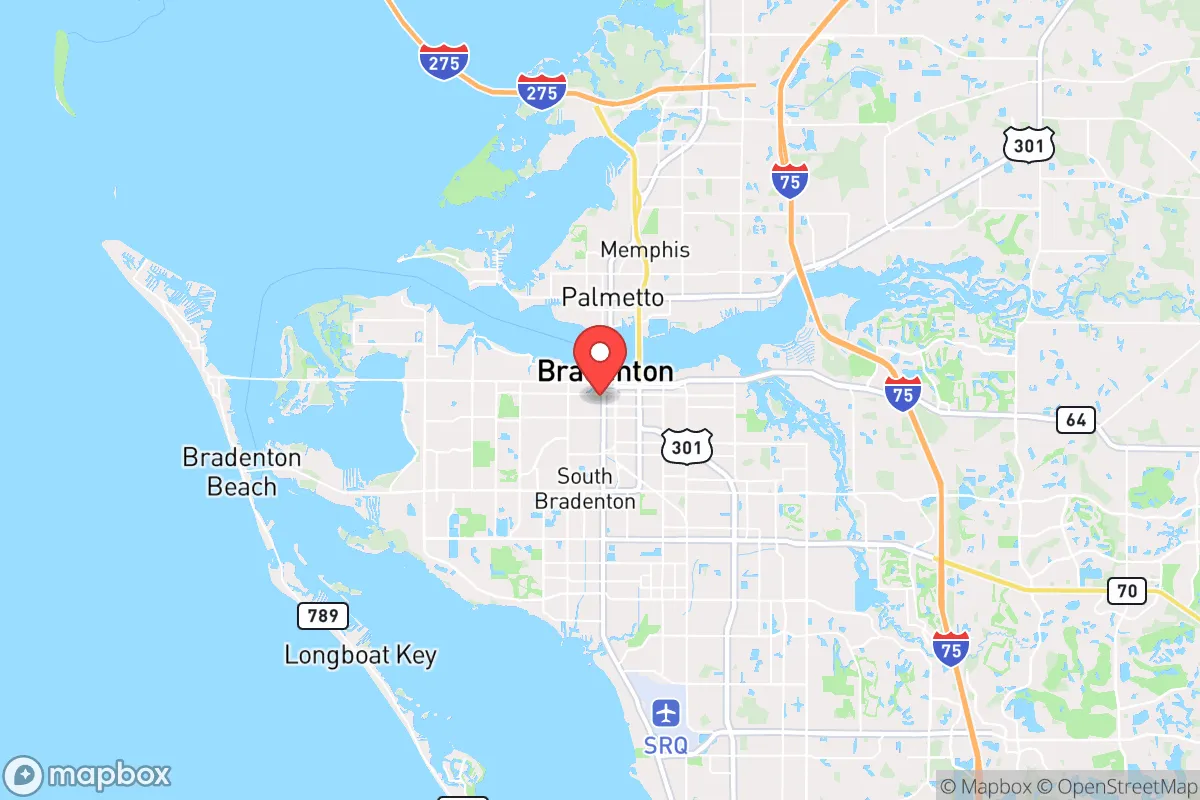
District shown is the primary district for this city’s centroid. Cities may span multiple districts.
Local Political AnalysisPolitical Analysis of Bradenton, FL
Bradenton has long been a reliably conservative community, and the numbers back that up with a Cook PVI of R+7—two points redder than the state of Florida as a whole. I’ve lived here long enough to remember when you could count the stoplights on one hand, and the political culture matched that small-town, mind-your-own-business vibe. Over the past decade, though, you can feel the pressure shifting. More folks are moving in from blue states, and while most still lean right, there’s a creeping sense that the old-school live-and-let-live attitude is being tested by new voices pushing for bigger government and more regulations. The trajectory isn’t alarming yet, but if you’ve been paying attention, you know we have to stay engaged to keep Bradenton from drifting toward the kind of overreach you see in places like St. Petersburg or even parts of Sarasota just south of us.
How it compares
Bradenton’s R+7 rating puts it noticeably to the right of Florida’s statewide R+5, which means local elections and policy decisions tend to favor limited government, lower taxes, and Second Amendment protections more consistently than the state average. Drive ten miles south into Sarasota and you’ll find a more mixed bag—Sarasota County itself is still red, but the city of Sarasota has a vocal progressive minority that’s pushed for things like stricter rental regulations and more public spending on social programs. Head north to St. Petersburg and you’re in a solidly blue city where government intervention in housing and business is the norm. Bradenton, by contrast, has kept its county commission and school board firmly in conservative hands, though recent elections have seen closer margins. The difference matters: when the state legislature passes a preemption law, Bradenton actually follows it, while some neighboring cities look for loopholes to impose their own rules.
What this means for residents
For someone who values personal freedom and minimal government meddling, Bradenton still offers a pretty good deal. Property taxes are reasonable, zoning is less restrictive than in Sarasota, and you won’t find the kind of mask mandates or business shutdowns that plagued other parts of Florida during the pandemic. That said, the influx of new residents—many from high-tax, high-regulation states—is slowly changing the conversation. You’ll hear more chatter at city council meetings about “affordable housing mandates” and “climate action plans,” which are code words for more bureaucracy and higher costs. The school board has held the line on curriculum transparency and parental rights, but it takes constant vigilance. If the trend continues, Bradenton could start looking more like the places people moved here to escape.
Culturally, Bradenton remains a place where people wave from their trucks and neighbors actually know each other’s names. The policy distinctions from the rest of Florida are subtle but real: we’ve got a stronger tradition of supporting local agriculture and resisting overdevelopment, and the Second Amendment isn’t just tolerated here—it’s celebrated. The biggest worry I hear from longtime friends is that the very freedoms that make Bradenton attractive are under slow, steady pressure from outside influences. We’re not there yet, but if you care about keeping government off your back and out of your wallet, this is a community worth keeping an eye on—and getting involved in before it’s too late.

State Political ClimatePolitical Climate in Florida
State Political AnalysisPolitical Environment in the State
Florida is a solidly Republican state with a Cook PVI of R+5, but calling it a simple red state misses the real story. Over the past 20 years, the state has undergone a dramatic political realignment, shifting from a perennial battleground where elections were decided by a few thousand votes to a reliably conservative stronghold where Republicans now hold supermajorities in both legislative chambers and control every statewide office. The dominant coalition is a mix of native conservatives, transplants from the Northeast and Midwest seeking lower taxes and fewer restrictions, and a growing bloc of Hispanic voters, particularly Cuban-Americans and Venezuelans, who have moved rightward on economic and social issues. This shift accelerated noticeably after 2020, driven by a backlash against COVID-era mandates and a broader cultural realignment that made Florida a symbol of resistance to progressive governance elsewhere.
Urban vs. rural divide
The political map of Florida is a study in contrasts. The major metropolitan areas—Miami-Dade County, Orlando (Orange County), and Tampa (Hillsborough County)—still lean Democratic, but the margins have shrunk considerably. Miami-Dade, once a Democratic stronghold, has been trending right for a decade; in 2020, Donald Trump improved his performance there by double digits compared to 2016, and in 2022, Governor Ron DeSantis actually won the county outright. The I-4 corridor, stretching from Tampa through Lakeland to Orlando, remains the key swing region, but even there, the Republican edge has grown. The real engine of the state's conservative tilt is the vast expanse of rural and suburban territory: the Panhandle from Pensacola to Tallahassee, the interior counties like Lake and Marion, and the rapidly growing southwest coast from Naples to Fort Myers. These areas vote Republican by margins of 20 to 40 points, and they are growing faster than the Democratic-leaning urban cores. The political geography is simple: the more you get away from the downtowns of Miami, Orlando, and Tampa, the more conservative it gets.
Policy environment
Florida's policy environment is a direct reflection of its conservative governance. There is no state income tax, a major draw for relocating families and businesses. The regulatory posture is aggressively pro-business, with a streamlined permitting process and a legal environment that strongly favors employers and property owners. On education, the state has been a national leader in school choice, with programs like the Family Empowerment Scholarship and the Florida Tax Credit Scholarship allowing parents to direct public funds to private or alternative schools. The Parental Rights in Education Act (HB 1557), often mischaracterized as the "Don't Say Gay" law, prohibits classroom instruction on sexual orientation and gender identity in early grades, a move that has made Florida a flashpoint in the national culture war but has been broadly popular with conservative and many moderate parents. Healthcare policy has focused on transparency and competition, with the state rejecting Medicaid expansion and instead pursuing market-based reforms. Election laws have been tightened, with the passage of SB 90 in 2021, which added voter ID requirements, restricted drop boxes, and limited third-party ballot collection. The state also created an Office of Election Crimes and Security, a first in the nation, to investigate and prosecute election law violations.
Trajectory & freedom
On the question of freedom, Florida's trajectory under Governor Ron DeSantis has been toward expanding personal liberty in several key areas, while also asserting state authority in others. The state passed constitutional carry (permitless carry of firearms) in 2023, eliminating the need for a government-issued permit to carry a concealed weapon. During the COVID-19 pandemic, Florida was among the first states to lift lockdowns and mask mandates, and it passed legislation banning vaccine passports and prohibiting employers from mandating COVID-19 vaccines. The Stop WOKE Act (HB 7) restricted critical race theory and other forms of identity-based instruction in schools and workplaces, a move framed as protecting individuals from compelled speech and discriminatory ideology. On property rights, the state has strengthened protections against eminent domain and has been aggressive in preempting local ordinances that restrict land use. However, some conservatives have raised concerns about the state's use of power in areas like the Disney special district dispute, where the state revoked the company's self-governing status after it opposed the Parental Rights in Education Act. This has created a tension: the state is expanding freedom in many areas, but it is also willing to use its authority to punish political opponents, which gives some pause about the long-term direction of governance.
Civil unrest & political movements
Florida has seen its share of political flashpoints, but the character of unrest has shifted. The 2020 Black Lives Matter protests in Miami, Orlando, and Jacksonville were significant, but the state's response—including the creation of a dedicated law enforcement unit to monitor protests—was notably more restrained than in other states. The real political energy in recent years has come from the right. Moms for Liberty, a conservative parental rights group, was founded in Florida and has become a national force, organizing school board takeovers and advocating for curriculum transparency. Immigration politics are a major issue, with the state passing SB 1718 in 2023, which requires businesses with more than 25 employees to use E-Verify, bans local governments from providing ID cards to undocumented immigrants, and makes it a felony to transport undocumented individuals into the state. The state has also bused migrants to Democratic-led states as a protest against federal immigration policy. There is no serious secession or nullification movement in Florida, but there is a strong strain of federalism and resistance to federal overreach, particularly on environmental regulation and immigration. Election integrity remains a live issue, with the state's new election police unit actively investigating cases of voter fraud, though critics argue it is a solution in search of a problem.
Projection
Over the next 5 to 10 years, Florida is likely to become more conservative, not less. The demographic trends driving this are clear: the state is growing by roughly 300,000 to 400,000 people per year, and the vast majority of new residents are coming from high-tax, high-regulation states like New York, California, and Illinois. These transplants are not moving to Florida to vote for the same policies they left behind. The Hispanic vote, particularly in Miami-Dade and Central Florida, is continuing to shift rightward, driven by economic concerns and a strong aversion to socialist rhetoric from the left. The urban cores of Miami, Orlando, and Tampa will remain Democratic, but their influence will be diluted by the faster growth of the suburbs and exurbs. The biggest wild card is the state's vulnerability to hurricanes and climate change, which could eventually slow growth in coastal areas, but for now, the political trajectory is firmly in the conservative direction. A new resident moving in today should expect to find a state that is increasingly assertive in protecting its sovereignty, skeptical of federal authority, and committed to a low-tax, low-regulation model of governance.
For a conservative individual or family considering relocation, Florida offers a policy environment that aligns closely with traditional values of limited government, personal responsibility, and parental authority. The state's political trajectory is stable and predictable, with a dominant Republican majority that shows no signs of weakening. The practical takeaway is straightforward: if you are looking for a place where your tax dollars are not funding progressive social experiments, where your children's education is not subject to ideological indoctrination, and where your right to self-defense is respected, Florida is one of the strongest options in the country. Just be prepared for the heat—both the weather and the political spotlight that comes with living in a state that has become a national symbol of conservative governance.
* Values derived from national, state, county, city and local statistics and may differ in a specific area. Last updated: 2026-05-14T13:31:05.000Z
Narrative content on this page is AI-generated and may contain mistakes. Verify any details that matter before acting on them.
ReloMaps may earn a commission from affiliate links at no extra cost to you.

