 Popular
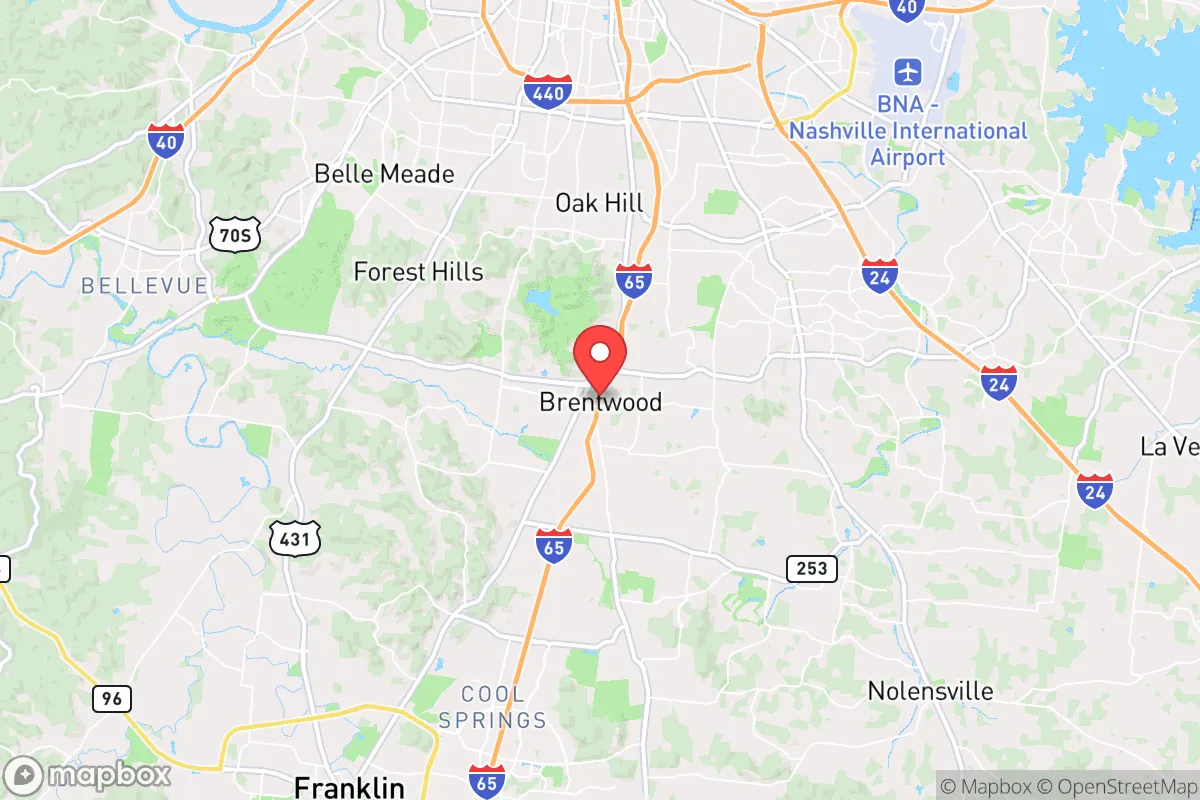
Personal Sovereignty in Brentwood, TN
Viable for self-reliance. Generally workable, though some barriers may limit total independence.
What does Personal Sovereignty tell us?
Personal Sovereignty measures your capacity for self-reliance and independence with minimal government friction. Higher scores mean fewer barriers between you and the way you want to live... but it assumes you have the space you need and good neighbors.
What does this tell us?
Personal Sovereignty measures your capacity for self-reliance and independence with minimal government friction. Higher scores mean fewer barriers between you and the way you want to live... but it assumes you have the space you need and good neighbors.
State Policy
Energy independence: Importer (25% of energy produced in-state)
Personal Liberty
Homesteading

Personal Liberty Analysis
Brentwood, Tennessee, offers one of the strongest personal sovereignty environments in the Southeast, anchored by Tennessee’s absence of a state income tax and a firmly established culture of self-reliance. For individuals and families weighing relocation, the city combines affluent Williamson County’s low regulatory footprint with state-level protections for gun owners, parents, and property holders. The practical question is not whether autonomy exists here, but how far you can push it within a master-planned, high-HOA suburb that sits just south of Nashville’s urban core.
Tax burden and regulatory posture: how light is the touch?
Tennessee’s fiscal structure is the single biggest lever for personal sovereignty in Brentwood. The state levies no personal income tax on wages, and the Hall Income Tax on dividends and interest was fully repealed in 2021, meaning the state takes nothing directly from your earnings. The trade-off is a reliance on consumption and property taxes: the state sales tax rate is 7%, with Williamson County adding roughly 2.25% to 2.75%, landing a combined rate near 9.75% depending on the exact address. Property taxes are comparatively modest — Williamson County’s rate hovers around $2.15 per $100 of assessed value, and Brentwood’s municipal portion adds a small increment, keeping the effective rate well below what you would face in Nashville-Davidson County or most Illinois or California suburbs.
Regulatory posture at the state level is deliberately light-touch. Tennessee is a right-to-work state, has no state-level occupational licensing for dozens of common trades, and preempts local governments from enacting their own minimum wage or paid leave mandates. In Brentwood specifically, the city operates under a home-rule charter but leans conservative on land use: zoning is enforced, and the city’s planning commission has historically favored large-lot single-family development over dense mixed-use projects. That means fewer surprises from new apartment blocks or commercial encroachment, but it also means you cannot simply do whatever you want with your property — the city’s design review board has real authority over exterior changes in many neighborhoods.
Self-defense and gun law specifics: what can you legally do?
Tennessee is a constitutional carry state, and Brentwood sits squarely within that framework. Since 2021, any law-abiding adult 21 or older can carry a handgun openly or concealed without a permit. For those who want reciprocity when traveling, a Tennessee Enhanced Handgun Carry Permit requires an eight-hour course and a live-fire qualification, but it is not required for in-state carry. The state also has a strong Castle Doctrine statute — Tennessee Code § 39-11-611 — which creates a legal presumption that a person using force against an unlawful intruder in their home, vehicle, or place of business had a reasonable fear of death or serious bodily injury. There is no duty to retreat in any place where you are lawfully present.
Brentwood itself is a low-crime jurisdiction — the city’s violent crime rate is consistently a fraction of the national average — but the legal environment treats self-defense as a right, not a privilege. One practical note: Brentwood is a wealthy, heavily policed suburb, and officers here are professional but proactive. If you carry, you are legally fine, but you should expect that a traffic stop or a noise complaint will involve a routine check of your permit status. The city also has a handful of sensitive-location restrictions — schools, government buildings, and the like — that mirror state law, so know the prohibited zones before you carry into the Williamson County courthouse or a local school event.
Self-reliance and homesteading viability: lot sizes, zoning, and off-grid feasibility
This is where Brentwood’s suburban character creates real tension with the homesteading ideal. The city’s zoning code mandates minimum lot sizes that are generous by national standards — most residential districts require one to three acres per home, and some estate zones require five acres or more. That gives you room for a substantial garden, a workshop, or a small orchard. But Brentwood is not rural Williamson County; the city has strict rules on accessory structures, and the HOA covenants that govern most neighborhoods add another layer of approval for anything visible from the street. A chicken coop is generally fine on a one-acre lot, but a full-scale livestock operation or a detached metal workshop may require a conditional-use permit and neighbor sign-off.
Off-grid feasibility is limited. The city requires connection to municipal water and sewer in most areas, and solar panel installations must comply with the design review board’s aesthetic guidelines — ground-mounted arrays are often restricted in favor of roof-mounted systems. Rainwater harvesting is legal and even encouraged by state law, but Brentwood’s building code requires a professional engineer’s stamp for any cistern over 500 gallons. If your vision of self-reliance is a fully independent homestead with well water, septic, and solar, you will find that vision far more achievable in the unincorporated parts of Williamson County or neighboring Hickman County, where zoning is minimal and utility hookups are optional. In Brentwood, self-reliance means growing your own vegetables and generating your own power within a framework that still expects you to be a connected, taxed, and regulated resident.
Personal liberties: parental rights, medical autonomy, speech, and property
Tennessee has moved decisively in recent years on parental rights and medical autonomy. The state’s 2023 “Parents’ Bill of Rights” gives parents explicit authority over their children’s education, healthcare decisions, and school records, and it requires schools to notify parents before any medical or mental-health screening. Tennessee also has no state-level mandate for childhood vaccines, and while schools may require certain immunizations for attendance, the state allows broad medical and religious exemptions. On medical autonomy, Tennessee is a direct-democracy outlier: the state has no general sales tax on groceries, but it also has no state-level protection for abortion access — the 2020 “Heartbeat Law” bans most procedures after roughly six weeks, with narrow exceptions. For adults seeking elective procedures, the state does not require a prescription for most over-the-counter medications, and telehealth access is broad.
Speech and property rights are strongly protected. Tennessee is one of the few states with an explicit constitutional amendment protecting the right to record law enforcement in public, and the state has no anti-SLAPP statute, but its defamation standards are plaintiff-friendly. Property rights are reinforced by the state’s 2014 “Property Protection Act,” which requires government agencies to prove a compelling interest before taking land via eminent domain for private development. In Brentwood, the practical effect is that your home and land are about as secure from government seizure as anywhere in the country. The city’s zoning and HOA structure does limit your freedom to modify your property, but that is a contractual choice you make at purchase, not a state-imposed restriction.
Compared to the rest of the country, Brentwood ranks in the top tier for personal sovereignty. The absence of state income tax, constitutional carry, strong Castle Doctrine protections, and explicit parental rights statutes put it ahead of most coastal and Midwestern jurisdictions. The trade-offs are real but narrow: you trade the raw freedom of rural Tennessee for the safety, schools, and infrastructure of an affluent suburb, and you accept that HOAs and design review boards will have a say in your property’s appearance. For a single professional or a family that wants maximum legal autonomy without sacrificing schools and low crime, Brentwood is about as good as it gets in the Southeast. If your priority is true off-grid independence, look twenty miles west — but for personal sovereignty within a functioning, prosperous community, this is a top-tier choice.

* Values derived from national, state, county, city and local statistics and may differ in a specific area. Last updated: 2026-10-12T01:16:51.000Z
Narrative content on this page is AI-generated and may contain mistakes. Verify any details that matter before acting on them.
ReloMaps may earn a commission from affiliate links at no extra cost to you.

