 Popular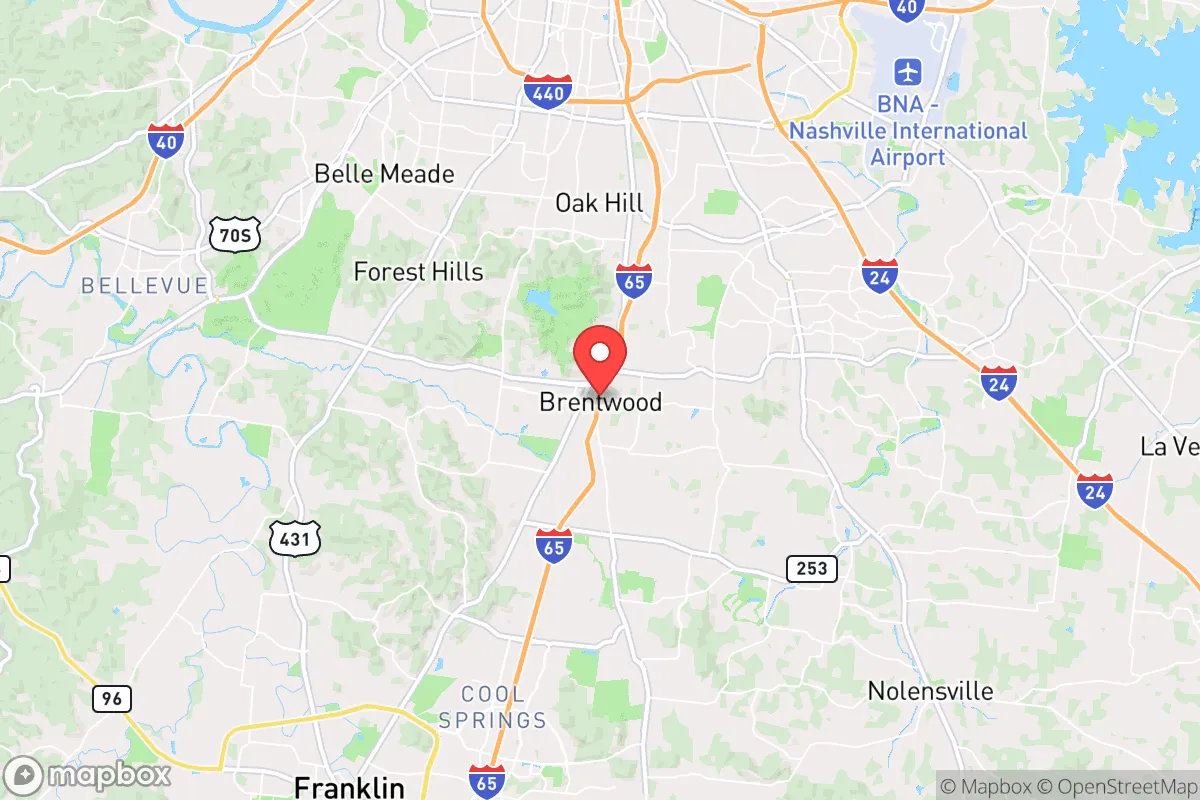
Political ClimatePolitical Climate in Brentwood, TN
District shown is the primary district for this city’s centroid. Cities may span multiple districts.
Local Political AnalysisPolitical Analysis of Brentwood, TN
Brentwood is a deep blue island in a deep red state. With a Cook PVI of D+23, the city is one of the most reliably Democratic-leaning communities in Tennessee, which itself carries a solid R+13 rating. That’s a 36-point gap between the city and the state — a political chasm you can feel the moment you cross the county line into Williamson County’s more rural precincts or drive 20 minutes south to Franklin, where the politics are more purple. Brentwood’s trajectory has been steadily leftward for the past decade, driven by an influx of highly educated professionals from out of state, many of whom work in healthcare, tech, or finance and bring national-party voting habits with them.
How it compares
To understand Brentwood’s politics, you have to look at its neighbors. Franklin, just to the south, leans Republican but is more moderate than the state average — think R+5 or so. The unincorporated parts of Williamson County, especially around College Grove and Thompson’s Station, vote heavily Republican, often R+20 or more. Meanwhile, Nashville’s Davidson County, which borders Brentwood to the north, is also D+23, making Brentwood politically more akin to a Nashville suburb than a typical Tennessee exurb. The contrast is stark: a Brentwood voter is about as likely to vote for a Democrat as a voter in downtown Nashville, while a voter in nearby Nolensville or Spring Hill is far more likely to back a Republican. This split means Brentwood residents often find themselves at odds with their own county commission and state legislature, which are dominated by Republicans. The city’s federal representation — in Tennessee’s 5th Congressional District — is currently held by a Democrat, but the district was redrawn in 2022 to be more competitive, and the seat flipped to Republican in 2024. That’s the reality: Brentwood’s local voice is blue, but the state’s is red, and the tension is real.
What this means for residents
For liberal residents, Brentwood is a comfortable bubble. You can live, work, and socialize in an environment where your politics are the norm, not the exception. Local schools and city government tend to reflect progressive priorities — think robust funding for public education, green space preservation, and inclusive community events. But when it comes to state-level issues like abortion access, gun laws, or education vouchers, Brentwood liberals are on the losing side of every major vote in Nashville. For conservative residents, the dynamic is reversed. You’ll be in the minority in your own neighborhood, but you’ll see your values reflected in state law and county policy. Many longtime conservative families have adapted by focusing on local issues — school board races, zoning decisions — where their votes carry more weight. The practical outcome is a community that’s politically polarized but generally civil; people don’t argue about politics at the grocery store, but they know where their neighbors stand.
Culturally, Brentwood’s blue lean shows up in subtle ways. The city’s farmers markets, bookstores, and coffee shops have a distinctly progressive vibe, and you’ll see more Harris-Walz yard signs than Trump-Pence ones in most subdivisions. But the state’s conservative tilt means that policy fights — over library books, drag shows, or COVID mandates — occasionally flare up, especially during election cycles. Looking ahead, Brentwood’s trajectory seems locked in: as long as the city continues to attract out-of-state professionals, its Democratic lean will likely hold or even deepen. But the state as a whole is moving right, so the gap between Brentwood and Tennessee will probably widen, making the city an even more distinct political outlier in the years to come.

State Political ClimatePolitical Climate in Tennessee
State Political AnalysisPolitical Environment in the State
Tennessee has been a reliably Republican state for two decades, with a Cook PVI of R+13, meaning it votes about 13 points more Republican than the nation as a whole. The state’s current political reality is defined by a dominant GOP trifecta in Nashville, a deep urban-rural split, and a policy agenda that has moved steadily rightward since the mid-2010s. For a relocator, the practical takeaway is that you are moving into a state where conservative governance is the default, but the character of that conservatism varies dramatically depending on whether you land in Memphis, Nashville, or a small town in East Tennessee.
Urban vs. rural divide
The political map of Tennessee is a study in stark contrasts. The four major metros — Memphis, Nashville, Knoxville, and Chattanooga — anchor the state’s Democratic vote, but they do so with very different intensities. Shelby County, home to Memphis, is the bluest large county in the state, routinely delivering 65-70% of its vote to Democratic candidates; it is the last true stronghold of the old Southern Democratic coalition, heavily African American and union-influenced. Davidson County (Nashville) has become the state’s progressive engine, with a fast-growing, college-educated population that has turned it into a reliably blue island — though its politics are more tech-sector liberal than Memphis’s older civil-rights tradition. Knoxville and Chattanooga are more moderate; both have Democratic-leaning urban cores but are surrounded by deep-red suburbs and exurbs that make their congressional districts safely Republican.
Outside those metros, the state is overwhelmingly conservative. The Nashville suburbs — Williamson County (Franklin, Brentwood), Rutherford County (Murfreesboro), and Wilson County (Lebanon) — are among the most Republican suburban areas in the country, with Williamson County routinely voting 70%+ GOP. East Tennessee, anchored by the Tri-Cities (Johnson City, Kingsport, Bristol) and stretching down to the Smokies, is the most culturally conservative region, with a strong Appalachian identity and a history of Unionist sentiment that has evolved into rock-ribbed Republicanism. The rural western counties along the Mississippi River, like Dyer and Obion, are also deeply red, though they share economic concerns with Memphis that sometimes create strange political bedfellows on issues like agriculture and infrastructure.
Policy environment
Tennessee’s policy environment is defined by three pillars: no state income tax, a right-to-work labor law, and a regulatory posture that favors business. The state has no personal income tax on wages (only a 1% tax on interest and dividend income, which is being phased out), and its sales tax is among the highest in the nation at 7% base, with local options pushing it to nearly 10% in some counties. This structure is regressive — lower-income residents pay a higher effective rate — but it is a major draw for high earners and retirees from high-tax states like California and Illinois.
Education policy is a flashpoint. Tennessee was an early adopter of charter schools and has a robust school-choice movement, but it has also seen bitter fights over vouchers and curriculum. The state passed a law in 2021 banning the teaching of critical race theory in K-12 classrooms, and in 2024 it enacted a sweeping parental-rights law that requires schools to notify parents of any curriculum changes and gives them the right to opt their children out of sex education. Higher education remains a mixed bag: the University of Tennessee system is a major research institution, but the state has also moved to restrict tenure and diversity programs at public universities, a trend that accelerated after the 2024 election.
Healthcare is where Tennessee is most distinctive. The state has not expanded Medicaid under the Affordable Care Act, leaving roughly 300,000 residents in the coverage gap. Instead, it has pursued a block-grant waiver for its Medicaid program (TennCare) and has leaned into deregulation, allowing nurse practitioners and physician assistants to practice with less physician oversight. The state also has a strict abortion ban — a near-total prohibition with narrow exceptions — that took effect after the Dobbs decision in 2022.
Recent policy direction
The last five years have seen Tennessee move decisively on several fronts that matter to relocators weighing personal liberty and government power. On guns, the state became a constitutional-carry state in 2021, allowing any adult who can legally possess a firearm to carry it without a permit. That same year, it passed a law designating Tennessee a “Second Amendment Sanctuary State,” prohibiting state and local agencies from enforcing federal gun laws that the legislature deems unconstitutional. On education and parental rights, the 2024 “Parental Bill of Rights” (SB 2440) requires schools to post all curriculum materials online, mandates parental consent for any student participation in surveys about mental health or sexuality, and creates a private right of action for parents to sue districts that violate the law.
On speech and privacy, Tennessee has been a leader in the conservative movement to regulate social media. The 2024 “Protecting Children from Social Media Act” requires age verification for platforms and gives parents the right to sue companies that fail to comply. The state has also passed a law banning TikTok on government devices and has joined multi-state lawsuits against the Biden administration’s social media moderation policies. On medical and bodily autonomy, the abortion ban is the headline, but the state has also restricted gender-affirming care for minors, banned transgender athletes from female school sports, and passed a law allowing medical providers to refuse procedures on religious or moral grounds. Property rights have been strengthened with a 2023 law that limits the use of eminent domain for private economic development, and the state has moved to preempt local zoning and environmental regulations that conflict with state policy.
On voting and ballot access, Tennessee has tightened its laws: it requires a photo ID to vote, has strict voter-purge procedures, and in 2023 created a new Election Integrity Unit within the Secretary of State’s office to investigate alleged fraud. The state also moved to a closed primary system for Republican voters in 2024, meaning only registered Republicans can vote in GOP primaries — a change that has shifted the center of gravity in state politics further right.
Civil unrest & political movements
Tennessee has seen its share of political flashpoints in recent years. The most visible was the 2023 expulsion of two Black Democratic state legislators — Justin Jones and Justin Pearson — from the House for participating in a gun-control protest on the chamber floor after the Covenant School shooting in Nashville. The expulsions made national news and galvanized progressive organizing in the state, but they also energized the conservative base, which saw the action as a defense of legislative order. The Covenant shooting itself — a mass shooting at a private Christian school in a wealthy Nashville neighborhood — became a defining moment, pitting the state’s gun-friendly posture against the grief of an affluent, politically mixed community.
Immigration politics have been comparatively quiet, but the state has passed laws requiring local law enforcement to cooperate with federal immigration authorities and banning sanctuary-city policies. There is no serious secession or nullification movement in Tennessee, though the Second Amendment Sanctuary law is a form of nullification rhetoric that resonates in rural areas. The state has also been a battleground over election integrity: the 2020 election saw baseless claims of fraud in Shelby County, and the state’s 2024 voter-purge efforts drew lawsuits from civil-rights groups alleging disenfranchisement of minority voters.
Projection
Over the next five to ten years, Tennessee is likely to become more, not less, Republican at the state level, even as its metros grow more liberal. The in-migration pattern — driven by no income tax, lower housing costs, and a business-friendly climate — is bringing in a mix of conservative retirees and remote workers, but the net effect is reinforcing the GOP majority. The state’s population is projected to grow fastest in the Nashville and Knoxville exurbs, which are solidly Republican, while the rural west continues to lose population. The Democratic vote will become increasingly concentrated in Memphis and Nashville, making the state’s two major cities more progressive but less influential in statewide races. Expect continued movement on school choice, further deregulation of healthcare, and more preemption of local ordinances — particularly around housing and zoning, where the state has already shown a willingness to override Nashville’s land-use decisions.
Bottom line for a new resident
If you are moving to Tennessee, the practical reality is straightforward: you will live in a state where conservative governance is the norm, and your experience will vary sharply by location. In Nashville or Memphis, you will find a vibrant liberal community, but you will also see the limits of local power — the state legislature will override your city council on issues from gun control to mask mandates. In the suburbs and rural areas, you will find a deep-rooted conservative culture that is welcoming to newcomers who share its values and wary of those who do not. The tax structure is genuinely favorable for high earners and retirees, but you will pay for it with higher sales taxes and fewer public services. The state is safe, growing, and politically stable, but it is not a place of political ambiguity — you will know where you stand, and so will your neighbors.
* Values derived from national, state, county, city and local statistics and may differ in a specific area. Last updated: 2026-10-12T01:16:51.000Z
Narrative content on this page is AI-generated and may contain mistakes. Verify any details that matter before acting on them.
ReloMaps may earn a commission from affiliate links at no extra cost to you.

