 Popular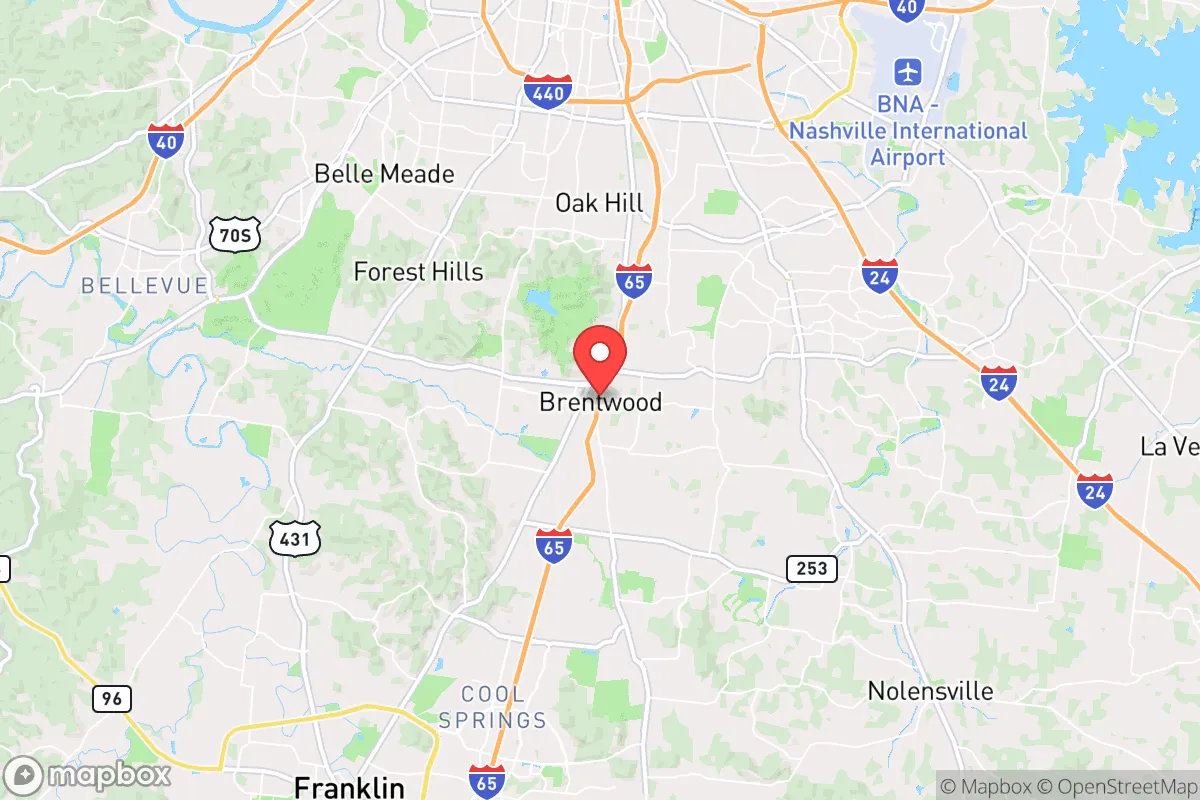
Strategic Assessment of Brentwood, TN
Multiple tactical vulnerabilities. Population density, target proximity, or disaster risk are likely compounding. A retreat property and exit planning is required.
What does the Strategic Assessment tell us?
Our Strategic Assessment grades tactical survivability of an area. Major population centers, military targets, fallout zones, natural disasters, and border exposure all drive risk — lower exposure means a more defensible position in a crisis.
This is heavily inspired by Joel Skousen's Strategic Relocation book. Highly recommended you checkout the book ($)What does this tell us?
Our Strategic Assessment grades tactical survivability of an area. Major population centers, military targets, fallout zones, natural disasters, and border exposure all drive risk — lower exposure means a more defensible position in a crisis.
This is heavily inspired by Joel Skousen's Strategic Relocation book. Highly recommended you checkout the book ($)Strategic Pillars

Key Distances
Regional Safe Places
Below is our recommended "safe zones" in Tennessee and the surrounding area based on our strategic heuristics. For most people, it's unrealistic to live in a “safe zone” full-time due to work, family or other personal reasons. They tend to be more rural. However, many of these areas are perfect for second homes and retreat properties that double as a vacation home or even a short-term rental.
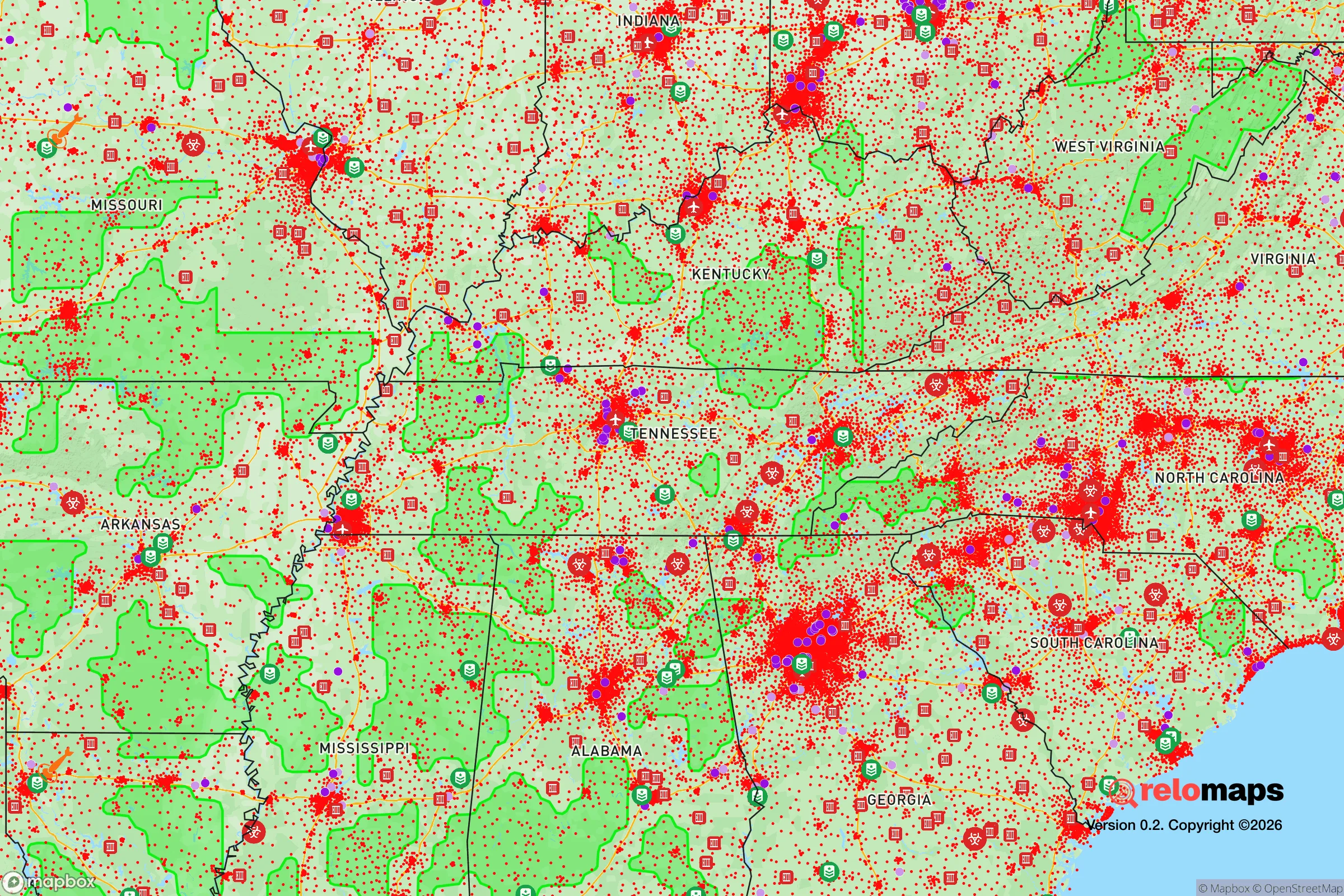
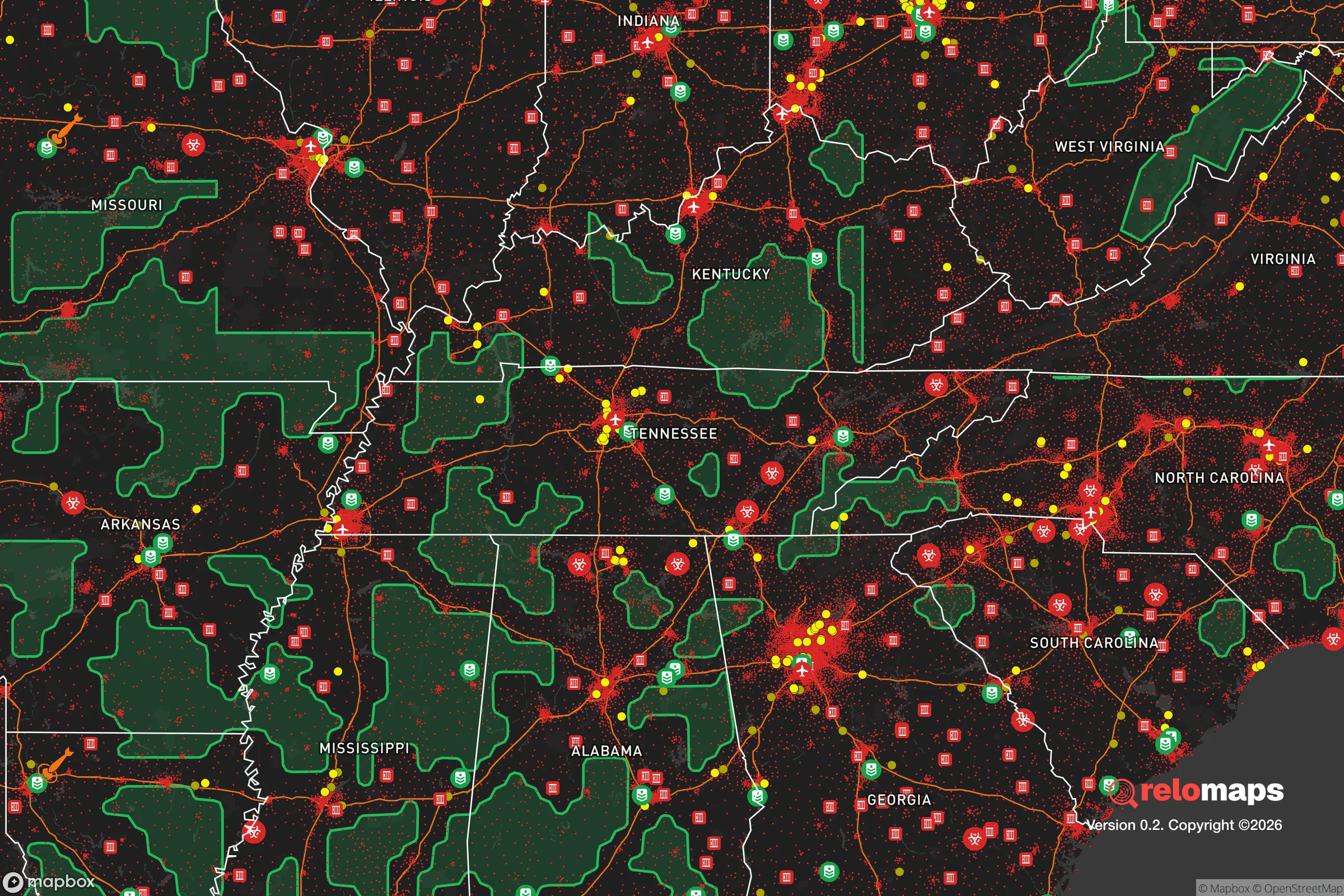


Important Note: For informational purposes only. This does not mean nothing bad ever happens in the green zones. Please use common sense. This is based on public data and modeled with AI. We tried to take a conservative approach but mistakes happen. We update this regularly as new information becomes available.
Solar Generator Recommendations
Backup power matters more here than in safer locations. We've picked three solar generators across budgets and capacity tiers — start with the budget unit if you only need a few essentials, or step up if you want to run a fridge and HVAC for days at a time.

Jackery Portable Power Station Explorer 300
Budget OptionPower on the Go: Weighing only 11 lbs, it's convenient to set up and store with book-sized foldable solar panels

BLUETTI Portable Power Station AC180
Designed for both indoor and outdoor scenarios, AC180 is highly capable as it has a robost capacity and continuous output power.

EF ECOFLOW DELTA Pro Ultra Power Station
Upgraded PickEcoFlow DELTA Pro Ultra is a whole-home energy system designed to grow with your family. Integrated with the Smart Home Panel 2, it scales to meet your evolving energy needs — keeping your home powered, intelligent, and secure through every stage of life.
We earn a commission, at no additional cost to you.
Strategic Assessment Analysis
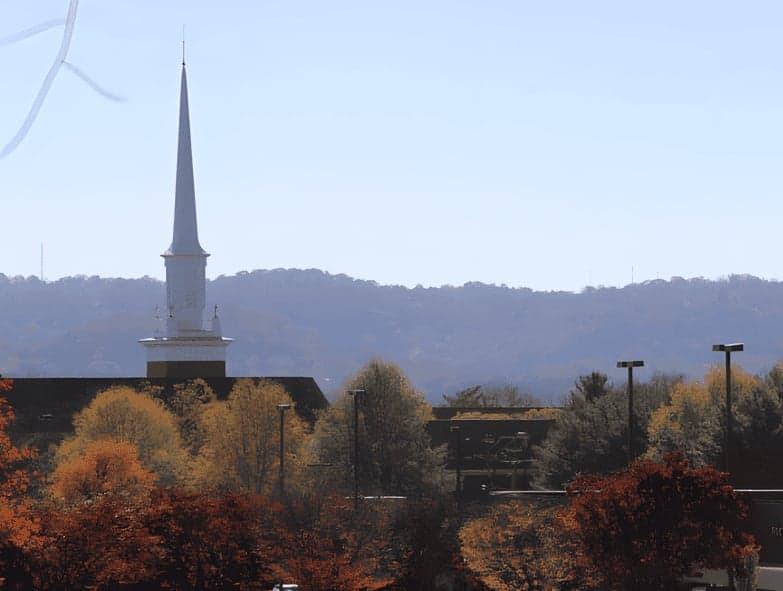
Brentwood, Tennessee, occupies a strategic position that balances proximity to a major metropolitan hub with the practical advantages of a suburban environment, making it a noteworthy consideration for relocation-minded individuals and families who prioritize disaster readiness and self-sufficiency. Located roughly 15 miles south of downtown Nashville, the city sits on the Highland Rim, a plateau that provides natural elevation advantages over the flood-prone Cumberland River basin to the north. For the preparedness-minded reader, Brentwood offers a compelling mix of access to regional resources and a built environment that, while not rural, can be leveraged for resilience with intentional planning.
Geographic position and natural advantages for preparedness
Brentwood’s location on the Highland Rim gives it a meaningful elevation advantage—typically 200 to 400 feet higher than downtown Nashville—which reduces exposure to riverine flooding and storm surge from the Cumberland River. The area’s underlying geology is primarily limestone and shale, with well-drained soils that support stable building foundations and reduce landslide risk compared to steeper terrain in East Tennessee. The city’s position in Williamson County places it within a region that experiences fewer tornado touchdowns than the traditional "Dixie Alley" corridor further west, though severe thunderstorms and occasional EF-0 to EF-2 tornadoes remain a realistic hazard. The local climate is humid subtropical, with hot summers and mild winters, which means freeze-related infrastructure failures are rare, and year-round outdoor activity for self-sufficiency projects is feasible. The natural landscape includes extensive hardwood forests and rolling hills, which provide some natural screening and noise buffering from the Interstate 65 corridor that bisects the city. For a relocator, these features mean that Brentwood offers a defensible terrain with good drainage, moderate seismic stability, and a climate that supports extended growing seasons for food production.
Risks, exposures, and proximity to fallout-relevant landmarks
The most significant risk for Brentwood in a disaster-readiness context is its proximity to Nashville, a major population center and a potential target for man-made threats. Nashville is home to critical infrastructure including the Tennessee Valley Authority’s Cumberland Fossil Plant (about 40 miles northwest), the Nashville International Airport (BNA), and multiple interstate highway junctions (I-40, I-65, I-24) that could become chokepoints during evacuation or supply disruptions. The city also lies within 60 miles of the Oak Ridge National Laboratory and the Y-12 National Security Complex, a nuclear weapons facility that, while well-guarded, represents a potential fallout source in a worst-case scenario. Brentwood’s position directly along I-65 means that any large-scale evacuation from Nashville would funnel traffic through the city, potentially creating gridlock and complicating self-sufficient relocation. Additionally, the area’s high property values and dense suburban development mean that population density is moderate but not low—roughly 1,200 people per square mile—which reduces the ability to maintain operational security or avoid resource competition during a prolonged crisis. The city’s reliance on the electrical grid, natural gas pipelines, and municipal water systems means that a regional power outage or cyberattack could disrupt daily life quickly, as most homes lack backup systems by default. For the preparedness-minded relocator, these factors underscore the need for a robust personal plan that accounts for potential evacuation routes away from Nashville, preferably south toward the less densely populated areas of southern Williamson County or adjacent Maury County.
Practical resilience for a relocator: food, water, energy, and defensibility
Brentwood’s suburban character presents both opportunities and challenges for practical self-sufficiency. The city’s zoning allows for backyard gardens and small livestock (chickens are permitted on lots of one acre or more, which covers many properties in the city’s eastern and southern sections), and the growing season runs from April to October, enabling two crop cycles for staples like tomatoes, beans, and squash. Local farmers’ markets, such as the Brentwood Farmers Market (seasonal, at the Brentwood Library), provide access to fresh produce and networking with regional growers, but reliance on these sources during a disruption would be limited. Water resilience is a critical concern: Brentwood’s municipal water comes from the Harpeth River and the Cumberland River via the Nashville Water System, both of which are vulnerable to contamination or supply interruption. Private wells are uncommon within city limits, so a relocator should plan for rainwater catchment (the area averages 50 inches of rainfall annually, which is above the national average) or storage of at least 14 gallons per person per day for two weeks as a baseline. Energy resilience is moderately achievable: solar panel installations are growing in the area, with net metering available through the local utility (Middle Tennessee Electric), but most homes are grid-tied without battery backup. Natural gas is widely available for heating and cooking, which provides a backup option if the electrical grid fails, but gas pipelines are themselves vulnerable to seismic or sabotage events. Defensibility is mixed: Brentwood’s layout features winding roads, cul-de-sacs, and wooded lots that create natural chokepoints and reduce through-traffic in residential neighborhoods, which is favorable for perimeter security. However, the city’s proximity to I-65 and multiple major arterials (Franklin Road, Concord Road, Moores Lane) means that a determined group could approach from multiple directions, and the lack of natural barriers like rivers or steep ridges on the city’s western side reduces tactical advantage. For a family, the best approach is to select a home on a larger lot (one acre or more) in the eastern or southern parts of the city, near the Williamson County line, where tree cover and lower density improve both water catchment potential and visual screening.
Overall, Brentwood presents a balanced strategic picture for the disaster-readiness relocator: it offers genuine natural advantages in elevation, climate, and terrain, but these are offset by its proximity to Nashville’s critical infrastructure and the inherent vulnerabilities of suburban density. The city is not a remote survivalist retreat, but it can be made resilient with deliberate investment in water storage, solar backup, and food production capacity. For a family or individual who wants to stay within commuting distance of Nashville’s economy while maintaining a credible self-sufficiency posture, Brentwood is a viable option—provided they treat preparedness as an ongoing project rather than a one-time purchase. The key takeaway is that Brentwood’s resilience is conditional: it works well for those who are proactive, but it offers little margin for those who assume the suburban infrastructure will always function.

* Values derived from national, state, county, city and local statistics and may differ in a specific area. Last updated: 2026-10-12T01:16:51.000Z
Narrative content on this page is AI-generated and may contain mistakes. Verify any details that matter before acting on them.
ReloMaps may earn a commission from affiliate links at no extra cost to you.

