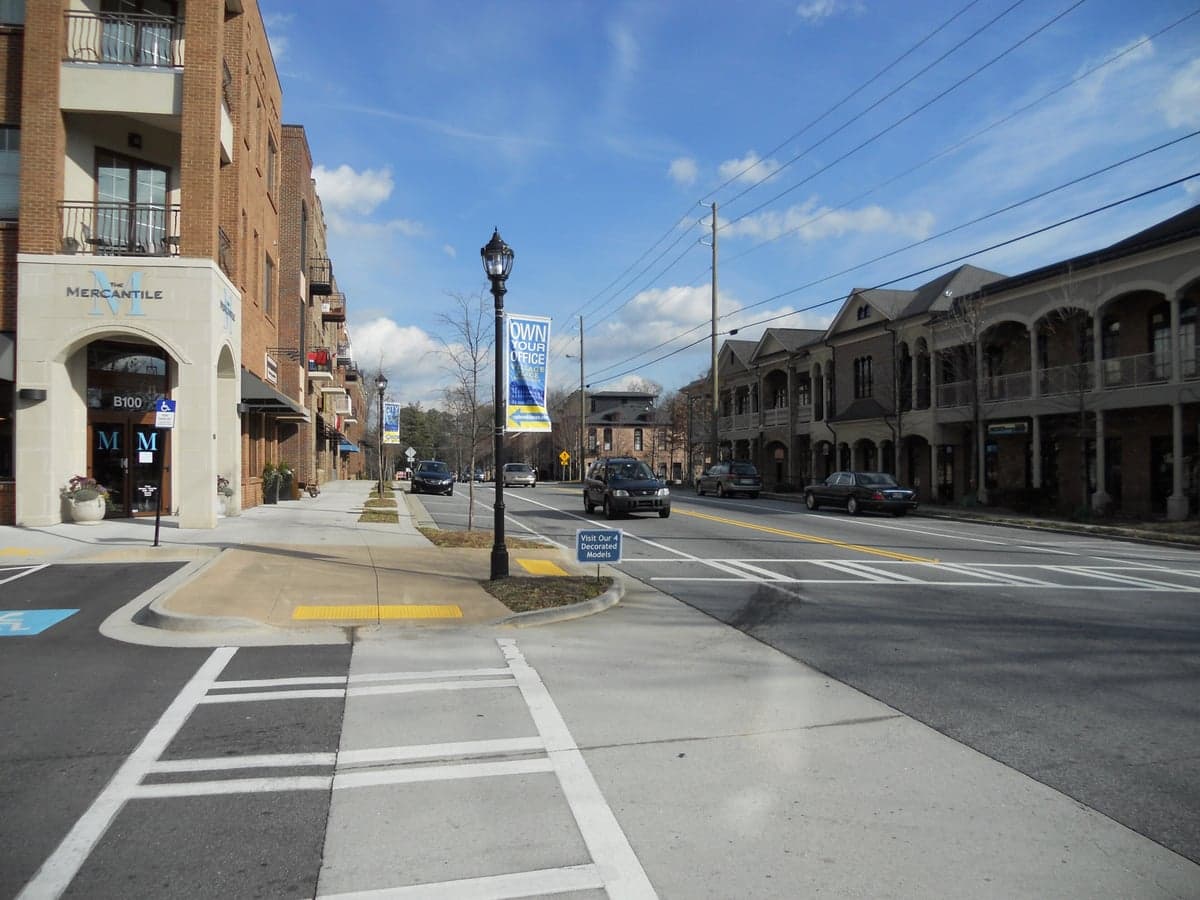
Photo: Wikipedia
Personal Sovereignty in Brookhaven, GA
Viable for self-reliance. Generally workable, though some barriers may limit total independence.
What does Personal Sovereignty tell us?
Personal Sovereignty measures your capacity for self-reliance and independence with minimal government friction. Higher scores mean fewer barriers between you and the way you want to live... but it assumes you have the space you need and good neighbors.
What does this tell us?
Personal Sovereignty measures your capacity for self-reliance and independence with minimal government friction. Higher scores mean fewer barriers between you and the way you want to live... but it assumes you have the space you need and good neighbors.
State Policy
Energy independence: Importer (12% of energy produced in-state)
Personal Liberty
Homesteading

Personal Liberty Analysis
For a conservative-leaning individual or family prioritizing personal sovereignty, Brookhaven, Georgia presents a mixed picture that requires careful calibration. While Georgia’s state-level legal framework offers significant advantages—including a constitutional carry law, a right-to-work environment, and relatively low property taxes—Brookhaven itself operates under a city government that has shown a willingness to layer on local regulations, from tree ordinances to short-term rental restrictions, that can feel like creeping overreach. The net effect is that you get a solid baseline of state-protected autonomy, but you must remain vigilant about local ordinances that can nibble away at your freedom to use your property as you see fit. This analysis breaks down the key sovereignty factors for a prepper-minded reader.
Tax burden and regulatory posture in Brookhaven compared to surrounding areas
Georgia’s state income tax is a flat 5.49%, which is moderate but not negligible, and there is no state-level estate or inheritance tax—a clear win for wealth preservation. Property taxes in DeKalb County, where Brookhaven sits, are higher than in many neighboring counties, with a millage rate around 22 mills for the county portion plus city taxes. This means a $400,000 home could carry an annual tax bill of roughly $4,500 to $5,000, which is noticeably steeper than in, say, Cherokee or Forsyth counties to the north. The regulatory posture in Brookhaven is more interventionist than in unincorporated areas of DeKalb or in smaller towns. The city has a robust code enforcement division that actively pursues violations related to grass height, inoperable vehicles, and property maintenance. For a prepper who wants to store supplies, keep a backup vehicle, or let a section of yard go wild for privacy, this can be a source of friction. The city also has a tree protection ordinance that restricts removal of trees over a certain diameter without a permit, which could complicate plans for solar panel installation or building a secure outbuilding. On the plus side, Georgia is a right-to-work state, meaning you cannot be forced to join a union as a condition of employment, and there is no state-level rent control, giving property owners more freedom in managing their investments.
Self-defense rights and gun law specifics in Georgia’s legal framework
Georgia is a strong Second Amendment state, and this is where Brookhaven benefits most from state preemption. Since 2022, Georgia has been a constitutional carry state, meaning any legal resident 21 or older can carry a concealed handgun without a permit. This is a non-negotiable advantage for personal sovereignty. There is no state-level red flag law, no magazine capacity restrictions, and no universal background checks beyond federal requirements. However, Brookhaven is in DeKalb County, which has a history of more progressive local governance. While state law preempts local gun ordinances, DeKalb County has attempted to pass symbolic resolutions in the past that signal a hostile attitude toward gun rights. The practical effect is minimal—you can still carry and own standard firearms—but the cultural environment in Brookhaven’s city hall may not be as supportive as in more rural parts of the state. For a prepper, this means you should be aware that local law enforcement attitudes may vary, and it is wise to keep a low profile with any defensive firearms. Stand-your-ground laws are fully in effect in Georgia, meaning you have no duty to retreat before using deadly force if you are lawfully present and believe it is necessary to prevent death or great bodily harm. This is a critical legal protection for anyone serious about self-defense.
Self-reliance and homesteading viability: lot sizes, zoning, and off-grid feasibility
This is the weakest category for Brookhaven. The city is a densely developed inner-ring suburb of Atlanta, with most residential lots ranging from one-quarter to one-half acre. Zoning is strict, and the city’s code explicitly prohibits keeping livestock, including chickens, in most residential zones. There are no provisions for beekeeping or small-scale agriculture within city limits. For a prepper looking to establish any kind of food sovereignty—raising meat, growing a substantial garden, or storing rainwater—Brookhaven is a poor fit. The city’s water and sewer systems are municipally managed, and there is no legal pathway to go fully off-grid with septic or well water. Solar panels are allowed but subject to the tree ordinance and homeowner association restrictions in many neighborhoods. The reality is that Brookhaven is designed for suburban convenience, not self-reliance. If homesteading is a priority, you would need to look at properties in unincorporated DeKalb County or neighboring Gwinnett County, where lot sizes are larger and zoning is more permissive. For a single individual or family who wants the security of a suburban home but is willing to rely on stockpiling and community networks rather than land-based self-sufficiency, Brookhaven can still work—but you will be dependent on the grid and supply chains.
Personal liberties: parental rights, medical autonomy, speech, and property
Georgia has strong parental rights protections under state law, including a statute that affirms parents’ fundamental right to direct the upbringing, education, and care of their children. This means that in Brookhaven, parents have legal backing to opt their children out of school curricula they find objectionable, and to make medical decisions without state interference. The state does not have a vaccine mandate for school attendance, though individual school districts may have policies that require certain immunizations. Medical autonomy is generally respected, with no state-level forced treatment laws for adults, though the COVID-era emergency orders in DeKalb County were more restrictive than in many other parts of Georgia. Free speech is protected under the First Amendment, and Georgia has no state-level law that criminalizes offensive speech, though local governments can regulate time, place, and manner of protests. Property rights are where Brookhaven’s local governance becomes most intrusive. The city has a rental registration program that requires landlords to register units and pay a fee, which is a form of government oversight that many conservatives view as overreach. There are also strict noise ordinances and a ban on parking commercial vehicles in residential driveways, which can affect those who run home-based businesses or own work trucks. For a prepper who values the ability to use their property without bureaucratic permission slips, these local rules are a significant downside.
Overall, Brookhaven offers a decent baseline of personal sovereignty thanks to Georgia’s state-level protections on guns, taxes, and parental rights, but it falls short for anyone seeking true self-reliance or minimal government interference. Compared to rural areas in north Georgia or even exurban counties like Paulding or Pickens, Brookhaven’s regulatory density and small lot sizes make it a less attractive option for a survivalist mindset. For a single individual or family who wants to live in a well-connected suburb with good schools and a strong legal framework for self-defense, it can work—but you will need to accept that your autonomy will be constrained by local ordinances and a more interventionist city government. If maximum sovereignty is your goal, you would be better served by looking at unincorporated areas or smaller towns where the regulatory footprint is lighter and the path to self-reliance is clearer.

* Values derived from national, state, county, city and local statistics and may differ in a specific area. Last updated: 2026-04-29T18:01:14.000Z
Narrative content on this page is AI-generated and may contain mistakes. Verify any details that matter before acting on them.
ReloMaps may earn a commission from affiliate links at no extra cost to you.

