
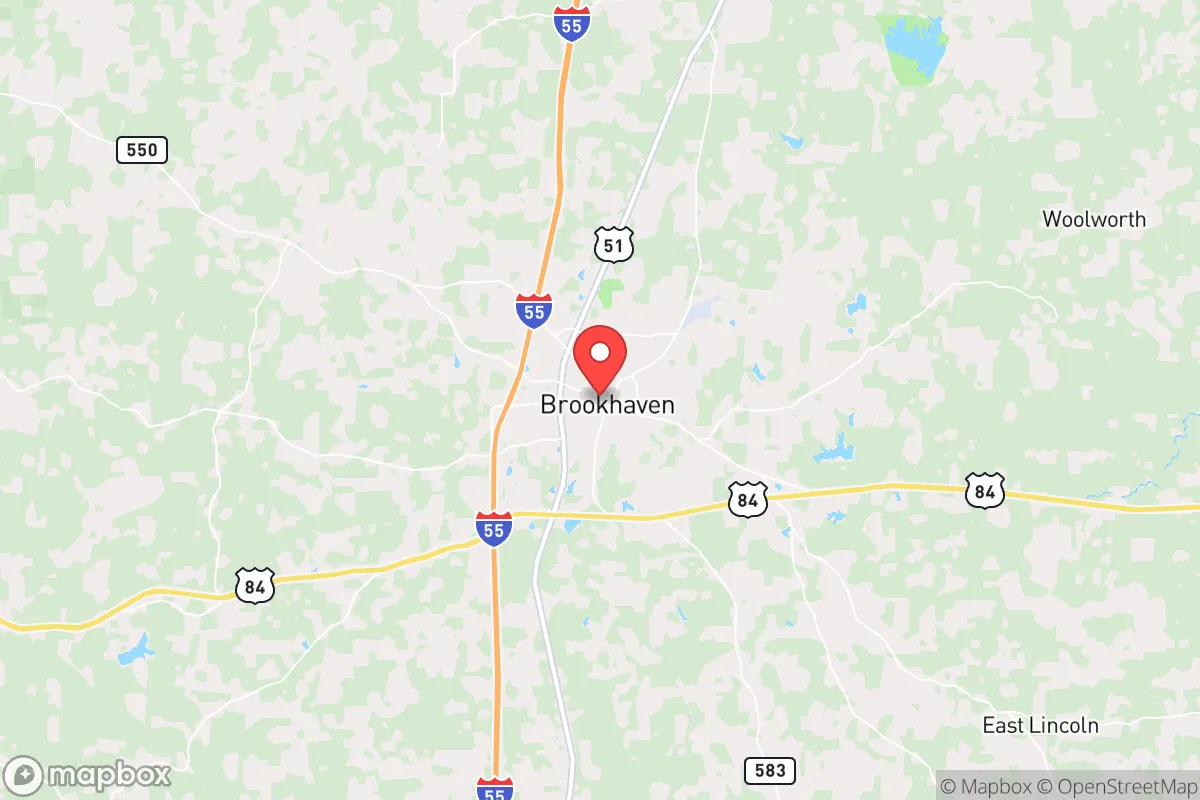
Photo: Wikipedia
Personal Sovereignty in Brookhaven, MS
Viable for self-reliance. Generally workable, though some barriers may limit total independence.
What does Personal Sovereignty tell us?
Personal Sovereignty measures your capacity for self-reliance and independence with minimal government friction. Higher scores mean fewer barriers between you and the way you want to live... but it assumes you have the space you need and good neighbors.
What does this tell us?
Personal Sovereignty measures your capacity for self-reliance and independence with minimal government friction. Higher scores mean fewer barriers between you and the way you want to live... but it assumes you have the space you need and good neighbors.
State Policy
Energy independence: Importer (50% of energy produced in-state)
Personal Liberty
Homesteading

Personal Liberty Analysis
Brookhaven, Mississippi, offers a personal sovereignty environment that is among the strongest in the South, largely because the state’s constitutional and statutory framework actively limits government overreach into daily life. For those who view autonomy as the ability to live, work, and defend oneself without bureaucratic interference, this town of roughly 12,000 in Lincoln County provides a practical baseline. Mississippi’s legal culture—rooted in a deep skepticism of federal mandates and a preference for local control—means that from tax policy to self-defense, the default answer is usually “yes, you can,” rather than “you need a permit or permission.” This isn’t a theoretical freedom; it’s embedded in the state’s tax code, property laws, and firearm statutes, making Brookhaven a viable option for individuals and families who prioritize self-reliance and want to minimize entanglements with state or federal agencies.
Tax burden and regulatory posture: how Mississippi law protects your income and property
Mississippi’s tax structure is deliberately designed to leave more money in your pocket, a critical factor for anyone seeking financial sovereignty. The state imposes a flat personal income tax rate of 4.0% on taxable income over $10,000, with the first $10,000 exempt—meaning a single filer earning $50,000 pays roughly $1,600 in state income tax. There is no state-level tax on Social Security benefits, and public and private pension income is fully exempt, which matters for long-term planning. Property taxes in Lincoln County are among the lowest in the nation: the average effective property tax rate hovers around 0.65% of assessed home value, compared to the national average of 1.1%. A $200,000 home in Brookhaven would incur roughly $1,300 annually in property taxes. Sales tax is 7.0% (state plus local), but groceries and prescription drugs are exempt. On the regulatory side, Mississippi is a right-to-work state with minimal occupational licensing burdens relative to coastal states. There are no state-level rent control laws, no statewide zoning mandates that override local discretion, and no state income tax on LLCs or S-corporations—just a flat 4.0% corporate income tax. For a prepper or survivalist, this means you can buy land, build a workshop, or start a side business without navigating a thicket of permits or facing a tax bill that punishes productivity. The state’s regulatory posture is best summed up by its “one-in, two-out” executive order on administrative rules, which requires agencies to eliminate two existing regulations for every new one proposed.
Self-defense and gun law specifics: what you can carry, where, and without what
Mississippi’s firearm laws are among the most permissive in the United States, and Brookhaven operates entirely within that framework. The state has constitutional carry—no permit required to carry a concealed handgun for anyone 21 or older who is legally allowed to possess a firearm. Open carry is also legal without a permit. There is no state-level requirement to register firearms, no waiting period for purchases, and no ban on any class of firearm, including AR-15s, standard-capacity magazines, or suppressors (though suppressors require a federal NFA tax stamp). Stand-your-ground laws are in full effect: there is no duty to retreat in any place where you are lawfully present, and the Castle Doctrine extends to your vehicle and place of business. Mississippi also has a “preemption” statute that prohibits local governments—including Brookhaven city council—from enacting any ordinance that restricts firearm possession, carry, or storage. This means no local magazine bans, no “safe storage” mandates, and no extra permitting layers. For a survivalist, the practical takeaway is that you can keep a loaded rifle in your truck, carry a concealed pistol while grocery shopping, and defend your home without worrying about a prosecutor second-guessing your decision to stand your ground. The state also recognizes lawful self-defense as an absolute bar to civil liability, meaning you cannot be sued by an attacker or their family for using force in a justified situation.
Self-reliance and homesteading viability: lot sizes, zoning, and off-grid feasibility
Brookhaven’s rural character and lax zoning make it a strong candidate for those seeking to live off-grid or operate a homestead. Within the city limits, residential lots typically range from one-quarter acre to one acre, but the unincorporated areas of Lincoln County—just a 10-minute drive from downtown—offer parcels from 2 to 40 acres at prices averaging $3,000 to $5,000 per acre. There is no county-wide zoning ordinance in Lincoln County; land use is governed primarily by subdivision regulations and septic system requirements from the Mississippi Department of Health. This means you can raise chickens, keep goats, or build a detached workshop without applying for a variance. Off-grid solar is legal and common: Mississippi has no state-level net metering requirement, but it also has no law prohibiting you from disconnecting from the grid entirely. Rainwater collection is unrestricted, and composting toilets are permitted under the state’s alternative onsite wastewater system rules. The city of Brookhaven does have a building code (based on the 2018 International Residential Code), but enforcement is limited to new construction and major renovations; existing structures are grandfathered. For a prepper, the key advantage is that you can buy a few acres, put in a well and septic, install solar panels, and build a pole barn without needing a dozen permits or facing a homeowners’ association that bans “unsightly” infrastructure. The local extension service at Mississippi State University also offers free soil testing and agricultural advice, which supports self-sufficiency in food production.
Personal liberties: parental rights, medical autonomy, speech, and property
Mississippi law explicitly protects several areas of personal liberty that are increasingly contested in other states. Parental rights are codified in state statute: parents have the fundamental right to direct the upbringing, education, and healthcare of their minor children, and no state agency may override that without a court order based on clear and convincing evidence. This means no mandatory school curriculum that contradicts parental values, and no state-mandated medical procedures without parental consent. Medical autonomy is similarly strong: Mississippi has no vaccine mandate for adults, no state-run vaccine passport system, and no requirement that employers mandate COVID-19 vaccines (the state attorney general has opined that such mandates violate state law). The state also has a “Right to Try” law that allows terminally ill patients to access experimental treatments without FDA approval, and a “Medical Freedom” law that prohibits discrimination based on vaccination status. On speech, Mississippi is a “no prior restraint” state: there are no state-level hate speech laws that criminalize protected speech, and the state’s shield law protects journalists from being forced to reveal sources. Property rights are reinforced by a strong eminent domain statute that requires “public use” (not just “public benefit”) and mandates compensation at fair market value plus relocation costs. For a survivalist, these protections mean you can homeschool without excessive state oversight, refuse medical treatments you don’t want, speak your mind on local politics without fear of legal retaliation, and keep your land without worrying about a government taking for a private development project.
Overall, Brookhaven’s sovereignty profile ranks among the top 10% of small towns in the United States for those who prioritize personal autonomy over government convenience. The combination of constitutional carry, low taxes, minimal zoning, strong parental rights, and a legal culture that defaults to “permissionless” activity creates an environment where you can live largely as you see fit. Compared to areas in the Northeast or West Coast, where permitting, taxation, and regulatory compliance are constant overhead, Brookhaven offers a baseline of freedom that requires little active defense—the state’s laws already do that work for you. For a single individual or family looking to reduce their exposure to government overreach while maintaining access to basic infrastructure (grocery stores, healthcare, internet), this town represents a practical, low-friction option in a country where such options are shrinking.

* Values derived from national, state, county, city and local statistics and may differ in a specific area. Last updated: 2026-04-21T21:44:24.000Z
Narrative content on this page is AI-generated and may contain mistakes. Verify any details that matter before acting on them.
ReloMaps may earn a commission from affiliate links at no extra cost to you.

