
Photo: Wikipedia
Political ClimatePolitical Climate in Brookhaven, MS
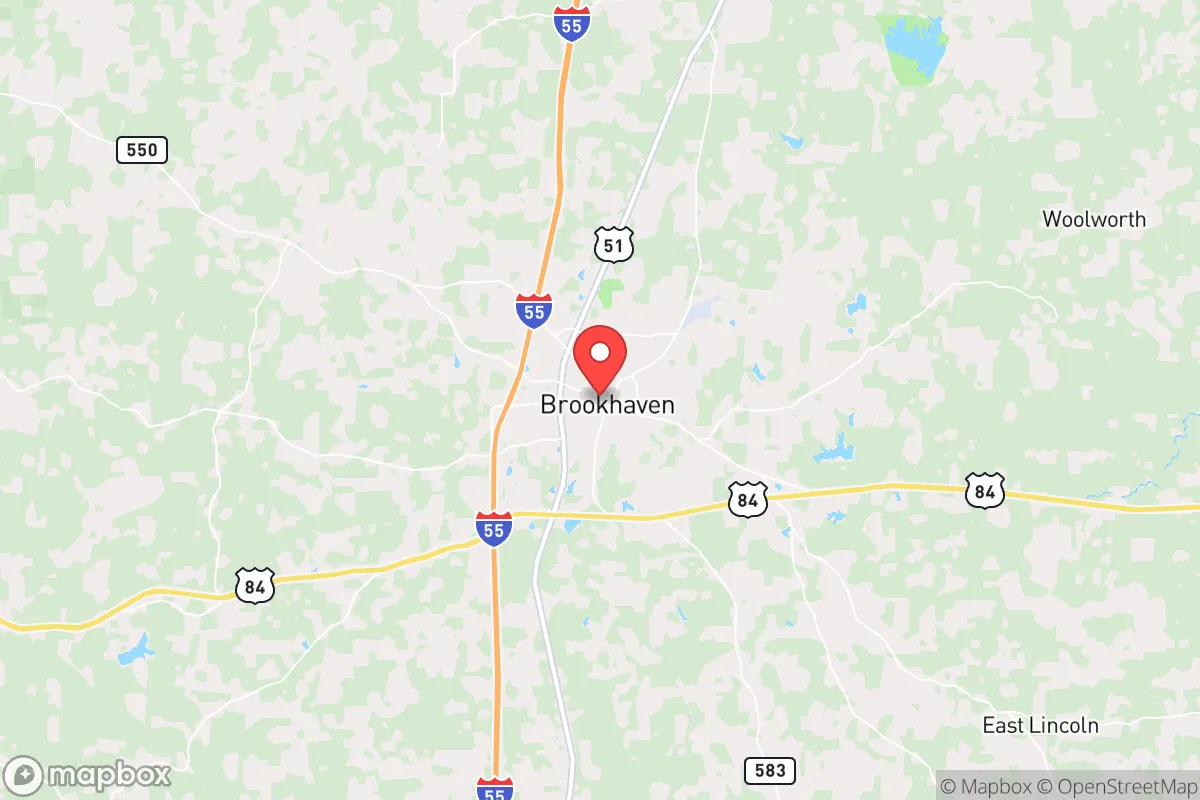
District shown is the primary district for this city’s centroid. Cities may span multiple districts.
Local Political AnalysisPolitical Analysis of Brookhaven, MS
Brookhaven, Mississippi, sits solidly in conservative territory, with a Cook PVI of R+14 that reflects the deep-rooted political traditions of the region. This isn't a place that flips with national trends; it's a community where folks have long valued limited government, personal responsibility, and the right to live without excessive interference. Over the past decade, the political lean has held steady, though you can feel a subtle shift in the air—not toward the left, but a growing wariness of any creeping government overreach, whether from Jackson or Washington. The trajectory here is one of cautious preservation, with most residents preferring to keep things as they are rather than experiment with progressive policies that have caused headaches elsewhere.
How it compares
When you stack Brookhaven against nearby cities, the contrast is clear. Head south to McComb, and you'll find a more mixed political landscape, with a higher Democratic vote share that reflects its different demographic and economic history. To the west, Natchez leans slightly more moderate, though still conservative by national standards. But Brookhaven is the anchor of Lincoln County's conservative bloc—a place where the R+14 rating feels earned, not accidental. The surrounding towns like Wesson and Bogue Chitto are even more rural and traditional, often voting further right than Brookhaven itself. What sets Brookhaven apart is its role as a small commercial hub; it attracts some newcomers from more liberal areas, but the local culture and voting patterns have proven remarkably resistant to outside influence. That's a good thing, because when you see what's happened in places like Jackson or Hattiesburg—where progressive policies have led to higher crime and bureaucratic bloat—you appreciate the stability here.
What this means for residents
For the people living here, the political climate translates into a daily life that feels freer than in many parts of the country. Property taxes remain low, zoning is minimal, and there's a general expectation that the government stays out of your business—whether that's how you run your small business, what you teach your kids, or how you exercise your Second Amendment rights. The local school board and city council are dominated by conservatives who prioritize fiscal restraint and local control, which means fewer mandates from above. That said, there's a growing concern among long-time residents about the slow creep of federal and state regulations, especially around environmental rules and healthcare mandates. The worry is that if Brookhaven ever starts to mirror the progressive shifts seen in larger Mississippi cities, it could lose the very character that makes it a good place to raise a family or retire in peace.
Culturally, Brookhaven stands out for its strong sense of community self-reliance. You won't find the kind of activist-driven politics that dominate in college towns or coastal suburbs. Instead, the local discourse centers on practical matters: keeping taxes low, maintaining good roads, and ensuring that law enforcement has the resources to keep the streets safe without turning into an occupying force. There's a healthy skepticism of any policy that sounds like it comes from a think tank rather than from the front porch of a neighbor. In the long term, the biggest challenge will be holding the line against outside pressures—whether from federal grant strings attached to infrastructure money or from state-level efforts to centralize decision-making. If Brookhaven can keep its local focus and resist the temptation to adopt trendy progressive ideas, it will remain one of the most reliably conservative small towns in the South. But that requires vigilance, because once you let the government get its foot in the door on one issue, it's hard to push it back out.

State Political ClimatePolitical Climate in Mississippi
State Political AnalysisPolitical Environment in the State
Mississippi is one of the most reliably conservative states in the nation, with a deep-rooted Republican lean that has only solidified over the past two decades. The state has not voted for a Democratic presidential candidate since 1976, and in 2024, Donald Trump carried it by over 17 points. The dominant coalition is a blend of rural, evangelical, and working-class voters, with the GOP holding supermajorities in both chambers of the state legislature and every statewide office. Over the last 10-20 years, the shift has been away from the old "Blue Dog" Democrat tradition and toward a hardline conservative posture, especially on social issues and gun rights, though economic populism still has a real foothold in the Delta.
Urban vs. rural divide
The political map of Mississippi is starkly divided between its handful of urban centers and the vast rural countryside. The Jackson metro area, anchored by Hinds County, is the state's lone Democratic stronghold, consistently voting blue by double digits due to a high concentration of African American voters and a shrinking but active progressive base. In contrast, the Gulf Coast cities of Biloxi, Gulfport, and Ocean Springs lean Republican, though they have a more moderate, pro-business flavor than the inland counties. The DeSoto County suburbs of Memphis—places like Southaven and Olive Branch—are among the most reliably red in the state, driven by white, middle-class families who fled Tennessee's blue shift. Meanwhile, the northeastern hill country around Tupelo and the Pine Belt around Hattiesburg are solidly conservative but with a libertarian streak, especially on property rights and taxes. The Delta region, including Greenville and Clarksdale, remains a Democratic holdout due to its majority-black population, but turnout there is low, and its political influence is waning as population declines.
Policy environment
Mississippi's policy environment is aggressively conservative, with a focus on low taxes, limited regulation, and cultural traditionalism. The state has a flat income tax of 4.0% (phasing down to 3.99% by 2026), no estate tax, and a sales tax that averages around 7%. Property taxes are among the lowest in the nation, a major draw for retirees and families. Education policy is dominated by school choice: the state has a robust charter school law and a growing Education Scholarship Account program that lets parents use public funds for private or homeschool expenses. Healthcare is a mixed bag—Mississippi rejected Medicaid expansion under the ACA, leaving a coverage gap, but the state has loosened scope-of-practice laws for nurse practitioners to improve rural access. Election laws are strict: voter ID is required, absentee voting is limited, and there is no early voting in person. The state also passed a 2023 law banning ranked-choice voting and ranked-choice ballot initiatives, locking in the traditional primary-and-general system.
Trajectory & freedom
On the freedom front, Mississippi has been moving decisively in the direction of expanded personal liberty, especially on gun rights, parental rights, and religious freedom. In 2023, the legislature passed a permitless carry law, allowing any adult who can legally possess a firearm to carry it openly or concealed without a license. The same year, the "Parents' Bill of Rights" was signed into law, requiring schools to notify parents of any medical or mental health services offered to their children and to obtain consent before any gender-related counseling. On medical freedom, Mississippi banned COVID-19 vaccine mandates for state employees and contractors in 2021 and has resisted federal pressure on mask mandates. Property rights were strengthened with a 2022 law limiting eminent domain for economic development. However, the state still maintains a strict ban on abortion with no exceptions for rape or incest, and medical marijuana was only legalized in 2022 after a long court battle—so "freedom" here is selective and culturally defined.
Civil unrest & political movements
Mississippi has a relatively low profile for civil unrest compared to other Southern states, but there are flashpoints. The most visible is the ongoing controversy over the state flag, which was changed in 2020 from the Confederate battle emblem to a magnolia design—a move that sparked fierce backlash in rural counties but was largely accepted in the suburbs. Immigration politics are muted because Mississippi has a small foreign-born population, but the state passed a 2023 law requiring local law enforcement to cooperate with ICE detainers. Election integrity has been a hot topic: after the 2020 election, the legislature tightened absentee ballot rules and banned ballot drop boxes, citing concerns about fraud. There is a small but vocal "State Sovereignty" movement in the northeastern counties, with some local officials passing symbolic resolutions asserting the right to nullify federal gun laws. You won't see large protests in the streets, but you will hear plenty of talk about "coastal elites" and "federal overreach" at any local diner.
Projection
Over the next 5-10 years, Mississippi is likely to become even more conservative, driven by two demographic trends: the out-migration of younger, more liberal-leaning residents from Jackson and the Delta to other states, and the in-migration of retirees and remote workers from blue states who are drawn by low taxes and a slower pace of life. The Gulf Coast, especially around Ocean Springs and Biloxi, is seeing steady growth from Florida and Louisiana transplants, while DeSoto County continues to absorb Memphis spillover. The rural counties will continue to lose population, which will concentrate political power in the suburbs and exurbs. Expect further tax cuts, more school choice expansion, and a continued push against federal mandates on everything from environmental regulation to education. The biggest wildcard is the state's healthcare system: if the coverage gap widens, it could create pressure for Medicaid expansion, but that would require a major shift in the legislature's leadership.
For a new resident, the bottom line is this: Mississippi offers a deeply conservative environment where your taxes are low, your gun rights are broad, and your children's education is largely under your control. You will find a culture that values personal responsibility and local autonomy, but you should also expect limited public services, especially in rural areas, and a political climate that is resistant to change. If you are looking for a place where the government stays out of your business and your family's life, Mississippi delivers—just know that "freedom" here comes with a specific cultural and religious flavor that may not suit everyone.
* Values derived from national, state, county, city and local statistics and may differ in a specific area. Last updated: 2026-04-21T21:44:24.000Z
Narrative content on this page is AI-generated and may contain mistakes. Verify any details that matter before acting on them.
ReloMaps may earn a commission from affiliate links at no extra cost to you.

