 Popular
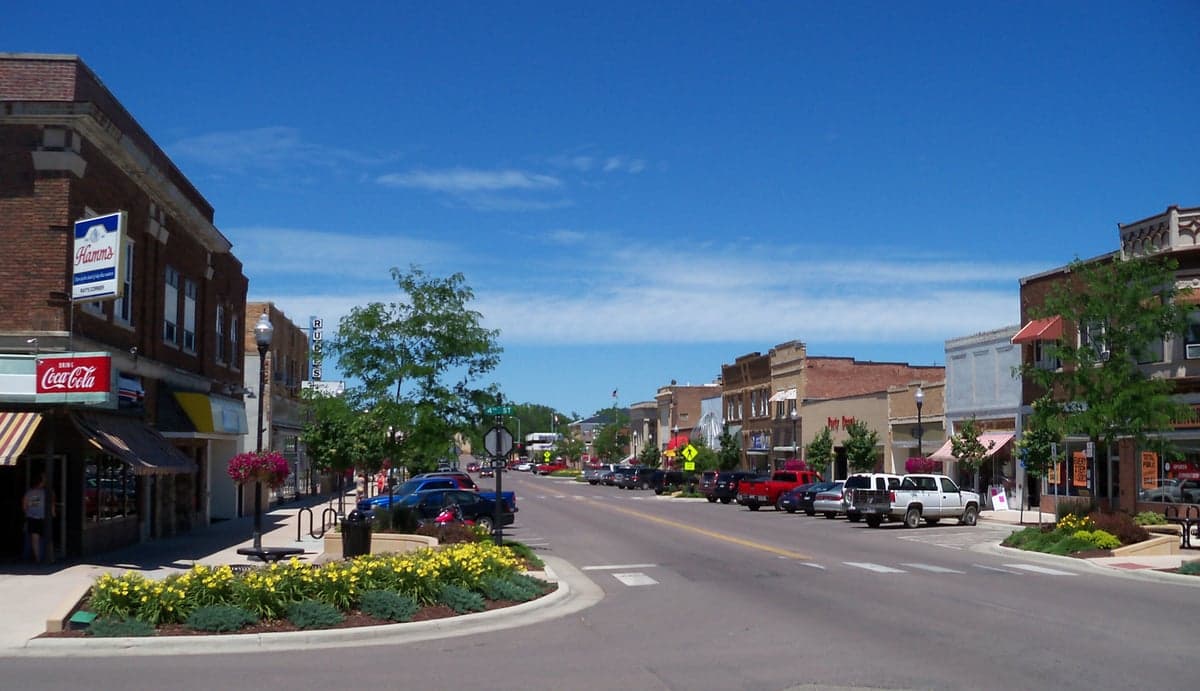
Photo: Wikipedia
Demographics of Brookings, SD
Affluence Level in Brookings, SD
A middle-class area roughly in line with national averages across income, home values, education, and employment.
People of Brookings, SD
The people of Brookings, SD today form a community of roughly 23,710 residents that is predominantly white (86.4%) and highly educated, with nearly half (49.7%) holding a college degree. The city’s identity is shaped by its dual role as a regional agricultural hub and home to South Dakota State University, giving it a younger, more transient population than the surrounding countryside. A modest but growing foreign-born population (4.6%) and small but distinct Asian (2.2%) and Indian (2.6%) communities add layers to what remains a culturally homogeneous, family-oriented city. Brookings is neither a melting pot nor a monoculture — it is a stable, midwestern college town where newcomers often arrive for education or employment and stay for the safety and schools.
How the city was settled and grew
Brookings was founded in 1857 by settlers drawn by the Dakota Land Company’s promise of fertile prairie, but the first permanent wave arrived after the 1862 Homestead Act. Norwegian, German, and Swedish immigrants dominated this early period, establishing farms and small businesses along the Big Sioux River. The arrival of the railroad in 1879 and the founding of South Dakota State University (then Dakota Agricultural College) in 1881 transformed the settlement into a regional trade and education center. The original town core — now Historic Downtown Brookings along Main Avenue — was built by Scandinavian carpenters and merchants, while the Hillcrest neighborhood, platted in the 1880s, housed the families of early professors and railroad officials. A second wave of German-Russian immigrants arrived around 1900, settling in the North Brookings area near the railroad yards and grain elevators. By 1950, the population had reached roughly 7,000, overwhelmingly white and native-born, with the university as the primary engine of growth.
Modern era (post-1965)
The post-1965 period brought modest diversification, driven almost entirely by the university and the expansion of regional employers like Daktronics (founded 1968) and 3M’s Brookings plant. The foreign-born share rose from under 1% in 1970 to 4.6% today, with the most notable change being the arrival of Indian and East/Southeast Asian graduate students and professionals. Indian families (2.6% of the population) tend to cluster in the University Village area near campus and in the newer Sixth Street Corridor subdivisions, drawn by proximity to SDSU’s engineering and pharmacy programs. East/Southeast Asian residents (2.2%) — primarily Chinese, Korean, and Vietnamese — are more dispersed but also concentrate in the South Brookings neighborhoods built since 2000, where newer housing stock and shorter commutes to the university and Daktronics are valued. The Hispanic population (4.0%) grew steadily from the 1990s onward, largely through agricultural and food-processing work; many families settled in the West Brookings area near the industrial parks and along 22nd Avenue. The Black population remains very small (1.5%), mostly students and faculty associated with SDSU. Domestic in-migration — primarily from Minnesota, Iowa, and Nebraska — has kept the white share high, as retirees and remote workers are drawn by low crime and the Arlington Addition and Pheasant Ridge subdivisions. The city has not experienced the rapid suburbanization seen in larger metros; instead, growth has been steady, infill-oriented, and largely contained within the existing city limits.
The future
The population of Brookings is projected to grow modestly — likely reaching 27,000–28,000 by 2040 — driven by SDSU enrollment, expansion of Daktronics and other tech employers, and continued in-migration of midwestern families seeking affordable housing and good schools. The Indian and East/Southeast Asian communities are likely to grow slowly as university recruitment of international graduate students continues, but they will remain small enclaves rather than forming distinct ethnic neighborhoods; most second-generation children are assimilating into the broader white-majority culture. The Hispanic population may grow slightly faster, as agricultural and service-sector jobs attract new arrivals, but the city’s high housing costs relative to rural alternatives will limit rapid expansion. The white share will likely decline from 86.4% to around 82–83% by 2040, but Brookings will remain a predominantly white, college-educated city. There is no evidence of tribalization into ethnic enclaves; instead, the pattern is one of gradual, diffuse integration, with newcomers of all backgrounds dispersing across newer subdivisions like Sunset Ridge and Prairie View rather than concentrating in historic immigrant neighborhoods.
For someone moving to Brookings today, the city offers a stable, safe, and education-focused environment where the population is slowly diversifying but remains culturally midwestern and predominantly white. The university and tech employers provide a steady stream of newcomers, but the city’s small size and strong local identity mean that new residents — whether from India, China, or rural Minnesota — tend to integrate into existing social structures rather than forming separate communities. Brookings is becoming slightly more diverse, but it is not becoming a different kind of place.

* Values derived from national, state, county, city and local statistics and may differ in a specific area. Last updated: 2026-04-29T18:36:03.000Z
Narrative content on this page is AI-generated and may contain mistakes. Verify any details that matter before acting on them.
ReloMaps may earn a commission from affiliate links at no extra cost to you.

