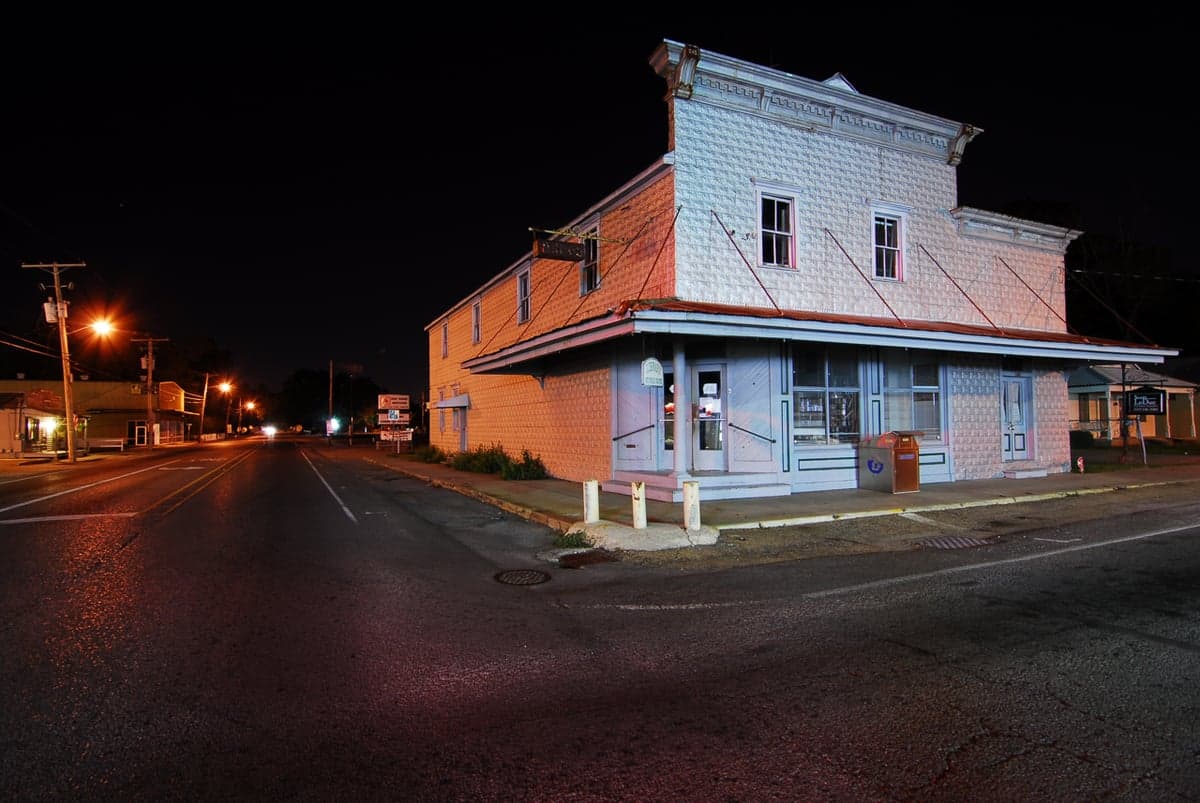
Photo: Wikipedia
Strategic Assessment of Broussard, LA
Meaningful friction. Expect exposure to either population pressure, blast zones, or natural disaster risk. Consider buying a retreat property.
What does the Strategic Assessment tell us?
Our Strategic Assessment grades tactical survivability of an area. Major population centers, military targets, fallout zones, natural disasters, and border exposure all drive risk — lower exposure means a more defensible position in a crisis.
This is heavily inspired by Joel Skousen's Strategic Relocation book. Highly recommended you checkout the book ($)What does this tell us?
Our Strategic Assessment grades tactical survivability of an area. Major population centers, military targets, fallout zones, natural disasters, and border exposure all drive risk — lower exposure means a more defensible position in a crisis.
This is heavily inspired by Joel Skousen's Strategic Relocation book. Highly recommended you checkout the book ($)Strategic Pillars

Key Distances
Regional Safe Places
Below is our recommended "safe zones" in Louisiana and the surrounding area based on our strategic heuristics. For most people, it's unrealistic to live in a “safe zone” full-time due to work, family or other personal reasons. They tend to be more rural. However, many of these areas are perfect for second homes and retreat properties that double as a vacation home or even a short-term rental.

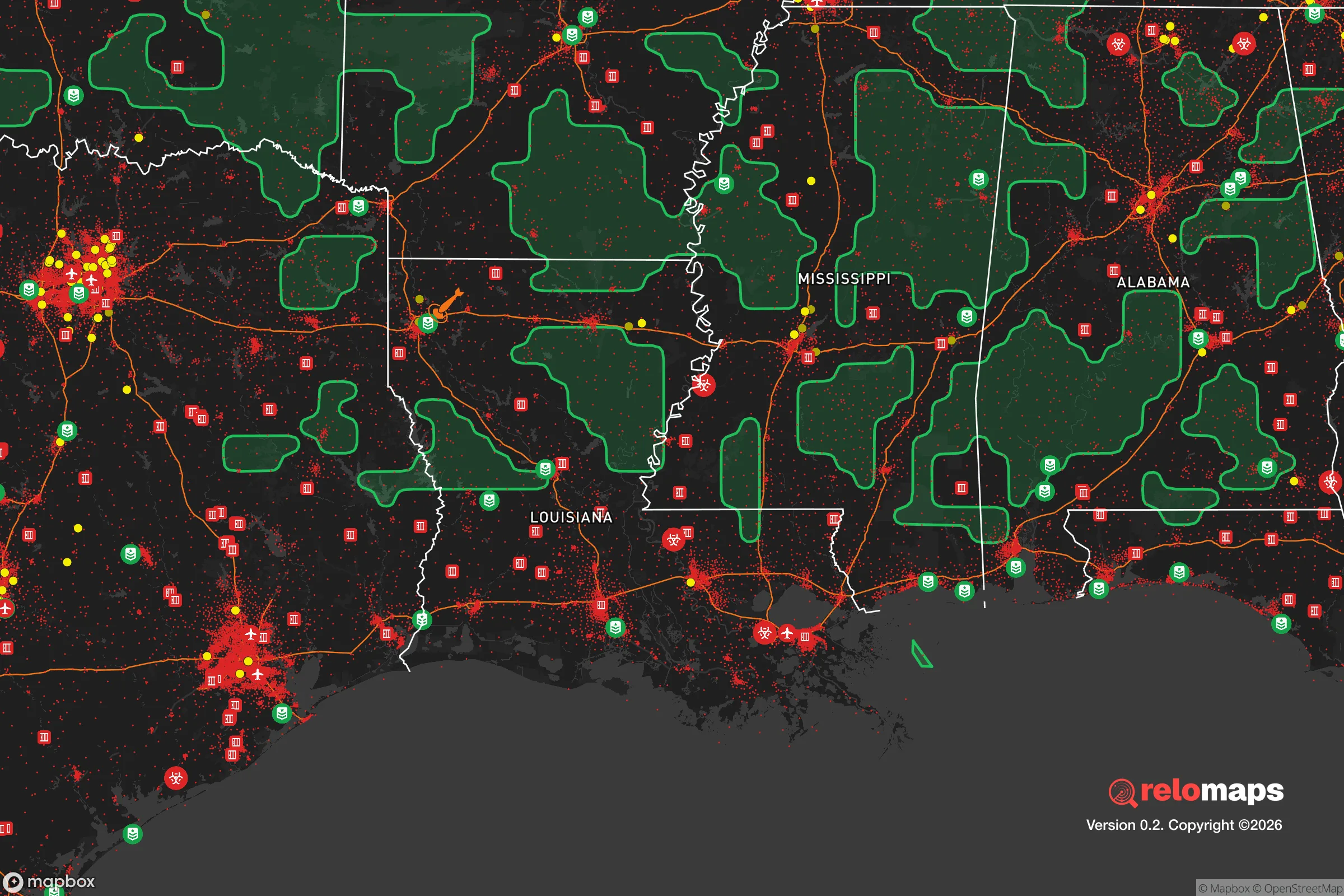


Important Note: For informational purposes only. This does not mean nothing bad ever happens in the green zones. Please use common sense. This is based on public data and modeled with AI. We tried to take a conservative approach but mistakes happen. We update this regularly as new information becomes available.
Solar Generator Recommendations
Backup power matters more here than in safer locations. We've picked three solar generators across budgets and capacity tiers — start with the budget unit if you only need a few essentials, or step up if you want to run a fridge and HVAC for days at a time.

Jackery Portable Power Station Explorer 300
Budget OptionPower on the Go: Weighing only 11 lbs, it's convenient to set up and store with book-sized foldable solar panels

BLUETTI Portable Power Station AC180
Designed for both indoor and outdoor scenarios, AC180 is highly capable as it has a robost capacity and continuous output power.

EF ECOFLOW DELTA Pro Ultra Power Station
Upgraded PickEcoFlow DELTA Pro Ultra is a whole-home energy system designed to grow with your family. Integrated with the Smart Home Panel 2, it scales to meet your evolving energy needs — keeping your home powered, intelligent, and secure through every stage of life.
We earn a commission, at no additional cost to you.
Strategic Assessment Analysis
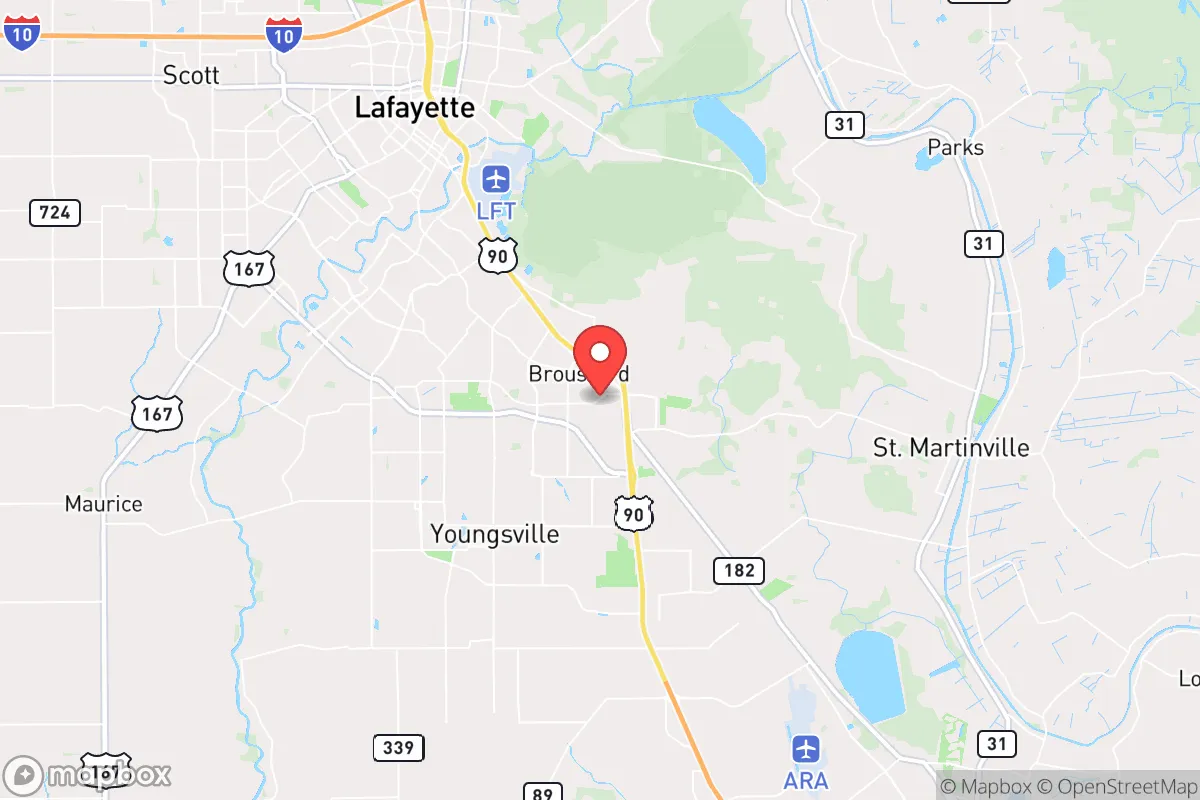
Broussard, Louisiana, sits in a strategic pocket of southern Louisiana that offers a blend of geographic insulation and practical resilience for those prioritizing self-reliance and preparedness. Located roughly 10 miles southeast of Lafayette, this town of about 13,000 residents benefits from being off the main hurricane landfall zones while still maintaining access to critical infrastructure. Its position along the Vermilion River and near the intersection of I-10 and US Highway 90 provides a logistical advantage for both supply movement and potential evacuation routes, though the area's flat terrain and proximity to the Gulf introduce specific vulnerabilities that any serious prepper must account for.
Geographic position and natural advantages for long-term stability
Broussard sits on relatively high ground for the region—at about 30 feet above sea level—which is a meaningful advantage in a state where much of the population lives at or near sea level. The town is situated on the natural levee of the Vermilion River, giving it better drainage and less flood risk than many surrounding communities. This elevation, combined with the area's distance from the immediate coast (roughly 40 miles inland), reduces the worst storm surge impacts that plague places like New Orleans or Houma. The surrounding landscape is a mix of agricultural fields, hardwood forests, and bayous, offering multiple options for off-grid living, hunting, and small-scale farming. The climate supports year-round growing seasons, with an average 240-day frost-free period, meaning a determined household can produce a significant portion of its own food. The local water table is high and generally accessible via shallow wells, and the Vermilion River provides a surface water source for those with proper filtration systems. For a relocator thinking in decades rather than months, the area's natural resource base—timber, fish, game, and fertile soil—is a solid foundation.
Risks, exposures, and proximity to fallout-relevant landmarks
The most significant risk in Broussard is hurricane-related flooding and wind damage. While the town avoids the worst storm surge, it is not immune to heavy rainfall flooding, as seen during the 2016 Louisiana floods that inundated parts of the region. The area sits in a FEMA-designated flood zone, and any property purchase should be carefully evaluated for flood history and elevation. Beyond weather, the strategic concern for a prepper is proximity to potential targets. Broussard is roughly 50 miles from the Mississippi River chemical corridor between Baton Rouge and New Orleans, which includes numerous refineries, chemical plants, and the Louisiana Offshore Oil Port (LOOP). A major industrial accident or targeted disruption at these facilities could create toxic plumes or supply chain disruptions. The town is also about 60 miles from the nuclear power plant at River Bend (near St. Francisville) and 90 miles from the Waterford plant near New Orleans. While not in the immediate fallout zone, a worst-case event at either facility could affect the region depending on wind patterns. On the plus side, Broussard is far enough from major urban centers—Lafayette is the nearest city of any size—that civil unrest or mass casualty events in larger cities would likely not spill over directly. The local population is relatively homogeneous and community-oriented, which can be a double-edged sword: strong social cohesion helps in a crisis, but outsiders may face a longer trust-building period.
Practical resilience for a relocator: food, water, energy, and defensibility
For a single individual or family looking to establish a resilient homestead, Broussard offers several practical advantages. The local climate supports three-season gardening, and the soil in the area is generally fertile, though it tends toward clay and requires amendment for optimal yields. Rainwater collection is viable, with annual precipitation averaging 60 inches, and the high water table means shallow wells are often productive. Solar energy is a mixed bag: the region gets about 215 sunny days per year, which is below the national average, but modern panels still produce meaningful power on overcast days. Battery storage and a backup generator running on propane or diesel would be wise investments. The town's layout is suburban and low-density, with many homes on lots of half an acre or more, providing space for gardens, chicken coops, and small livestock. Defensibility is moderate—the flat terrain offers few natural chokepoints, but the network of bayous and canals can be used to control access to certain areas. The local gun culture is strong, and Louisiana has permissive firearms laws, including constitutional carry, which is a practical consideration for those serious about self-defense. The nearest major medical facilities are in Lafayette (about 15 minutes away), which is a reasonable distance for routine care but could be problematic if the city becomes a no-go zone during a crisis. Stockpiling medications and learning basic emergency medicine would be prudent.
The overall strategic picture for Broussard is one of moderate resilience with clear trade-offs. It is not a remote mountain redoubt, nor is it a high-risk urban center. It sits in a middle ground that rewards preparation and local knowledge. The area's agricultural potential, water availability, and community cohesion are genuine strengths, while its vulnerability to hurricanes and proximity to industrial and energy infrastructure are the main liabilities. For a relocator who values being part of a functioning small town with access to resources and a like-minded population, Broussard is a viable option—provided they go in with eyes open about the flood risk and the need for a solid plan for weather-related disruptions. The key is to treat it as a base for building local resilience, not as a bug-out location that will solve all problems on its own. With the right property, a well-stocked pantry, and a willingness to integrate into the community, Broussard can serve as a defensible, productive home base for the uncertain years ahead.

* Values derived from national, state, county, city and local statistics and may differ in a specific area. Last updated: 2026-04-23T04:54:31.000Z
Narrative content on this page is AI-generated and may contain mistakes. Verify any details that matter before acting on them.
ReloMaps may earn a commission from affiliate links at no extra cost to you.

