Photo: Wikipedia
Demographics of Brunswick, MD
Affluence Level in Brunswick, MD
An upper-middle-class area. Household wealth, education levels, and homeownership run ahead of national benchmarks.
People of Brunswick, MD
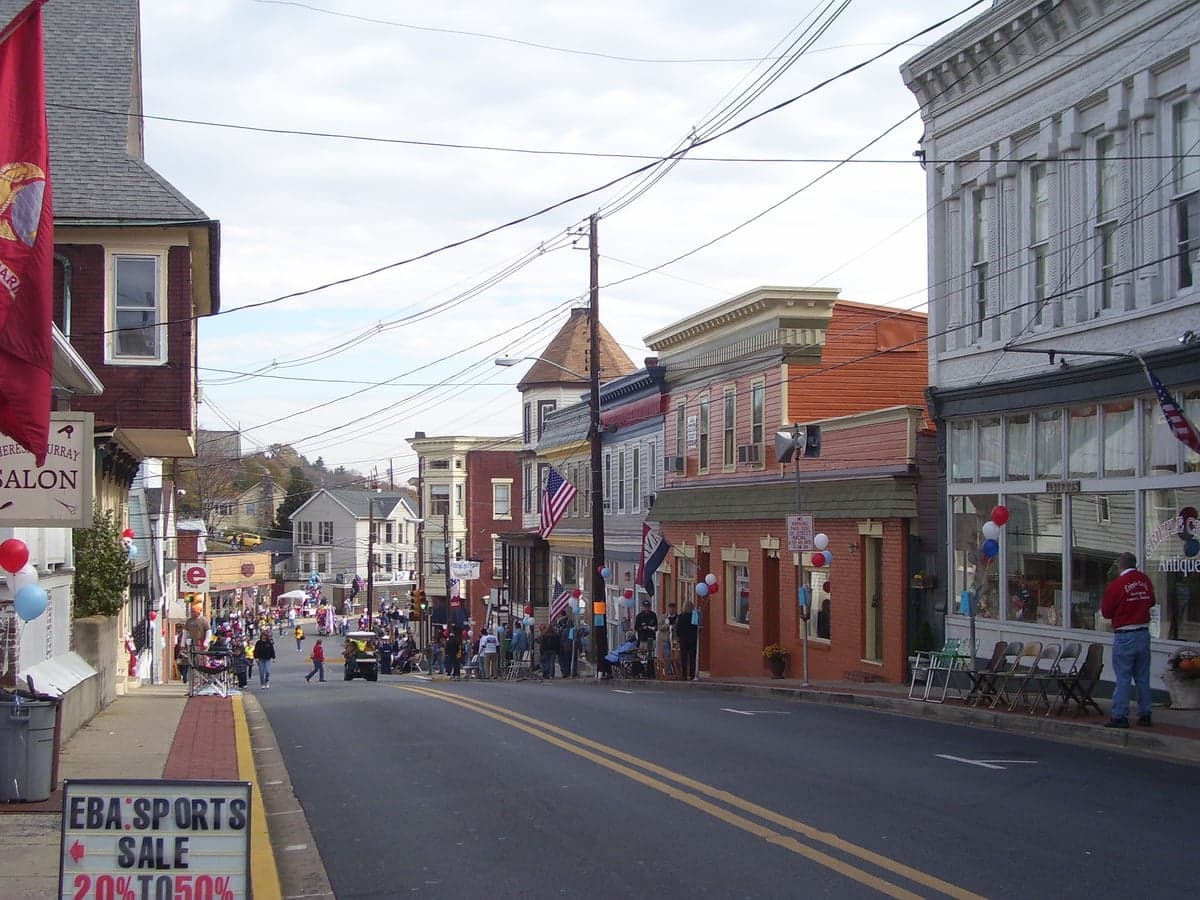
The people of Brunswick, Maryland, today number roughly 7,994, forming a predominantly white (71.8%) community with a notable and growing Hispanic minority (10.5%) and smaller Black (7.3%) and East/Southeast Asian (2.4%) populations. The city’s character is shaped by its historic railroad and manufacturing roots, now blending with a commuter-oriented identity as a more affordable alternative to the Washington, D.C., and Frederick job markets. With a foreign-born share of just 3.3% and a college-educated rate of 36.6%, Brunswick remains a largely native-born, working-to-middle-class town where family ties and local institutions still anchor daily life. Distinctive markers include a strong volunteer fire company culture, a historic downtown district, and a population that is slowly diversifying while retaining a small-town, predominantly white core.
How the city was settled and grew
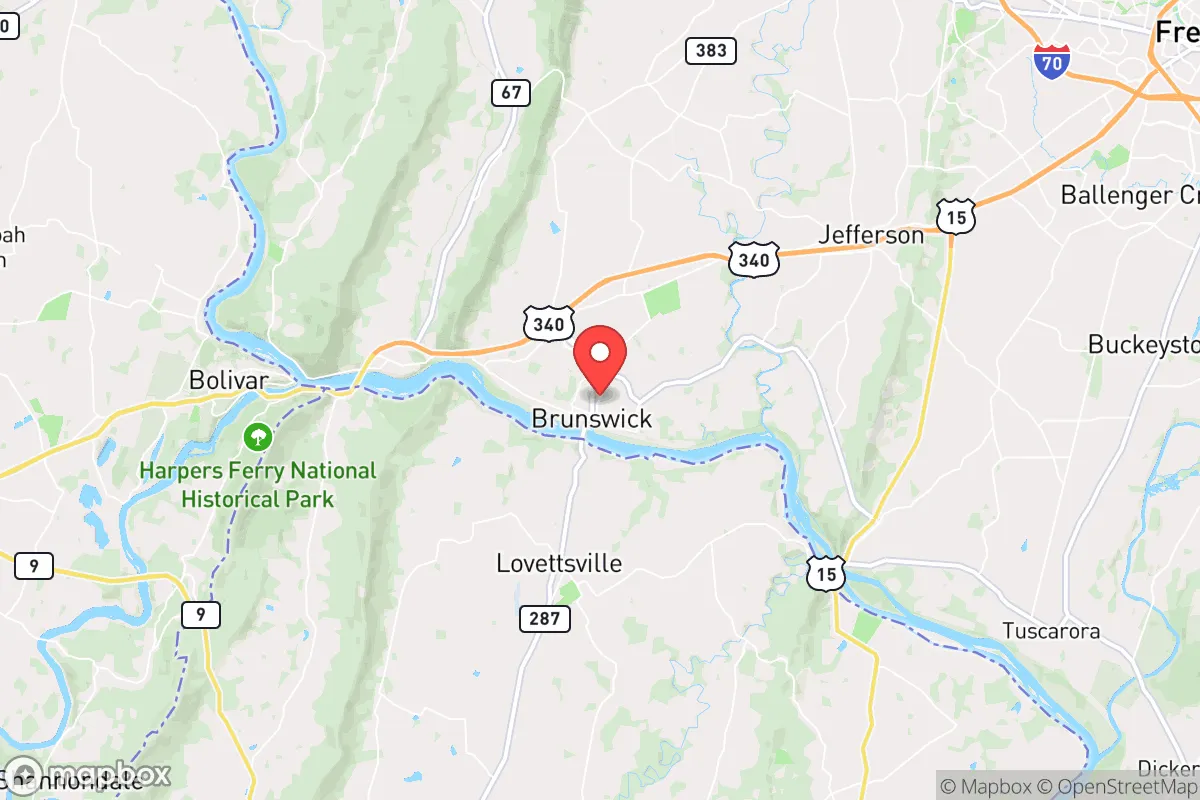
Brunswick’s population history begins with its strategic location along the Potomac River and the Chesapeake and Ohio Canal, which drew early settlers in the late 18th and early 19th centuries. The original European-American settlers were primarily of English, German, and Scots-Irish stock, arriving as farmers and canal laborers. The real population boom came with the arrival of the Baltimore and Ohio Railroad in the 1830s, which established Brunswick as a major rail hub. The railroad built the Brunswick Yard and attracted waves of Irish immigrants in the 1840s and 1850s to dig the canal and lay track, followed by Italian and Eastern European immigrants in the late 19th and early 20th centuries who worked in the rail shops and roundhouses. These groups settled in distinct neighborhoods: the Irish concentrated in “Irishtown” along the river flats near the canal, while Italian and Polish families built homes in the “Dutchmans” area (a local term for the German and Eastern European enclave) around the eastern edge of the rail yard. The railroad’s dominance meant that by 1900, Brunswick was a company town with a population of roughly 3,000, overwhelmingly white and native-born, with a small Black community that lived primarily in the “South End” near the river, working as domestic laborers and rail hands.
Modern era (post-1965)
After the 1965 Hart-Cellar Act, Brunswick saw only modest immigration-driven change, as the city’s industrial base began to decline. The railroad’s workforce shrank, and the city lost its manufacturing anchor. Domestic in-migration from the Washington, D.C., suburbs began in the 1990s and accelerated after 2000, as families and individuals sought lower housing costs. This wave was predominantly white and middle-class, settling in newer subdivisions like “Riverview Estates” and “Potomac Crossing” on the city’s western and northern edges. The Hispanic population grew from negligible levels in 1990 to 10.5% by 2020, driven by immigrant labor in construction, landscaping, and service industries. These newer Hispanic residents have concentrated in the older, more affordable housing stock of the “Downtown Historic District” and the “South End”, where rents are lower and multi-generational households are common. The Black population, at 7.3%, has remained relatively stable, with families still rooted in the South End and scattered through the central grid. The East/Southeast Asian share (2.4%) is a recent addition, largely professionals and small-business owners who have moved into the newer subdivisions. The Indian-subcontinent population (0.6%) is tiny and dispersed, with no distinct enclave. The city’s racial and ethnic landscape has shifted from nearly all-white in 1970 to a more diverse but still majority-white community, with the Hispanic share being the fastest-growing segment.
The future
Brunswick’s population is heading toward slow, steady diversification, driven primarily by Hispanic growth and continued white domestic in-migration from the D.C. metro area. The city is not tribalizing into rigid enclaves; instead, the older neighborhoods like the South End and Downtown are becoming more Hispanic, while the newer subdivisions remain predominantly white. The foreign-born share (3.3%) is low but likely to rise modestly as Hispanic families continue to settle and as the city’s affordable housing stock attracts immigrant service workers. The white share (71.8%) will likely decline gradually, but Brunswick is not on a trajectory toward a majority-minority status within the next 10-20 years. The college-educated rate (36.6%) is below the national average for suburbs, suggesting that the city remains a blue-collar and middle-class alternative rather than a magnet for high-skilled immigrants. The East/Southeast Asian and Indian populations are expected to remain small, as the city lacks the professional job base or ethnic infrastructure to attract large numbers. The biggest demographic story is the Hispanic community’s growth, which is likely to continue as families move in from nearby Frederick and from out-of-state, and as second-generation Hispanic residents start their own households in the same neighborhoods.
For someone moving to Brunswick now, the city is becoming a more diverse, still predominantly white, working-to-middle-class community with a strong local identity. The historic railroad neighborhoods are slowly changing, but the newer subdivisions offer a familiar, family-oriented suburban feel. The population is not homogenizing; rather, it is experiencing a gradual, organic diversification that is most visible in the older, more affordable parts of town. This means a new resident can expect a community that values its history and local institutions, while slowly adapting to a more varied demographic future.

* Values derived from national, state, county, city and local statistics and may differ in a specific area. Last updated: 2026-04-22T02:14:24.000Z
Narrative content on this page is AI-generated and may contain mistakes. Verify any details that matter before acting on them.
ReloMaps may earn a commission from affiliate links at no extra cost to you.

