Photo: Wikipedia
Demographics of Buckhannon, WV
Affluence Level in Buckhannon, WV
A below-average socioeconomic profile. Incomes, home values, and educational attainment trail the U.S., with higher poverty and unemployment.
People of Buckhannon, WV
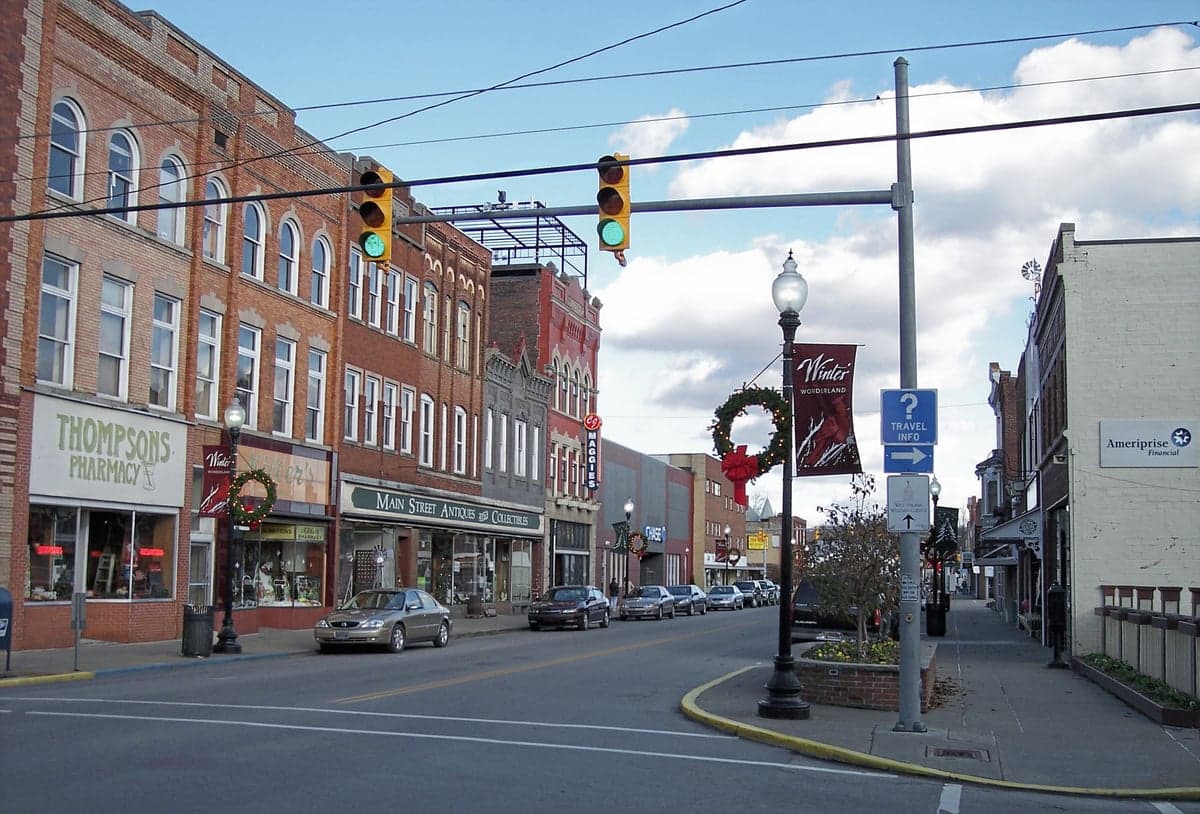
Buckhannon, West Virginia, is a small, predominantly white city of 5,144 residents where a deeply rooted Appalachian identity meets the stabilizing influence of West Virginia Wesleyan College. The population is notably less diverse than the national average, with 86.6% of residents identifying as white, and a foreign-born population of just 1.3%. The city’s character is shaped by a mix of long-standing local families, a modest college-town atmosphere, and a slower pace of life that appeals to those seeking a tight-knit, conservative-leaning community in central West Virginia.
How the city was settled and grew
Buckhannon’s human history begins with the indigenous Monongahela people, who inhabited the region for centuries before European contact. The first permanent white settlers arrived in the late 18th century, primarily of English, Scots-Irish, and German descent, drawn by land grants issued after the American Revolution. These early families—names like Butcher, Reger, and Strader—established homesteads along the Buckhannon River, forming the core of what would become the city. The town was officially founded in 1816 and incorporated in 1852, serving as the seat of Upshur County. The arrival of the Baltimore and Ohio Railroad in the 1880s spurred a second wave of growth, bringing Irish and Italian laborers who settled in the Island Addition neighborhood, a working-class district near the rail yards and river. The discovery of oil and natural gas in the early 20th century attracted additional workers, many of whom built homes in the South Buckhannon area, a neighborhood that remains a mix of older single-family homes and newer subdivisions. By the mid-20th century, the population was overwhelmingly white, with a small Black community concentrated near the East Main Street corridor, historically the site of the city’s African American churches and social institutions.
Modern era (post-1965)
Following the 1965 Hart-Cellar Act, Buckhannon saw minimal immigration, unlike larger U.S. cities. The foreign-born population today is only 1.3%, reflecting the city’s limited draw for international migrants. The most significant demographic shift since the 1970s has been domestic out-migration, as younger residents left for job opportunities in larger metropolitan areas. The city’s Black population, which stood at roughly 8% in the 1970s, has declined to 5.9% today, with many families moving to larger cities or suburban areas. The College Hill neighborhood, surrounding West Virginia Wesleyan College, has become the most diverse area, housing faculty, staff, and a small number of international students. East and Southeast Asian residents (1.1%) and Indian subcontinent residents (0.2%) are almost entirely affiliated with the college. The Hispanic population (1.9%) is a recent, small growth, with families settling in the North Buckhannon area near newer retail and service-sector jobs. The Upshur Village subdivision, developed in the 1990s and 2000s, attracted some in-migrants from other parts of West Virginia seeking newer, affordable housing, but the overall population has remained stable, hovering around 5,100 to 5,600 for decades.
The future
Buckhannon’s population is projected to remain relatively flat, with modest growth driven by retirees and remote workers seeking a lower cost of living. The city is not homogenizing into a single identity but is instead developing subtle enclaves: College Hill will likely remain the most diverse and transient area, while South Buckhannon and Island Addition will continue as predominantly white, working-class neighborhoods. The small Hispanic and Asian populations are expected to plateau rather than grow significantly, as the local economy—anchored by education, healthcare, and small manufacturing—does not attract large-scale immigration. The Black population may continue a slow decline as older residents pass away and younger generations relocate. For a newcomer, Buckhannon offers a stable, culturally homogeneous environment where community ties are strong, but diversity is limited. The city is becoming a quieter, older version of itself, appealing to those who value tradition, safety, and a slower pace over the dynamism of a growing, diverse metropolis.
Buckhannon is becoming a stable, predominantly white Appalachian college town where demographic change is slow and incremental. For a conservative-leaning individual or family moving in now, the city offers a predictable, low-crime environment with strong community institutions, but little racial or cultural diversity. The future points to continued stability, not transformation, making it a fit for those seeking continuity rather than change.

* Values derived from national, state, county, city and local statistics and may differ in a specific area. Last updated: 2026-05-01T15:24:29.000Z
Narrative content on this page is AI-generated and may contain mistakes. Verify any details that matter before acting on them.
ReloMaps may earn a commission from affiliate links at no extra cost to you.

