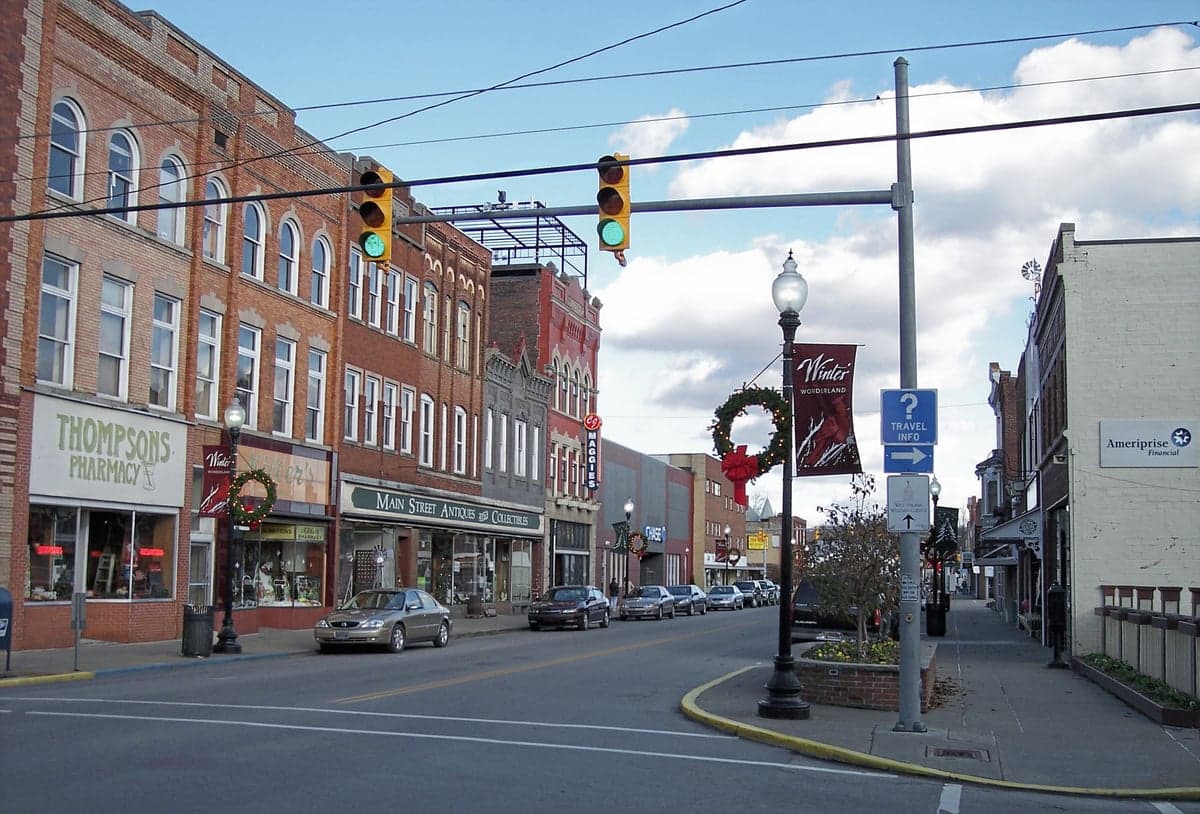
Photo: Wikipedia
Political ClimatePolitical Climate in Buckhannon, WV
District shown is the primary district for this city’s centroid. Cities may span multiple districts.
Local Political AnalysisPolitical Analysis of Buckhannon, WV
Buckhannon has long been a rock-solid conservative stronghold, and that hasn't changed much. The Cook PVI of R+20 tells you the lay of the land: this is deep-red territory, and it's been that way for as long as anyone can remember. You'll see Trump signs on lawns year-round, and the local chatter at the coffee shop is more about hunting season and property taxes than any progressive agenda. That said, there's a quiet unease among folks who've been here a while—they see the same national trends creeping in, and they're worried about what it means for the town's character.
How it compares
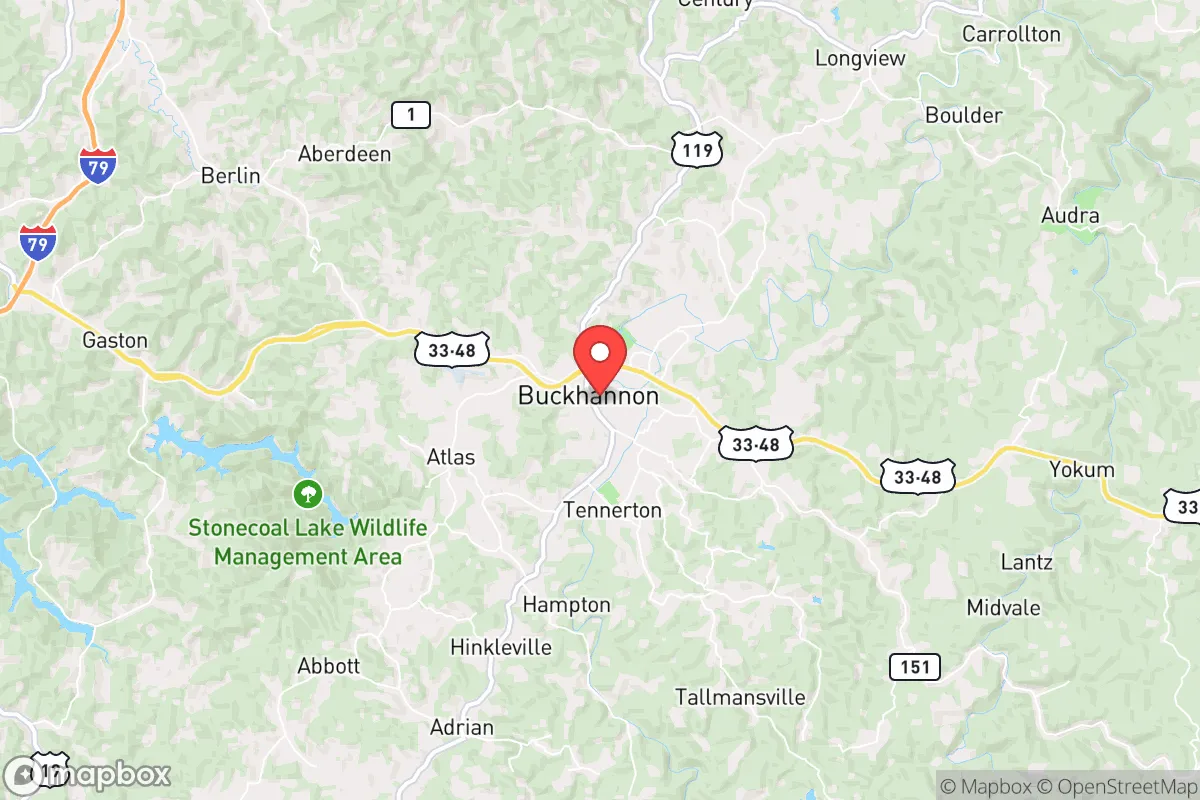
Drive twenty minutes north to Morgantown, and you're in a different world—a college town that's swung hard blue in recent years, with a PVI around D+15. That's a 35-point political gap in just a few miles. Down south, Elkins leans conservative but has a more moderate, artsy vibe that can feel out of step with Buckhannon's straight-talking, no-nonsense culture. Weston, just east, is more reliably red, but it doesn't have the same small-town pride or the West Virginia Wesleyan College influence that gives Buckhannon a slightly more educated, but still conservative, base. The real contrast is with the state's eastern panhandle, where D.C. commuters are turning once-red counties purple. Buckhannon hasn't seen that kind of influx, and most residents hope it stays that way.
What this means for residents
For the average family here, the political climate means less government meddling in daily life. You can run a small business without a dozen new regulations every year, and the local school board isn't pushing critical race theory or gender ideology on your kids. The county commission keeps taxes low and roads paved, and there's a general understanding that your personal freedoms—gun rights, homeschooling choices, religious expression—aren't up for debate. That's the Buckhannon way. But there's a growing concern that state-level pushes from Charleston, even in a red state, are starting to mirror federal overreach. Some folks worry about new zoning rules or environmental mandates that could hit the timber and natural gas industries that keep this area working. If that trend accelerates, you'll see more families looking at property in even smaller, more rural communities like French Creek or Rock Cave.
One thing that sets Buckhannon apart is its quiet resistance to the culture war noise. You don't see the same kind of performative political theater you get in bigger towns. People here vote conservative, but they also help their neighbors regardless of party. The real red flag for long-time residents is any sign that outside money or progressive activism is trying to change that—like when a few folks pushed for a diversity committee at the college a few years back. It fizzled out, but it left a bad taste. The bottom line: Buckhannon is still a place where you can live free, raise your kids with traditional values, and not have the government breathing down your neck. But you've got to keep an eye on the horizon, because the winds of change are blowing, and not everyone here is ready to let them in.

State Political ClimatePolitical Climate in West Virginia
State Political AnalysisPolitical Environment in the State
West Virginia has long been one of the most reliably Republican states in the nation, but that wasn’t always the case. As recently as the 1990s, it was a Democratic stronghold at the state and local level, with a conservative, union-heavy, coal-country flavor. The realignment accelerated after 2000, and by 2024, Donald Trump carried the state by nearly 40 points, with every single county voting red. The dominant coalition today is a mix of rural, working-class voters, evangelical Christians, and former Democrats who feel the national party left them behind. Over the past 10-20 years, the shift has been dramatic and decisive — West Virginia is now one of the most conservative states in the country, and that trajectory shows no signs of reversing.
Urban vs. rural divide
The political map of West Virginia is surprisingly uniform — there are no blue strongholds left. The largest city, Charleston, leans Republican but is more moderate than the rest of the state, with Kanawha County voting about 58% for Trump in 2024. Morgantown, home to West Virginia University, is the most liberal pocket, but even Monongalia County went 55% for Trump. Huntington and Wheeling are solidly red, with the Ohio River counties trending even more conservative than the state average. The real engine of the GOP majority is the rural, mountainous interior — counties like Mingo, Logan, and McDowell routinely deliver 75-80% of their votes to Republicans. The urban-rural divide here isn’t about cities vs. farms; it’s about college towns vs. coal country, and coal country wins every time.
Policy environment
West Virginia’s policy environment is aggressively conservative. There is no state income tax on Social Security and a flat 4.12% personal income tax that the legislature is actively working to phase out entirely. Property taxes are among the lowest in the nation, capped by the state constitution at 1.5% of assessed value. The state is a Second Amendment sanctuary — constitutional carry became law in 2016, and no permit is needed to carry a concealed firearm. Education policy has been a flashpoint: the state passed a universal school choice law in 2021, allowing any family to use public funds for private or homeschool expenses. On healthcare, West Virginia expanded Medicaid under the ACA, but the legislature has resisted further expansion and has passed laws restricting abortion to the first eight weeks, with no exceptions for rape or incest. Election laws are strict: voter ID is required, early voting is limited to 10 days, and no-excuse absentee voting was eliminated in 2021. The state also passed a law in 2023 banning ranked-choice voting and requiring hand-counted paper ballots in all counties.
Trajectory & freedom
West Virginia is becoming more free by almost any measure of personal liberty, especially for conservatives. The 2021 school choice law was a landmark — it lets parents redirect per-pupil state funding to approved private schools, online programs, or homeschooling expenses. In 2023, the legislature passed a Parental Bill of Rights requiring schools to notify parents of any curriculum involving human sexuality and to obtain consent before administering surveys on mental health or family life. Gun rights have expanded steadily: constitutional carry, preemption laws that block local gun ordinances, and a 2024 law allowing firearms in locked vehicles on school property. Medical autonomy took a hit with the near-total abortion ban, but for those who oppose abortion, that’s a gain in freedom. Property rights were strengthened in 2022 with a law limiting the use of eminent domain for economic development. The only area where freedom has contracted is in the realm of COVID-era mandates — the state banned vaccine mandates for state employees and private businesses in 2022, which was a net positive for personal choice. Overall, the trend is toward fewer restrictions on gun ownership, education choice, and parental control.
Civil unrest & political movements
West Virginia has seen its share of political activism, but it’s mostly on the right. The 2021 teachers’ strike was a rare left-wing flashpoint, with educators walking out over pay and benefits, but it didn’t shift the political landscape. The dominant movements are conservative: the West Virginia Citizens Defense League is active in gun rights advocacy, and the Moms for Liberty chapter in Berkeley County has been vocal on school curriculum issues. Immigration politics are muted — the state has one of the smallest foreign-born populations in the country, and there are no sanctuary cities. Election integrity has been a hot topic: the 2020 audit of the state’s election system found no widespread fraud, but the legislature still passed the 2021 voting restrictions. There have been no major secession or nullification movements, though some rural counties have passed resolutions declaring themselves “Second Amendment sanctuaries.” The most visible flashpoint for a new resident would be the “Don’t Tread on Me” flags and Trump signs that are ubiquitous in even the smallest towns — it’s a state where political expression is overwhelmingly conservative and unapologetic.
Projection
Over the next 5-10 years, West Virginia will likely become even more conservative. The population is aging and shrinking — the state lost 3.2% of its population between 2020 and 2024 — and the young, liberal-leaning residents who leave for college often don’t return. In-migration is small but growing, mostly from neighboring states like Virginia and Ohio, and these newcomers tend to be retirees or remote workers seeking low taxes and rural living — a demographic that leans right. The coal industry is in terminal decline, but the state is pivoting to natural gas and manufacturing, which doesn’t change the political calculus much. The only wildcard is the growing presence of remote workers in places like Shepherdstown and Lewisburg, which could introduce a small, moderate-liberal influence. But given the state’s entrenched Republican supermajority and the lack of any organized Democratic opposition, expect continued expansion of school choice, further tax cuts, and more gun rights legislation. The state will remain a redoubt of conservative governance in an increasingly blue region.
For someone moving to West Virginia, the bottom line is this: you’re coming to a place where the government largely stays out of your business, especially on guns, education, and taxes. The political culture is friendly to traditional values, and you won’t find the kind of progressive activism that dominates in neighboring states like Virginia or Maryland. If you value low taxes, strong gun rights, and a community that shares your conservative outlook, West Virginia is one of the best bets in the country. Just be prepared for a slower pace of life, a shrinking population, and a political landscape that’s unlikely to change anytime soon.
* Values derived from national, state, county, city and local statistics and may differ in a specific area. Last updated: 2026-05-01T15:24:29.000Z
Narrative content on this page is AI-generated and may contain mistakes. Verify any details that matter before acting on them.
ReloMaps may earn a commission from affiliate links at no extra cost to you.

