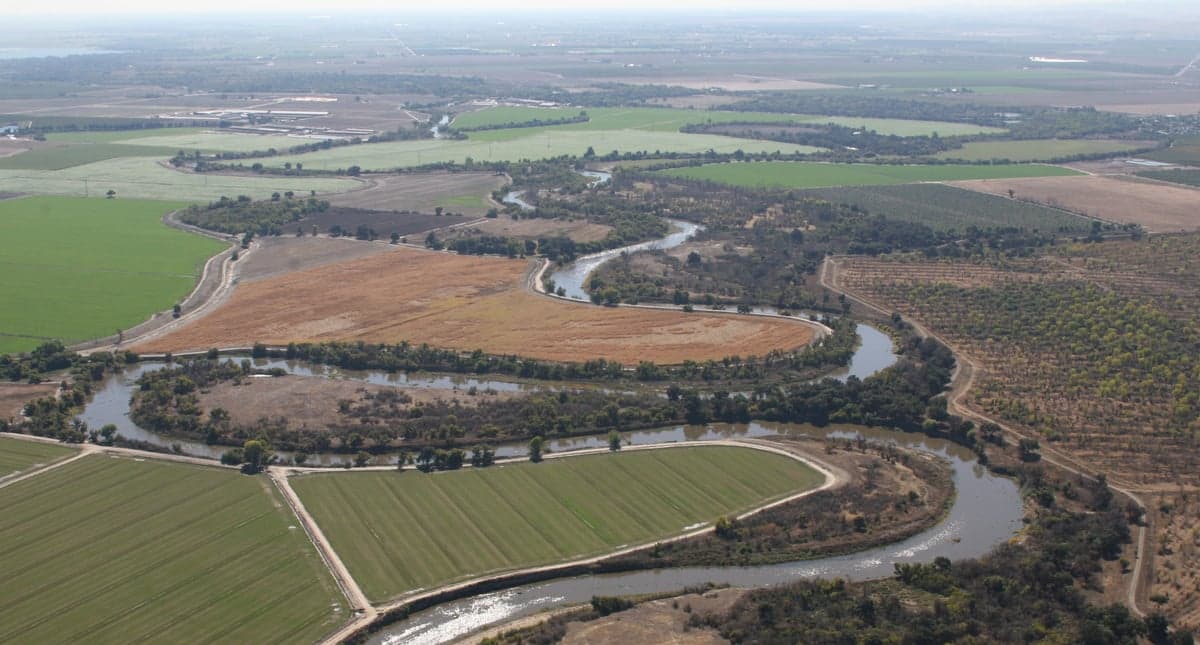
Photo: Wikipedia
Demographics of Stanislaus County
Affluence Level in Stanislaus County
A middle-class area roughly in line with national averages across income, home values, education, and employment.
People of Stanislaus County
Today, Stanislaus County’s 552,250 residents form a predominantly Hispanic and white working-class population centered on the agricultural cities of Modesto, Turlock, and Ceres, with a growing East/Southeast Asian and Indian presence. The county is 49.2% Hispanic, 37.5% white, 3.8% East/Southeast Asian, 2.7% Black, and 1.9% Indian (subcontinent), with a foreign-born share of 10.7% and a college-educated rate of just 19.1%. Its identity is rooted in a century of agricultural migration—from Dust Bowl Okies to Mexican farmworkers—producing a culturally conservative, family-oriented, and blue-collar character that sets it apart from the more suburbanized Bay Area counties to the west.
Settlement & growth (pre-1960)
The original inhabitants of the Stanislaus River region were the Yokuts people, specifically the Northern Valley Yokuts bands, who lived in seasonal villages along the river and its tributaries for thousands of years before European contact. Spanish colonization arrived indirectly through Mission San José (founded 1797), which drew Yokuts for labor, but permanent Spanish settlement was sparse—the area remained a frontier of the Mexican rancho system after 1821. The first non-Native settlers were Mexican land-grant recipients, such as the 1843 Rancho del Rio Estanislao grant, which covered much of what is now Modesto and Ceres.
The California Gold Rush of 1848-1855 brought the first significant American influx, but Stanislaus County’s real settlement wave began after statehood in 1850. The Central Pacific Railroad reached the area in 1870, and the town of Modesto was founded that same year as a railroad depot and agricultural hub. The county’s population exploded between 1870 and 1920, driven by three distinct groups: Midwestern farmers (primarily from Iowa, Illinois, and Missouri) who arrived by rail to take up wheat and fruit farming; Portuguese immigrants from the Azores, who began arriving in the 1880s and concentrated in Turlock and Hilmar, where they established dairy operations; and Italian immigrants, mostly from northern Italy, who settled in Modesto and Riverbank to work in fruit orchards and canneries. By 1910, the county was already a mosaic of white Protestant farmers, Portuguese Catholics, and Italian Catholics, with a small but growing Mexican population drawn by railroad and agricultural labor.
The Dust Bowl migration of the 1930s brought a massive wave of Okies and Arkies—white families from Oklahoma, Arkansas, and Texas fleeing the Dust Bowl and the Great Depression. They settled in Modesto, Ceres, and Oakdale, working as farm laborers and later in canneries and packing sheds. This group, along with earlier Midwesterners, formed the core of the county’s white working-class identity. The post-World War II period (1945-1960) saw continued agricultural expansion, with the Bracero Program (1942-1964) bringing tens of thousands of Mexican temporary workers, many of whom settled permanently in Modesto, Ceres, and Patterson. By 1960, the county’s population had reached approximately 157,000, with a white majority of roughly 85% and a Hispanic minority of about 12%.
Modern era (post-1965)
The 1965 Hart-Cellar Act fundamentally reshaped Stanislaus County’s demographics, as it did across California. The end of the Bracero Program in 1964, combined with new family reunification provisions, triggered a surge in Mexican immigration. Between 1970 and 2000, the Hispanic share of the county’s population rose from roughly 15% to over 35%, driven by both immigration and higher birth rates. These new arrivals concentrated in Modesto’s south side, Ceres, and Patterson, where they formed dense, Spanish-speaking enclaves anchored by Catholic parishes and Mexican grocery stores. The agricultural economy—dairy, almonds, walnuts, and tomatoes—continued to pull in Mexican workers, while the canneries and food-processing plants of Modesto and Turlock provided year-round employment.
Domestic migration also shifted the county’s character after 1980. The Bay Area’s rising housing costs pushed white and Asian families eastward into Stanislaus County, particularly into Modesto’s newer subdivisions and the exurban developments of Riverbank and Waterford. This in-migration accelerated after 2000, with the county’s population growing from 446,997 in 2000 to 514,453 in 2010, and then to 552,250 by 2024. The East/Southeast Asian population—primarily Filipino, Vietnamese, and Chinese—grew from negligible levels in 1980 to 3.8% today, with concentrations in Modesto and Turlock, often drawn by healthcare and education jobs. The Indian (subcontinent) population, at 1.9%, is a more recent arrival, clustering in Modesto and Patterson, with many working in technology and medical fields. The Black population, at 2.7%, is small but stable, with roots in the post-World War II migration of African Americans from the South to California’s Central Valley for agricultural and industrial work.
Suburbanization has been the dominant geographic trend since 1990. Modesto remains the county’s economic and cultural hub, but its growth has slowed as development has shifted to Patterson (which grew from 4,600 in 1990 to over 24,000 today), Riverbank, and Oakdale. These towns have attracted Bay Area commuters and retirees seeking lower housing costs, creating a more politically mixed electorate—though the county as a whole remains conservative-leaning, with a Republican voter registration edge and a strong agricultural and gun-owning culture.
The future
Stanislaus County’s population is projected to reach approximately 620,000 by 2040, driven primarily by natural increase among the Hispanic population and continued domestic in-migration from the Bay Area. The Hispanic share is likely to rise from 49.2% to around 55-58% by 2040, while the white share will continue its slow decline from 37.5% to roughly 30-32%. The East/Southeast Asian and Indian populations are expected to grow modestly, reaching 5-6% and 2.5-3% respectively, as healthcare and technology sectors expand in Modesto and Turlock. The county is not tribalizing into distinct ethnic enclaves—rather, it is homogenizing into a Hispanic-majority, working-class culture that absorbs newcomers, whether they are white retirees from the Bay Area or Indian tech workers. The college-educated rate, at 19.1%, is likely to rise slowly as more professionals move in, but the county will remain a blue-collar, family-oriented place where agriculture, food processing, and logistics dominate the economy.
For a conservative-leaning individual or family moving in now, Stanislaus County offers a stable, culturally conservative environment with low housing costs relative to coastal California, a strong agricultural identity, and a growing but manageable diversity. The county is not becoming a liberal enclave—its politics, religion, and social values remain rooted in the Dust Bowl and Mexican Catholic traditions that built it. The future is one of gradual demographic change, but cultural continuity: a Hispanic-majority, working-class, and politically conservative Central Valley county that absorbs newcomers into its existing fabric rather than being transformed by them.

* Values derived from national, state, county, city and local statistics and may differ in a specific area. Last updated: 2026-05-30T05:04:31.000Z
Narrative content on this page is AI-generated and may contain mistakes. Verify any details that matter before acting on them.
ReloMaps may earn a commission from affiliate links at no extra cost to you.

