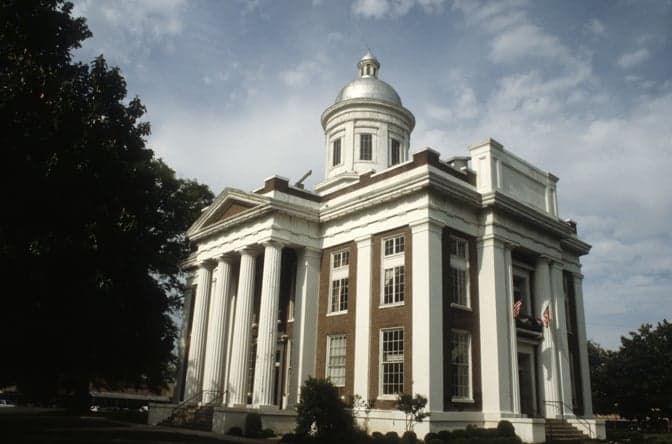

Photo: Wikipedia
Demographics of Canton, MS
Affluence Level in Canton, MS
A below-average socioeconomic profile. Incomes, home values, and educational attainment trail the U.S., with higher poverty and unemployment.
People of Canton, MS
The people of Canton, Mississippi, today form a predominantly Black community of 10,863 residents, with a character shaped by deep-rooted family networks, a strong church presence, and a quiet resilience born from the city's industrial and agricultural past. The population is 74.7% Black, 18.4% White, and 6.2% Hispanic, with a foreign-born share of just 2.5% and a college-educated rate of 22.1%. Distinctive markers include a tight-knit, multi-generational social fabric, a visible civic pride centered on the historic downtown square, and a growing but still modest Hispanic presence that is beginning to reshape parts of the city's eastern edge.
How the city was settled and grew
Canton was founded in 1834 as a railroad and trading hub on the Mississippi Central Railroad, drawing its earliest White settlers from the Carolinas and Virginia who established cotton plantations in the surrounding fertile Delta-adjacent bottomlands. Enslaved Black laborers, who would become the majority population after emancipation, built the city's original infrastructure and worked those plantations. After the Civil War, freedmen established the historic Liberty Hill neighborhood, a self-sufficient Black community centered on Liberty Street with its own churches, schools, and businesses. The early 20th century brought a second wave of Black families from rural Madison County into the Brickyard district, named for the clay pits and brick kilns that provided steady industrial work. White families concentrated in the North Canton area near the railroad depot and along the higher ground of Peace Street, while the city's small Jewish merchant community—mostly German Jews arriving in the 1850s–1880s—settled around the downtown square, operating dry goods stores and clothing shops that served both races.
Modern era (post-1965)
The post-1965 era saw Canton's White population decline sharply as school desegregation and the collapse of local manufacturing pushed many families to nearby Madison and Ridgeland. The Black population, already the majority, consolidated its presence in historic neighborhoods like Liberty Hill and Brickyard, while also expanding into previously White areas such as East Canton along Highway 22. The Hispanic population began arriving in the 1990s, drawn by work at the Nissan Canton assembly plant (opened 2003) and poultry processing facilities in nearby Morton and Forest. These mostly Mexican and Central American families settled in the East Canton corridor, particularly around the intersection of Highway 22 and Liberty Street, where a small cluster of tiendas and taquerias now serves the community. The Asian population remains negligible at 0.2%, and the Indian-subcontinent population is effectively zero, reflecting Canton's limited draw for professional-class immigrants compared to the Jackson suburbs. The city's college-educated rate of 22.1% is well below the state average, a legacy of limited local white-collar employment and out-migration of educated young adults.
The future
Canton's population is slowly homogenizing into a majority-Black city with a growing Hispanic minority, while the White share continues to decline. The Hispanic population, currently 6.2%, is the fastest-growing segment, driven by births and continued labor migration to the Nissan plant and logistics centers along Interstate 55. These families are increasingly settling in East Canton and the newer subdivisions near the Nissan plant, such as Fairfield Estates, where affordable housing and proximity to industrial jobs create a natural corridor. The Black population remains stable but aging, with younger Black adults often leaving for Jackson, Atlanta, or Memphis after high school. The White population, now under 20%, is concentrated among older residents in North Canton and a small number of families in the rural fringes. Over the next 10–20 years, Canton is likely to become more Hispanic (projected 10–12% by 2040) while remaining overwhelmingly Black, with little growth in Asian or Indian populations. The city is not tribalizing into distinct enclaves so much as experiencing a gradual ethnic succession in the eastern neighborhoods.
For someone moving in now, Canton offers a deeply rooted, family-oriented community with a strong sense of place, but limited economic mobility and a demographic trajectory that favors the Hispanic and Black working class. The city is becoming more diverse in a binary sense—Black and Hispanic—while remaining culturally conservative and church-centered. New residents should expect a quiet, affordable lifestyle with close ties to Jackson's amenities, but should also be prepared for a population that is slowly shrinking and aging, with few young professionals or college-educated peers outside the industrial sector.

* Values derived from national, state, county, city and local statistics and may differ in a specific area. Last updated: 2026-04-19T14:33:11.000Z
Narrative content on this page is AI-generated and may contain mistakes. Verify any details that matter before acting on them.
ReloMaps may earn a commission from affiliate links at no extra cost to you.

