Photo: Wikipedia
Demographics of Carson City, NV
Affluence Level in Carson City, NV
A middle-class area roughly in line with national averages across income, home values, education, and employment.
People of Carson City, NV
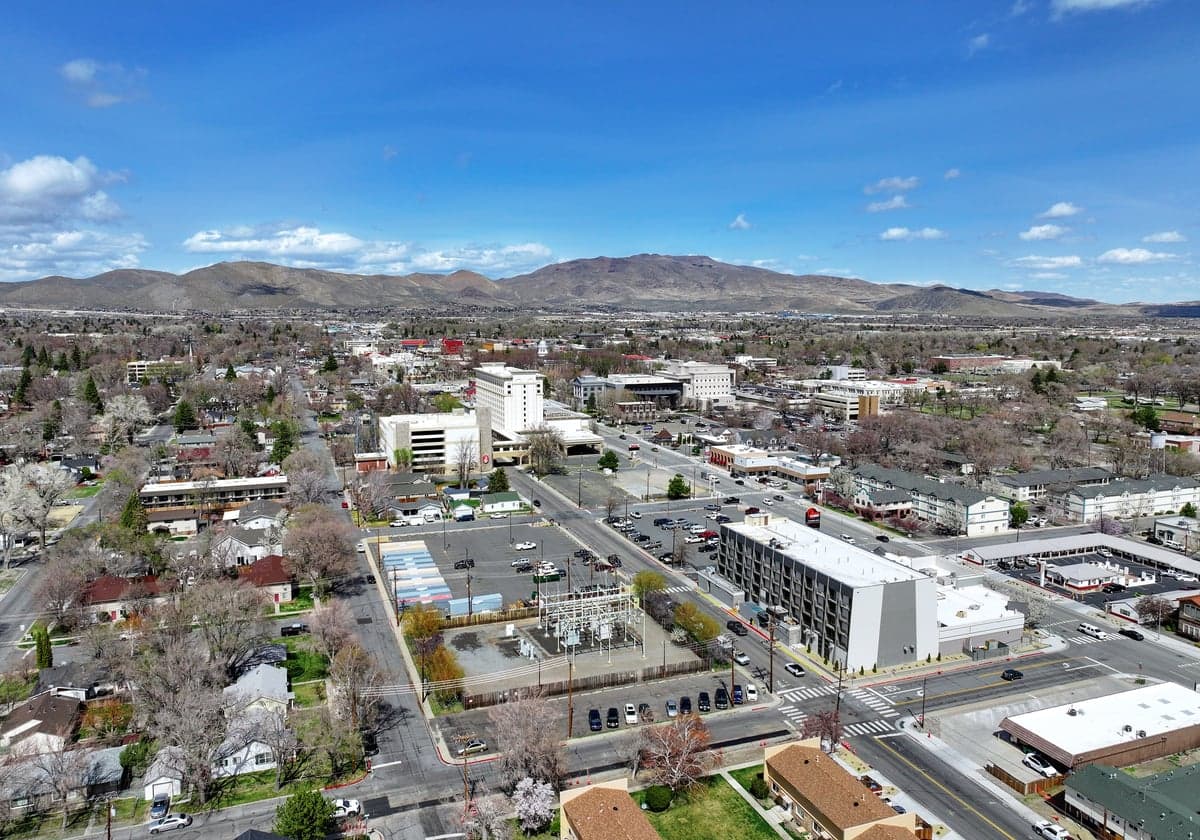
Carson City’s 58,364 residents form a predominantly white (63.2%) and Hispanic (25.9%) community with a small but growing East/Southeast Asian presence (2.4%) and a negligible Indian-subcontinent share (0.2%). The city is notably less diverse than neighboring Reno or Las Vegas, with a foreign-born population of just 6.5% and a college-educated rate of 24.5%—below the national average. This is a working-class, politically moderate-to-conservative state capital where government employment, healthcare, and small manufacturing anchor daily life. The population is older than the state median, with a distinct family-oriented character and a low crime rate that appeals to parents seeking stability.
How the city was settled and grew
Carson City was founded in 1858 as a trading post and named after the scout Kit Carson, but its real growth came with the 1859 Comstock Lode silver strike in nearby Virginia City. The original population was overwhelmingly white—miners, merchants, and speculators from the eastern U.S., many of whom were Civil War veterans or fortune-seekers. The city became the Nevada territorial capital in 1861 and the state capital in 1864, drawing a second wave of government clerks, lawyers, and railroad workers. The historic West Side neighborhood, centered around Curry Street and the Capitol, housed the early political and professional class in Victorian homes that still stand today. Meanwhile, the "South Carson" district (along South Carson Street) developed as a working-class corridor for railroad and mill laborers, including a small number of Chinese immigrants who built the Virginia & Truckee Railroad in the 1870s—though most left after the line was completed. By 1900, the city was nearly 95% white, with a tiny Black population (mostly railroad porters) and a handful of Hispanic families tied to ranching. The population plateaued at roughly 5,000 through the 1930s, as mining declined and the state government remained modest in size.
Modern era (post-1965)
The post-1965 period brought two major shifts. First, the 1960s and 1970s saw an influx of white retirees and state employees from California, drawn by Nevada’s lack of income tax and lower housing costs. This wave settled in the North Carson area (north of Fifth Street) and the newer Eagle Valley subdivisions, which filled with ranch-style homes on larger lots. Second, the Hispanic population began growing steadily after 1980, driven by agricultural and construction work in the surrounding valleys. Today, Hispanic residents (25.9%) are concentrated in the East Carson corridor (east of Carson Street, near the airport) and in the Mills Park area, where many families work in landscaping, hospitality, or the state’s maintenance crews. The East/Southeast Asian community (2.4%) is small but visible in the West Side and around the Carson Tahoe Regional Medical Center, where Filipino nurses and Chinese-American professionals have settled since 2000. The Black population (1.9%) remains tiny and scattered, with no distinct neighborhood concentration. The Indian-subcontinent population (0.2%) is negligible, consisting of a few dozen families employed in tech or healthcare, living in the newer Sunridge subdivision east of town. Notably, the foreign-born share (6.5%) is far lower than Nevada’s 19% average, reflecting Carson City’s limited draw for recent immigrants compared to Las Vegas or Reno.
The future
Demographic projections suggest Carson City will continue to homogenize rather than tribalize into distinct ethnic enclaves. The Hispanic share is expected to rise slowly to 30–32% by 2040, driven by higher birth rates and continued in-migration from California and Mexico, but these families are dispersing across the city rather than clustering. The white population is aging and declining slightly in absolute numbers, as younger white residents move to Reno or out of state for jobs. The East/Southeast Asian community may grow modestly if the medical center expands, but no large-scale immigration wave is anticipated. The city’s low college attainment (24.5%) and limited high-tech employment mean it will likely remain a blue-collar capital—stable, affordable, and politically conservative, but not a magnet for the diverse, educated workforce reshaping other Nevada cities. For a relocating family or individual, Carson City offers a safe, slow-paced environment with a predictable demographic trajectory: gradually more Hispanic, still majority white, and unlikely to see rapid change.
In short, Carson City is becoming a slightly more Hispanic version of its older self—a quiet, government-anchored town where the population is aging in place and new arrivals are mostly domestic, not foreign. For someone moving in now, the city offers low crime, good schools, and a conservative social fabric, but limited ethnic diversity and a workforce that skews toward public-sector and service jobs rather than tech or finance.

* Values derived from national, state, county, city and local statistics and may differ in a specific area. Last updated: 2026-04-22T01:26:04.000Z
Narrative content on this page is AI-generated and may contain mistakes. Verify any details that matter before acting on them.
ReloMaps may earn a commission from affiliate links at no extra cost to you.

