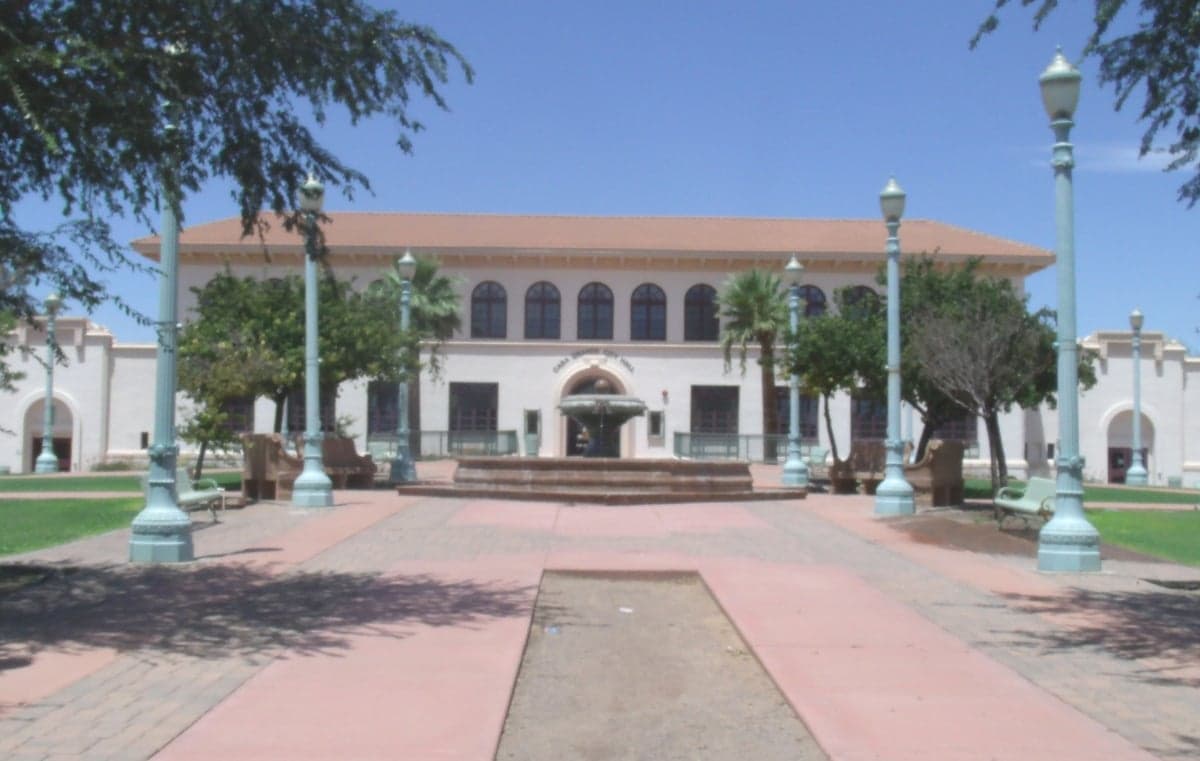
Photo: Wikipedia
Demographics of Casa Grande, AZ
Affluence Level in Casa Grande, AZ
A middle-class area roughly in line with national averages across income, home values, education, and employment.
People of Casa Grande, AZ
The people of Casa Grande, Arizona today form a nearly balanced binational community, with a population of 57,590 split almost evenly between non-Hispanic white residents (43.4%) and Hispanic or Latino residents (43.1%). The city is younger and less college-educated than the national average—only 21.1% hold a bachelor’s degree or higher—and its foreign-born share sits at a modest 6.5%, lower than many other Arizona cities. This is a working-class, family-oriented Sun Belt city where the dominant identity is neither exclusively Anglo nor exclusively Hispanic, but a hybrid of both, shaped by agriculture, logistics, and affordable housing.
How the city was settled and grew
Casa Grande was founded in 1879 as a railroad stop on the Southern Pacific line, not as a Spanish or Mexican colonial settlement. The name comes from the nearby Hohokam ruins, but the modern population history begins with Anglo-American homesteaders and Midwestern farmers who arrived via rail in the 1880s and 1890s. These early settlers established cotton and alfalfa farms, and the city’s first residential core formed around what is now Historic Downtown Casa Grande, along Florence Boulevard and 2nd Street. Mexican laborers began arriving in significant numbers during the early 1900s, recruited to work the cotton fields and later the copper smelters. They settled in the La Palma neighborhood, a historic barrio south of the railroad tracks that remains a Hispanic cultural anchor today. By 1950, Casa Grande’s population was roughly 4,000, with a white majority and a substantial Mexican-American minority concentrated in La Palma and the Peartown area near the old cotton gin.
Modern era (post-1965)
The post-1965 era transformed Casa Grande from a sleepy farm town into a growing logistics and manufacturing hub. The Immigration and Nationality Act of 1965 opened doors for new immigration, but Casa Grande’s foreign-born share (6.5%) remains low compared to Phoenix or Tucson. Instead, the city’s Hispanic growth has come primarily from domestic migration—Mexican-American families moving from California and from rural Arizona counties seeking affordable housing and warehouse jobs. The opening of the Central Arizona College campus in 1970 and the construction of Interstate 10 in the 1980s spurred suburban-style development. Newer subdivisions such as Mountain View Ranch and Palo Verde Estates attracted white and Hispanic families alike, creating a more integrated suburban landscape. The Black population (4.5%) is small but concentrated in the Boulder Creek area and in rental complexes near the industrial parks. East and Southeast Asian residents (1.4%) are a recent addition, many employed at the Lucent Alcatel-Lucent (now Nokia) facility and the Abbott Nutrition plant, and they tend to live in the newer Villago master-planned community. The Indian-subcontinent population (0.3%) is tiny and scattered, without a distinct ethnic enclave.
The future
Casa Grande’s demographic future points toward continued binational homogenization rather than tribalization into distinct enclaves. The Hispanic and white shares are nearly equal now, and both groups are dispersing across the city’s newer subdivisions—Villago, Mountain View Ranch, and the West Side developments near the new hospital. The foreign-born share is unlikely to rise sharply because the city lacks the dense ethnic networks and low-wage service economy that attract new immigrants to Phoenix or Tucson. Instead, domestic migration from California and the Midwest will remain the primary driver of growth. The Black and Asian populations are small and will likely remain so, as Casa Grande does not have the job diversity or cultural infrastructure to attract large numbers of either group. The city is becoming more uniformly middle-class and family-oriented, with a growing number of dual-income households commuting to Phoenix or working in the expanding logistics corridor along I-10.
For someone moving in now, Casa Grande offers a stable, affordable, and culturally blended environment where the dominant social dynamic is not ethnic tension but economic pragmatism. The city is neither homogenizing into a white suburb nor tribalizing into ethnic enclaves—it is becoming a place where Hispanic and white families increasingly share the same neighborhoods, schools, and retail corridors. The next decade will likely see the Hispanic share edge past 50%, making Casa Grande one of the few Arizona cities where a non-white group becomes the plurality without displacing the existing white population through rapid immigration. This is a slow, organic demographic shift driven by family formation and housing affordability, not by international migration.

* Values derived from national, state, county, city and local statistics and may differ in a specific area. Last updated: 2026-04-21T18:25:23.000Z
Narrative content on this page is AI-generated and may contain mistakes. Verify any details that matter before acting on them.
ReloMaps may earn a commission from affiliate links at no extra cost to you.

