Photo: Wikipedia
Demographics of Casper, WY
Affluence Level in Casper, WY
A middle-class area roughly in line with national averages across income, home values, education, and employment.
People of Casper, WY
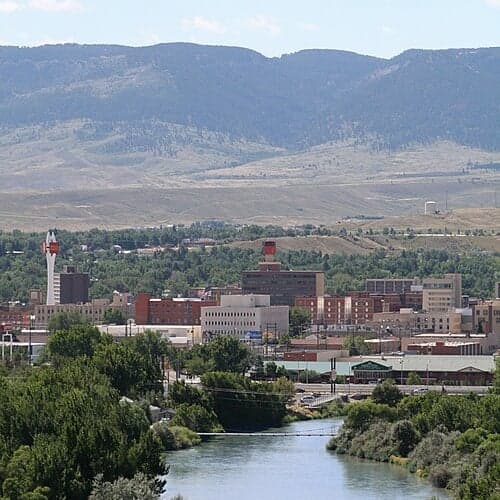
The people of Casper, Wyoming, today number roughly 58,754, forming a community that is notably homogeneous and rooted in a Western, working-class identity. With a population that is 85.7% white and only 0.8% foreign-born, Casper is less ethnically diverse than the national average, yet it carries a distinctive character shaped by energy booms, ranching heritage, and a strong sense of self-reliance. The city's density is low, and its identity markers—pickup trucks, oil field gear, and a deep attachment to outdoor recreation—reflect a population that values stability, tradition, and a slower pace of life.
How the city was settled and grew
Casper's human history begins not with colonial settlement but with the railroad and the discovery of oil. Founded in 1888 as a railroad town on the Chicago and North Western line, the original population was a mix of railroad workers, cattle ranchers, and entrepreneurs drawn by the promise of the open range. The first major wave came with the 1890s oil boom, when the Salt Creek Oil Field—one of the largest in the world—attracted thousands of workers from the Midwest and the Rocky Mountain region. These early settlers, overwhelmingly white and of Northern European descent, built the Old Casper neighborhood near the North Platte River, where modest frame houses and boarding houses still stand. By the 1920s, the city's population had swelled to over 10,000, and the South Park area began to develop as a residential district for oil executives and professionals. The Great Depression slowed growth, but World War II brought a second wave: workers for the oil refineries and the nearby Naval Petroleum Reserve, many of whom settled in the Westside neighborhood, a grid of post-war bungalows and ranch homes. Through the mid-20th century, Casper remained a white, blue-collar town, with a small Hispanic population—mostly Mexican-American railroad and ranch hands—concentrated in the North Casper area, a working-class district that still retains a slightly higher Hispanic share today.
Modern era (post-1965)
After the 1965 Hart-Cellar Act, Casper saw little change in its ethnic composition, as the city's remote location and energy-dependent economy did not attract the large-scale immigration seen in coastal cities. The post-1965 era was instead defined by domestic in-migration, driven by the oil booms of the 1970s and early 2000s. During the 1970s energy crisis, thousands of workers from Texas, Oklahoma, and the Gulf Coast moved to Casper, settling in newer subdivisions like Paradise Valley, a master-planned community on the city's eastern edge that grew rapidly with ranch-style homes and cul-de-sacs. The 1980s oil bust caused a population decline, but the 2000s shale boom brought a second wave of domestic migrants, many from the Dakotas and Montana, who filled the Eastridge neighborhood, a mix of 1990s and 2000s tract housing. Today, the foreign-born population remains minuscule at 0.8%, with the largest non-white group being Hispanic residents at 8.9%, many of whom are multi-generational families in North Casper and the Mountain View area. Black (0.6%), East/Southeast Asian (0.3%), and Indian-subcontinent (0.2%) communities are tiny and dispersed, with no distinct ethnic enclaves. The college-educated share is 30.0%, reflecting a modest but growing professional class, though the city's economy still leans heavily on energy, healthcare, and retail.
The future
Demographically, Casper is likely to remain a predominantly white, native-born city over the next 10–20 years. The Hispanic population is growing slowly—up from about 6% in 2000 to 8.9% today—but this growth is driven by natural increase rather than new immigration, and these families are assimilating into the broader community rather than forming separate enclaves. The city is not tribalizing into distinct ethnic neighborhoods; instead, it is homogenizing as newer subdivisions like Paradise Valley and Eastridge attract a mix of white and Hispanic middle-class families. The biggest demographic shift may be an aging population, as younger residents leave for college and careers in Denver or Salt Lake City, while retirees from the energy industry stay. For someone moving in now, Casper offers a stable, low-crime environment with a strong sense of community, but little ethnic diversity and limited cultural variety. It is becoming a place where the population is slowly graying and slightly diversifying, but the core identity—white, Western, and working-class—will likely persist for decades.
In short, Casper is a city built by oil and railroad workers, where the population has remained remarkably stable in its ethnic makeup for over a century. The future points to gradual Hispanic growth and an aging white majority, with no major influx of foreign-born residents. For a conservative-leaning individual or family, this means a predictable, safe community where the cultural and political landscape is unlikely to shift dramatically in the coming years.

* Values derived from national, state, county, city and local statistics and may differ in a specific area. Last updated: 2026-10-10T16:27:04.000Z
Narrative content on this page is AI-generated and may contain mistakes. Verify any details that matter before acting on them.
ReloMaps may earn a commission from affiliate links at no extra cost to you.

