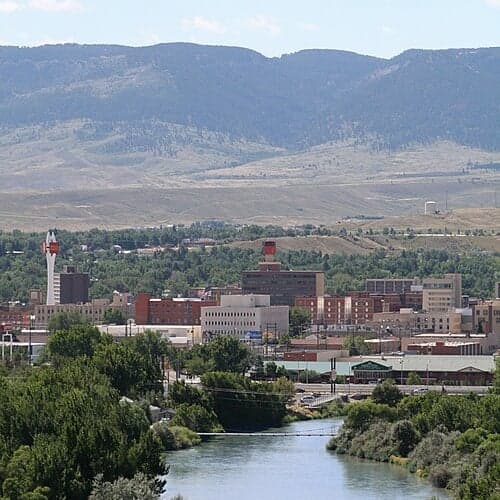
Photo: Wikipedia
Political ClimatePolitical Climate in Casper, WY
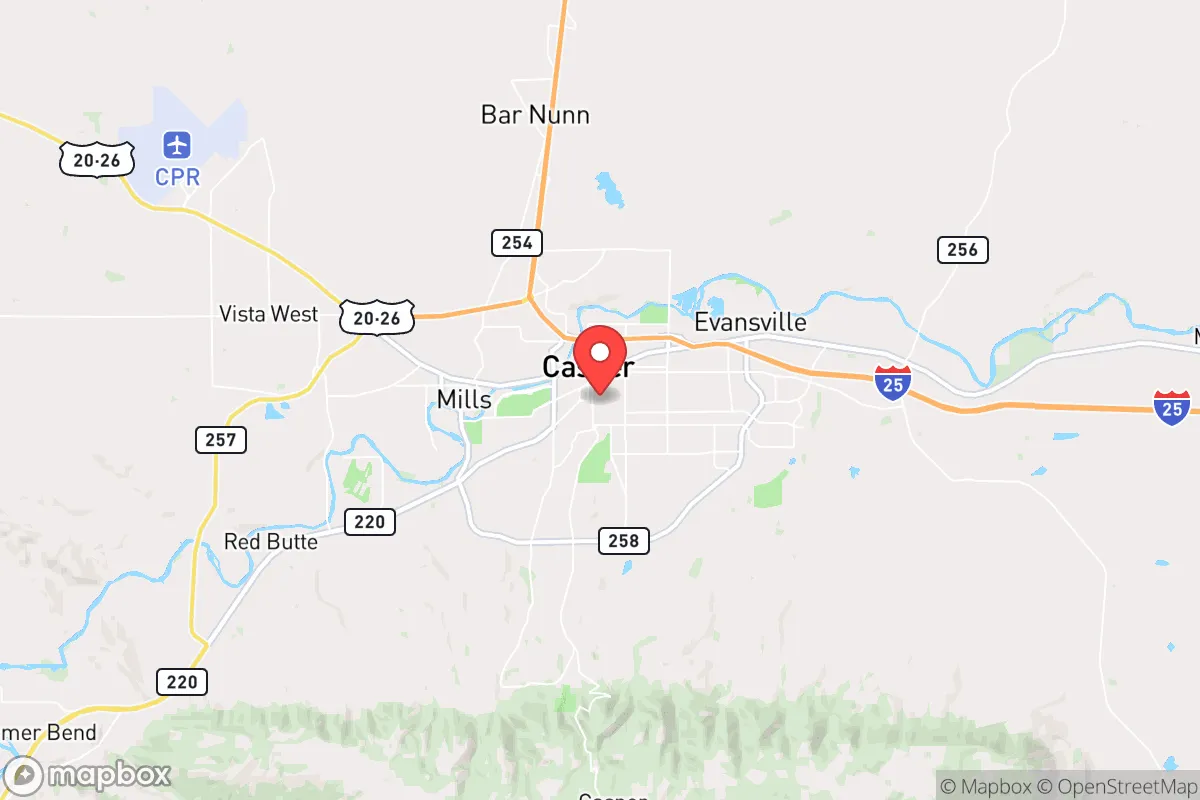
District shown is the primary district for this city’s centroid. Cities may span multiple districts.
Inherited from parent state — no local data available.
Local Political AnalysisPolitical Analysis of Casper, WY
Casper, Wyoming, has long been a rock-solid conservative stronghold, and that hasn't changed much. With a Cook PVI of R+23, the city and surrounding Natrona County consistently vote Republican by wide margins—think 70% or more in most presidential elections. But if you've lived here a while, you'll notice the political vibe is shifting, and not necessarily for the better. The old-school, live-and-let-live conservatism that defined this place is being challenged by a more progressive, government-first mindset creeping in from the coasts, and it's something locals are keeping a close eye on.
How it compares
Compared to other parts of Wyoming, Casper is actually a bit of a mixed bag. Head north to places like Sheridan or Buffalo, and you'll find a similar conservative bent, though maybe a little more libertarian-leaning on land use. Drive south to Laramie, home of the University of Wyoming, and you'll hit a noticeably more liberal pocket—think bike lanes, organic co-ops, and student activism. Casper sits in the middle: still deeply red, but with a growing number of transplants from Colorado and California who bring their big-city ideas about zoning, environmental regulations, and "equity" initiatives. The contrast is real. While the county as a whole votes red, the city council has seen a few progressive-leaning members push for things like higher density housing mandates and diversity training, which rubs a lot of old-timers the wrong way. It's not Laramie yet, but the trajectory is concerning if you value limited government and personal freedom.
What this means for residents
For the average Casper resident, this political climate means you still enjoy a lot of freedom compared to most of the country. No state income tax, relatively loose gun laws, and a general hands-off attitude from local government on things like property use and business operations. But there's a growing tension. You see it in debates over oil and gas permitting, where state-level officials are generally pro-industry, but local activists push for more environmental review. You see it in school board meetings, where battles over curriculum and parental rights are heating up. The biggest red flag for many is the slow creep of government overreach—things like mask mandates during COVID, which were thankfully short-lived here, or proposals to restrict short-term rentals. If you value being left alone to run your life and your business without a bureaucrat's permission, Casper is still a good bet, but you have to stay engaged. The old "Wyoming way" of neighbor helping neighbor without government interference is worth fighting for.
Culturally, Casper still feels like a place where a handshake matters more than a policy paper. The energy industry—oil, gas, coal, and now some wind—drives the economy, and most folks understand that prosperity comes from hard work, not government programs. You'll find strong support for the Second Amendment, local ranching traditions, and a general skepticism of federal authority. But there's a quiet worry among long-time residents that the next wave of newcomers, or the next election cycle, could tip the balance toward more regulation and less personal liberty. For now, Casper remains a place where conservative values hold firm, but it's not immune to the national trends. If you're thinking of moving here, know that you'll find plenty of like-minded neighbors who value freedom and self-reliance—just keep an eye on the local elections, because that's where the real fights are happening.

State Political ClimatePolitical Climate in Wyoming
State Political AnalysisPolitical Environment in the State
Wyoming is one of the most reliably Republican states in the nation, with a partisan lean that has only deepened over the past two decades. In the 2024 presidential election, Donald Trump carried the state by roughly 46 points, a margin that has held steady or widened since 2016. The dominant coalition is a mix of rural ranchers, energy-sector workers, and a growing number of conservative transplants fleeing blue states. Over the last 10-20 years, the state has shifted further right, driven by an exodus of moderate Democrats from the state legislature and a surge of libertarian-leaning newcomers into places like Laramie and Sheridan. While the state has always been red, the flavor has become more aggressively constitutionalist and anti-federal overreach.
Urban vs. rural divide
The political map of Wyoming is starkly divided between a handful of small urban centers and the vast, sparsely populated rural expanse. Cheyenne, the state capital and largest city, leans Republican but is the most moderate part of the state, with a noticeable presence of state employees and a small but vocal Democratic minority. Casper, the second-largest city, is reliably red but has a more pragmatic, energy-industry-driven conservatism. The real engine of the state’s hard-right tilt is the rural counties: Sublette County (Pinedale) and Carbon County (Rawlins) routinely vote 80%+ Republican. Teton County, home to Jackson Hole, is the glaring exception—it’s the only county that consistently votes Democratic, driven by wealthy out-of-state transplants and a tourism-based economy. That county’s blue streak is a source of constant tension, with locals grumbling about "California money" driving up property taxes and pushing progressive policies on land use and wildlife management.
Policy environment
Wyoming’s policy environment is aggressively pro-business and anti-tax. There is no state income tax, and the sales tax is a low 4%, though local options can push it to 6%. Property taxes are among the lowest in the nation, with no tax on retirement income—a major draw for conservative retirees. The regulatory posture is light-touch, especially for the energy sector (coal, oil, natural gas, and increasingly uranium). Education policy is a mixed bag: the state has a school choice program (the Wyoming School Choice Program, expanded in 2023) that allows education savings accounts, but rural districts often struggle with funding and teacher shortages. Election laws are solidly conservative: voter ID is required, same-day registration is not allowed, and mail-in voting is restricted to those with an excuse. The state has also passed a law (HB 100, 2023) banning the use of private money to fund election administration, a direct response to the 2020 "Zuckerbucks" controversy. Healthcare policy is limited; the state did not expand Medicaid under the ACA, and there is a strong push for medical freedom, including a 2021 law (SF 100) prohibiting vaccine passports and a 2023 law (HB 112) banning COVID-19 vaccine mandates for state employees.
Trajectory & freedom
Wyoming is becoming more free, at least by conservative and libertarian metrics. The state has been a national leader in the Second Amendment sanctuary movement, with a 2021 law (SF 102) declaring that federal gun laws infringing on the right to keep and bear arms are null and void within state borders. In 2023, the legislature passed the "Wyoming Freedom Act" (HB 108), which prohibits the enforcement of federal laws that don’t have a state equivalent—a direct challenge to federal overreach on everything from environmental regulations to gun control. Parental rights have been strengthened: the "Parents’ Bill of Rights" (SF 19, 2023) requires schools to notify parents of any medical or mental health services provided to their children and prohibits instruction on sexual orientation or gender identity in grades K-3. Medical autonomy has been expanded with a 2022 law (HB 92) allowing the use of experimental treatments for terminal patients, and a 2024 law (HB 100) banning the enforcement of federal mandates on medical procedures. Property rights are robust, with a 2023 law (HB 200) limiting the use of eminent domain for carbon pipelines. The only area where freedom has arguably contracted is in the realm of abortion: a 2022 trigger law (HB 92) banned abortion with very narrow exceptions, and a 2023 law (SF 109) criminalized the distribution of abortion pills by mail. For a conservative audience, this is a net positive, but it’s worth noting that the state’s libertarian streak sometimes clashes with its social conservatism.
Civil unrest & political movements
Wyoming is not a hotbed of civil unrest, but there are organized movements on both sides. The most visible is the "Wyoming Liberty Group," a libertarian-leaning organization that pushes for nullification of federal laws and has been behind the Second Amendment sanctuary and freedom act legislation. On the right, there is a growing "constitutional sheriff" movement, particularly in counties like Park County (Cody) and Fremont County (Lander), where sheriffs have publicly stated they will not enforce federal gun laws. Immigration politics are relatively quiet, as the state has a very small foreign-born population (around 3%), but there is a vocal minority pushing for state-level immigration enforcement, including a 2024 bill (HB 150) that would require local law enforcement to cooperate with ICE. There are no sanctuary cities in Wyoming; in fact, Jackson (Teton County) has been the site of tension over its progressive local policies, but even there, the county commission has resisted sanctuary status. Election integrity controversies are minimal, but the 2020 election saw a small but persistent group of activists calling for a forensic audit of the state’s voting machines—a demand that was rejected by the Republican Secretary of State. The most visible flashpoint for a new resident would likely be the annual "Wyoming State Fair" in Douglas, where political booths from both the Wyoming GOP and the Libertarian Party are common, and where you’ll see plenty of "Don’t Tread on Me" flags alongside Trump banners.
Projection
Over the next 5-10 years, Wyoming is likely to become even more conservative and libertarian, driven by two demographic trends. First, the state is seeing a steady influx of conservative migrants from California, Colorado, and the Pacific Northwest, who are drawn by low taxes, gun-friendly laws, and a slower pace of life. These newcomers tend to settle in Sheridan, Buffalo, and Laramie, and they are often more politically active than native-born residents. Second, the state’s young people are leaving for college and not returning, which is aging the population and further entrenching conservative voting patterns. The energy sector will remain a political force, but the state is also diversifying into data centers (Microsoft has a major facility in Cheyenne) and cryptocurrency mining, which tends to attract libertarian-leaning entrepreneurs. The biggest wild card is the federal government: if a future Democratic administration cracks down on fossil fuels or gun rights, expect Wyoming to lead the charge in nullification and possibly even talk of secession (a fringe but persistent idea in the state). For someone moving in now, expect to find a state that is increasingly assertive in its defiance of federal authority, with a political culture that values personal liberty above almost all else.
For a new resident, the bottom line is this: Wyoming offers one of the most freedom-friendly environments in the country, with low taxes, strong gun rights, and a government that is actively pushing back against federal overreach. The trade-offs are a limited job market outside of energy and government, harsh winters, and a social scene that can feel insular. If you value personal autonomy and don’t mind small-town life, you’ll fit right in. Just be prepared for the occasional culture clash if you end up near Jackson Hole.
* Values derived from national, state, county, city and local statistics and may differ in a specific area. Last updated: 2026-10-10T16:27:04.000Z
Narrative content on this page is AI-generated and may contain mistakes. Verify any details that matter before acting on them.
ReloMaps may earn a commission from affiliate links at no extra cost to you.

