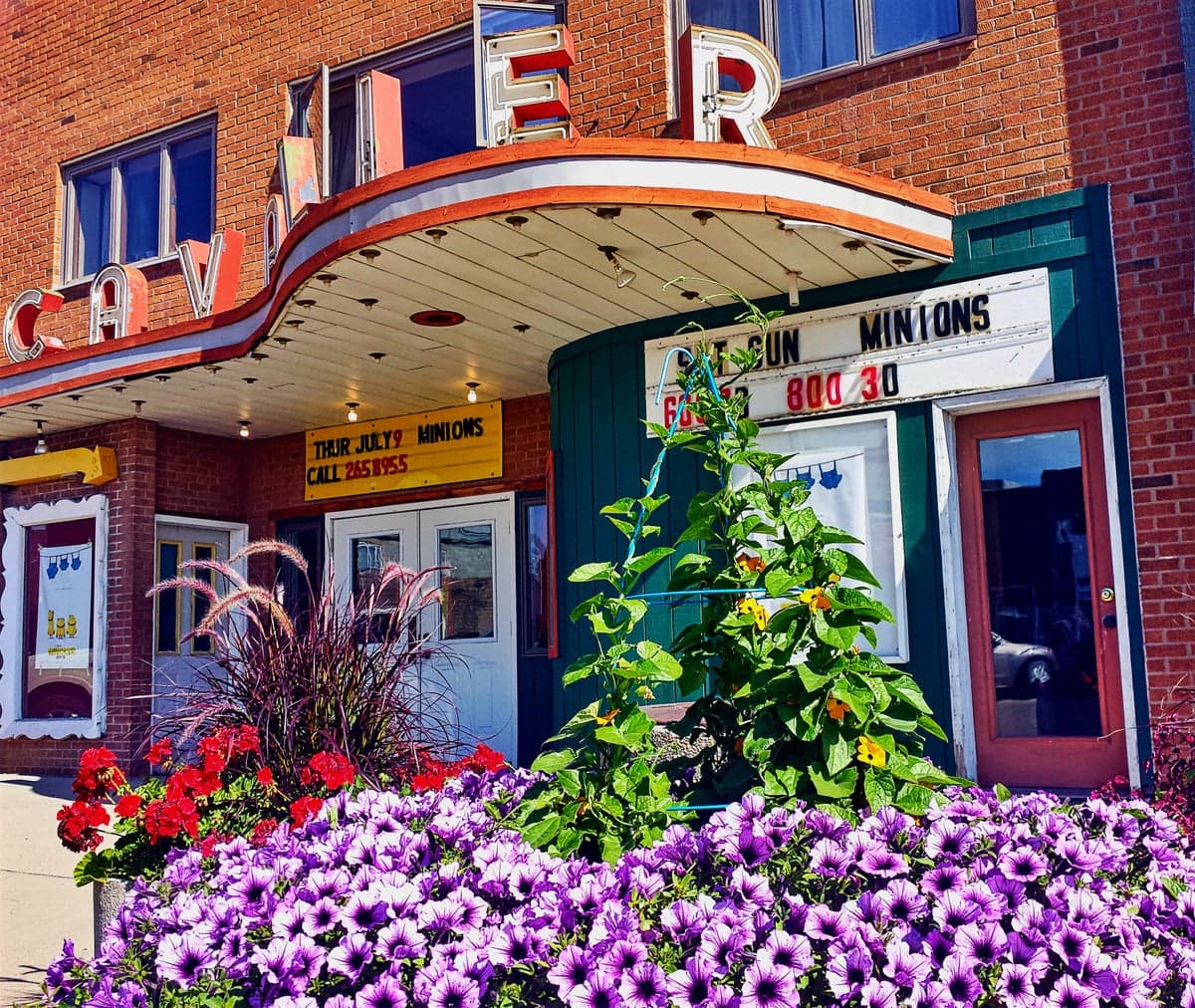
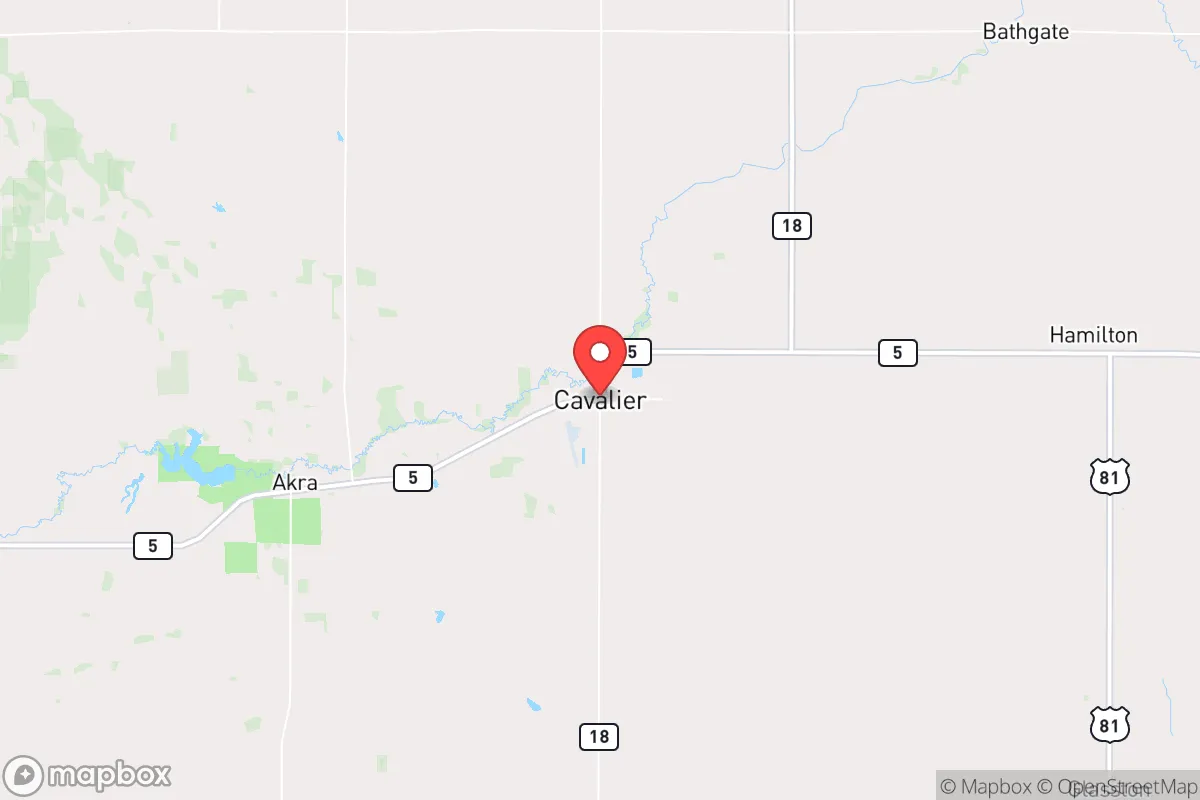
Photo: Wikipedia
Demographics of Cavalier, ND
Affluence Level in Cavalier, ND
A middle-class area roughly in line with national averages across income, home values, education, and employment.
People of Cavalier, ND
The people of Cavalier, North Dakota today number 1,304, forming a predominantly white (91.9%) community with a small but notable Black population (2.8%) and a foreign-born share of 2.2%. The city is characterized by its role as the Pembina County seat and a service hub for the surrounding agricultural region, with a population density that feels distinctly small-town. Residents are older on average than the national median, and the 27.9% college-educated rate reflects a workforce rooted in local government, healthcare, and agribusiness rather than a large professional class.
How the city was settled and grew
Cavalier was founded in 1875 as a railroad town on the line of the St. Paul, Minneapolis & Manitoba Railway (later the Great Northern). The original settlers were predominantly Norwegian and German immigrants drawn by the Homestead Act of 1862, which offered 160 acres of land to anyone willing to farm the flat, fertile plains of the Red River Valley. These early homesteaders built the first homes in what is now the Original Townsite district, centered around the railroad depot and the intersection of Main Street and 2nd Avenue. A second wave of Scandinavian immigrants arrived in the 1880s and 1890s, many settling in the North Side neighborhood, where they established Lutheran churches and a cooperative creamery. By 1900, the population had reached roughly 500, and the town was incorporated in 1901. The economy remained tied to wheat and sugar beet farming, with the American Crystal Sugar Company opening a receiving station in the 1920s that drew a small number of seasonal Mexican laborers—a precursor to the modern Hispanic population (now 1.9%). The South End district, developed after World War I, housed many of these seasonal workers in modest frame houses.
Modern era (post-1965)
The post-1965 period saw Cavalier’s population peak at around 1,500 in the 1970s, driven by the expansion of the Cavalier Air Force Station (a radar installation) and the growth of the Pembina County government. The Air Base Addition neighborhood, built in the 1960s and 1970s just west of the original townsite, housed military families and civilian contractors, introducing a transient population that was more racially diverse than the local norm. This area remains the most ethnically varied part of the city today, with a mix of white, Black, and Indian-subcontinent households (the latter comprising 0.9% of the city’s total). The Hillcrest subdivision, developed in the 1980s and 1990s on the city’s eastern edge, attracted younger families and professionals, but its growth has stalled as the overall population declined by roughly 15% since 2000. The Black population (2.8%) is largely concentrated in the Air Base Addition and a small cluster of rental properties near the hospital, reflecting a pattern of employment-driven migration rather than chain migration from a specific origin. The East/Southeast Asian population is effectively zero (0.0%), and the Indian-subcontinent community (0.9%) is composed primarily of healthcare professionals working at the Pembina County Memorial Hospital.
The future
Cavalier’s population is projected to continue a slow decline, mirroring trends across rural North Dakota. The city is homogenizing rather than tribalizing: the small Black and Indian-subcontinent populations are not growing, and the Hispanic share (1.9%) has plateaued. The foreign-born rate (2.2%) is well below the national average, and there is no evidence of new immigrant enclaves forming. The Original Townsite and North Side neighborhoods are aging, with many homes owned by retirees, while the Air Base Addition faces uncertainty as the Air Force station’s role diminishes. The next 10–20 years will likely see further population contraction, with the remaining residents concentrated in the Hillcrest and South End areas, where housing is newer and more affordable. In-migration will be limited to a trickle of healthcare workers and government employees, and the city will remain overwhelmingly white and native-born.
For a conservative-leaning individual or family considering relocation, Cavalier offers a stable, low-crime, and culturally homogeneous environment where traditional values and community ties remain strong. The population is not diversifying rapidly, and the city is becoming quieter and older. New arrivals will find a place where neighbors know each other, churches are central to social life, and the pace of change is slow—a deliberate choice for those seeking to escape the demographic flux of larger cities.

* Values derived from national, state, county, city and local statistics and may differ in a specific area. Last updated: 2026-10-10T16:27:06.000Z
Narrative content on this page is AI-generated and may contain mistakes. Verify any details that matter before acting on them.
ReloMaps may earn a commission from affiliate links at no extra cost to you.

