
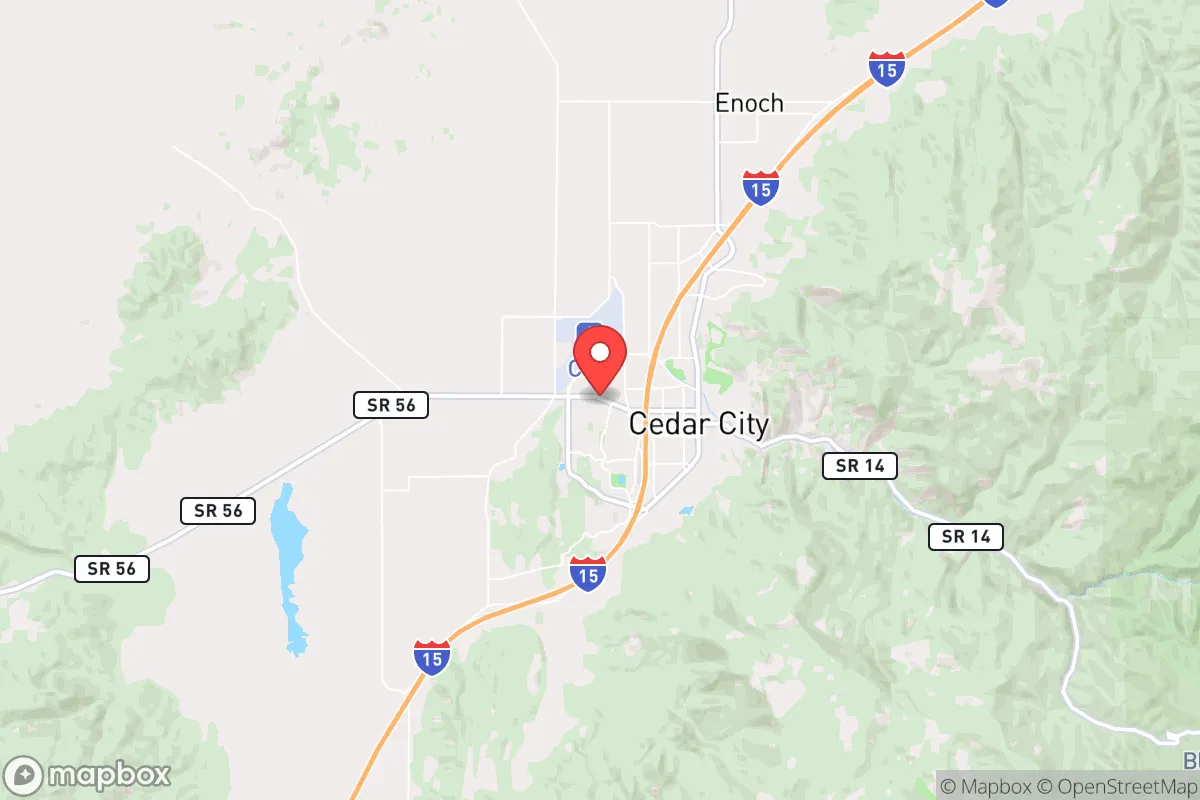
Photo: Wikipedia
Demographics of Cedar City, UT
Historical data isn't available for Cedar City, UT. Trends shown are for Iron County, UT.
Affluence Level in Cedar City, UT
A middle-class area roughly in line with national averages across income, home values, education, and employment.
People of Cedar City, UT
Cedar City, Utah, is home to 37,202 residents, a population that remains predominantly white (78.5%) with a growing Hispanic community (14.3%) and a very small foreign-born share of just 2.5%. The city’s character is shaped by its roots as an agricultural and iron-mining outpost, its role as a regional education hub anchored by Southern Utah University, and a strong Latter-day Saint cultural influence that still defines much of daily life. With 34.1% of adults holding a college degree, the population is more educated than the national average for similar-sized towns, reflecting the university’s draw. The people here are notably homogeneous in background and values, though the Hispanic presence is slowly diversifying the city’s social fabric.
How the city was settled and grew
Cedar City was founded in 1851 by Mormon pioneers sent by Brigham Young to establish an ironworks, part of a broader effort to make the Utah Territory self-sufficient. The original settlers were predominantly families from the British Isles and Scandinavia who had converted to the LDS Church, and they built the first homes in what is now the Downtown Historic District, centered around Main Street and 100 North. The iron industry failed by the 1860s, but the community pivoted to agriculture, livestock, and later timber, with new waves of LDS settlers arriving from other Utah settlements. By the early 1900s, the Fiddlers Canyon area (northeast of downtown) became a hub for farming families, while the Coal Creek corridor attracted workers for the railroad and small-scale mining. The population remained overwhelmingly white and LDS through the mid-20th century, with almost no non-white or foreign-born residents until after World War II.
Modern era (post-1965)
The 1965 Immigration and Nationality Act had little immediate effect on Cedar City, as the city’s remote location and lack of industrial jobs did not attract the large immigrant flows seen in coastal cities. Instead, the post-1965 era was defined by domestic in-migration: the expansion of Southern Utah University (founded as a teachers college in 1897) drew students and faculty from across the Intermountain West, and the construction of Interstate 15 in the 1970s made the city more accessible. The University District (south of campus, near 300 South) saw new subdivisions built for faculty and staff, while the Canyon Park area (east of I-15) attracted retirees and second-home buyers from California and Nevada. The Hispanic population began growing in the 1990s, driven by agricultural labor in nearby farms and construction work during the city’s building boom. Today, Hispanic residents (14.3%) are concentrated in the West Side neighborhoods near the old railroad tracks and along 200 West, where lower housing costs and proximity to service jobs have created a small but visible enclave. The East/Southeast Asian population (1.1%) is almost entirely tied to the university, with faculty and graduate students living in the Fiddlers Canyon area, while the Indian-subcontinent population (0.3%) is similarly university-linked. The Black population (1.0%) is scattered, with no single neighborhood concentration.
The future
Cedar City’s population is projected to grow modestly, likely reaching 45,000–50,000 by 2040, driven by continued university expansion and spillover from St. George’s rapid growth 50 miles south. The white share will likely decline slowly as the Hispanic population grows through both natural increase and continued in-migration for construction and service jobs. However, the city is not tribalizing into distinct ethnic enclaves; the Hispanic community is assimilating into the broader culture, with many second-generation residents attending SUU and moving into mixed neighborhoods. The foreign-born share (2.5%) is expected to remain low, as Cedar City lacks the industrial base or refugee resettlement programs that drive immigration in larger Utah cities like Salt Lake City. The East/Southeast Asian and Indian populations will likely plateau or grow only slightly, tied to specific academic departments at SUU. The city is homogenizing in values and lifestyle, with the LDS cultural framework remaining dominant, even as a small secular and out-of-state transplant population grows in the University District and Canyon Park.
For someone moving to Cedar City today, the city offers a stable, family-oriented community with a strong sense of local identity, low crime, and a cost of living below the national average. The population is becoming slightly more diverse, but the pace is slow, and the dominant culture remains white, LDS, and politically conservative. New residents will find a place where neighbors know each other, church and university anchor social life, and the biggest demographic change is the gradual growth of a Hispanic middle class rather than any dramatic shift in the city’s character.

* Values derived from national, state, county, city and local statistics and may differ in a specific area. Last updated: 2026-04-21T13:04:19.000Z
Narrative content on this page is AI-generated and may contain mistakes. Verify any details that matter before acting on them.
ReloMaps may earn a commission from affiliate links at no extra cost to you.

