Demographics of Celebration, FL
Affluence Level in Celebration, FL
An upper-middle-class area. Household wealth, education levels, and homeownership run ahead of national benchmarks.
People of Celebration, FL
The people of Celebration, Florida, today form a notably affluent, highly educated, and predominantly white community of 13,150 residents, defined by its planned-town origins and a demographic profile that skews heavily toward families and professionals. With a 56.1% college-educated rate and a median household income well above the national average, the population is characterized by a strong sense of curated community identity, drawn to the town’s Disney-backed design and walkable, small-town aesthetic. The population is 68.9% white, 18.4% Hispanic, 2.2% East/Southeast Asian, 1.2% Black, and 0.6% Indian (subcontinent), with 11.8% foreign-born, reflecting a largely domestic in-migration pattern with a modest but growing international component.
How the city was settled and grew
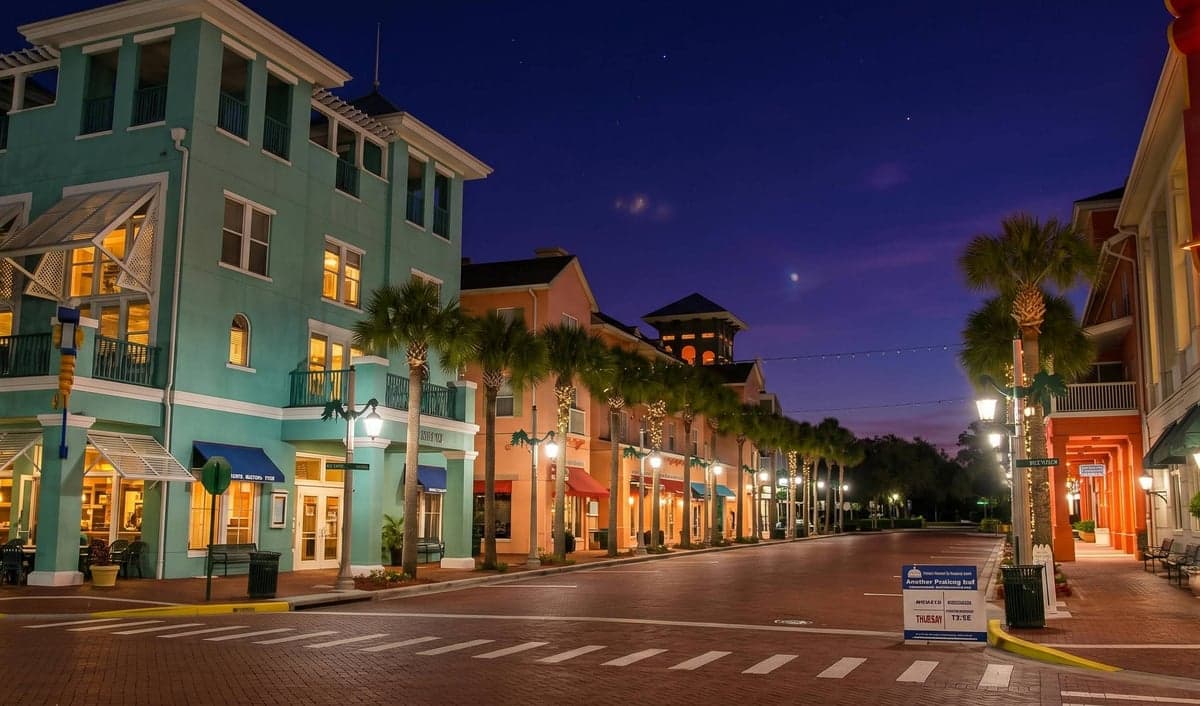
Celebration is a post-1990s planned community, not a historic settlement. It was conceived and developed by The Walt Disney Company in the mid-1990s on land Disney had acquired decades earlier as part of its Florida holdings. The first residents moved in in 1996, drawn by the vision of a New Urbanist town with neotraditional architecture, a downtown core, and a heavy emphasis on community life. The original wave of settlers were primarily upper-middle-class families from across the United States, particularly from the Northeast and Midwest, who were attracted by the promise of a safe, orderly, and aesthetically pleasing environment. The earliest neighborhoods to fill were the Lake Evalyn and Lake Rianhard districts, which offered the most direct access to the downtown and the iconic Celebration School. These early residents were overwhelmingly white and professional, setting the demographic tone that persists today.
Modern era (post-1965)
Because Celebration was built from scratch in the 1990s, its modern era is its entire history. The post-1965 immigration reforms that reshaped much of the U.S. had no direct impact on this town’s founding, as it did not exist. Instead, the demographic story of Celebration is one of domestic in-migration and a gradual, modest diversification. The initial population was nearly entirely white, but as the town matured, it began to attract a more varied mix. The Artisan Park neighborhood, developed in the 2000s, became a landing point for younger families and some Hispanic professionals, drawn by its slightly more affordable townhomes and proximity to the downtown. The West Village district, with its larger single-family homes, has remained a stronghold of the original white professional class. The Hispanic population, now 18.4%, has grown steadily, largely through domestic moves from other parts of Florida and the U.S., rather than direct international migration. The East/Southeast Asian community (2.2%) and the small Indian subcontinent population (0.6%) are concentrated in the Aqua and Emerald neighborhoods, often drawn by employment at nearby Disney World or in Orlando’s tech and healthcare sectors. The Black population remains very low at 1.2%, a figure that has not changed significantly since the town’s founding, reflecting the broader demographic challenges of attracting a more diverse resident base to a high-cost, planned community.
The future
The population of Celebration is likely to continue its slow, incremental diversification, but the town’s high housing costs and specific brand identity will keep it from becoming a major destination for immigrant communities. The Hispanic share is expected to grow modestly, potentially reaching the low 20% range over the next decade, driven by domestic moves from within Florida. The East/Southeast Asian and Indian subcontinent populations will likely remain small, plateauing at current levels unless new employment anchors emerge. The white share, while still dominant, will continue a gradual decline as the town ages and younger, more diverse families move in. The town is not tribalizing into distinct ethnic enclaves; rather, it is homogenizing around a shared lifestyle and income level, with neighborhoods like Lake Evalyn and Artisan Park remaining socioeconomically similar even as their ethnic composition shifts slightly. The biggest demographic risk is an aging population, as the original 1990s settlers enter retirement, potentially leading to a turnover in housing stock that could accelerate diversification or, conversely, attract more of the same demographic profile.
For someone moving in now, Celebration is becoming a slightly more diverse but still overwhelmingly white and affluent community, where the defining characteristic is not ethnicity but a shared commitment to the town’s planned, family-oriented lifestyle. The population is stable, well-educated, and likely to remain so, with the main change being a gradual increase in Hispanic residents and a slow decline in the white majority. It is a place where demographic change is happening at a measured, almost curated pace, reflecting the town’s origins as a carefully managed experiment in community building.

* Values derived from national, state, county, city and local statistics and may differ in a specific area. Last updated: 2026-05-13T16:26:24.000Z
Narrative content on this page is AI-generated and may contain mistakes. Verify any details that matter before acting on them.
ReloMaps may earn a commission from affiliate links at no extra cost to you.

