Photo: Wikipedia
Political ClimatePolitical Climate in Chamblee, GA
District shown is the primary district for this city’s centroid. Cities may span multiple districts.
Local Political AnalysisPolitical Analysis of Chamblee, GA
Chamblee’s political climate has shifted hard and fast over the past decade, and if you’ve lived here as long as I have, you’ve felt it. The Cook PVI now sits at D+27, meaning this is one of the most reliably Democratic suburbs in metro Atlanta. That wasn’t always the case—twenty years ago, this was a quieter, more middle-of-the-road community where local elections were decided on potholes and zoning, not national culture wars. Today, the city council and county commission are firmly progressive, and the voting patterns reflect a population that’s become younger, more transient, and more aligned with the urban core of Atlanta just a few miles south.
How it compares
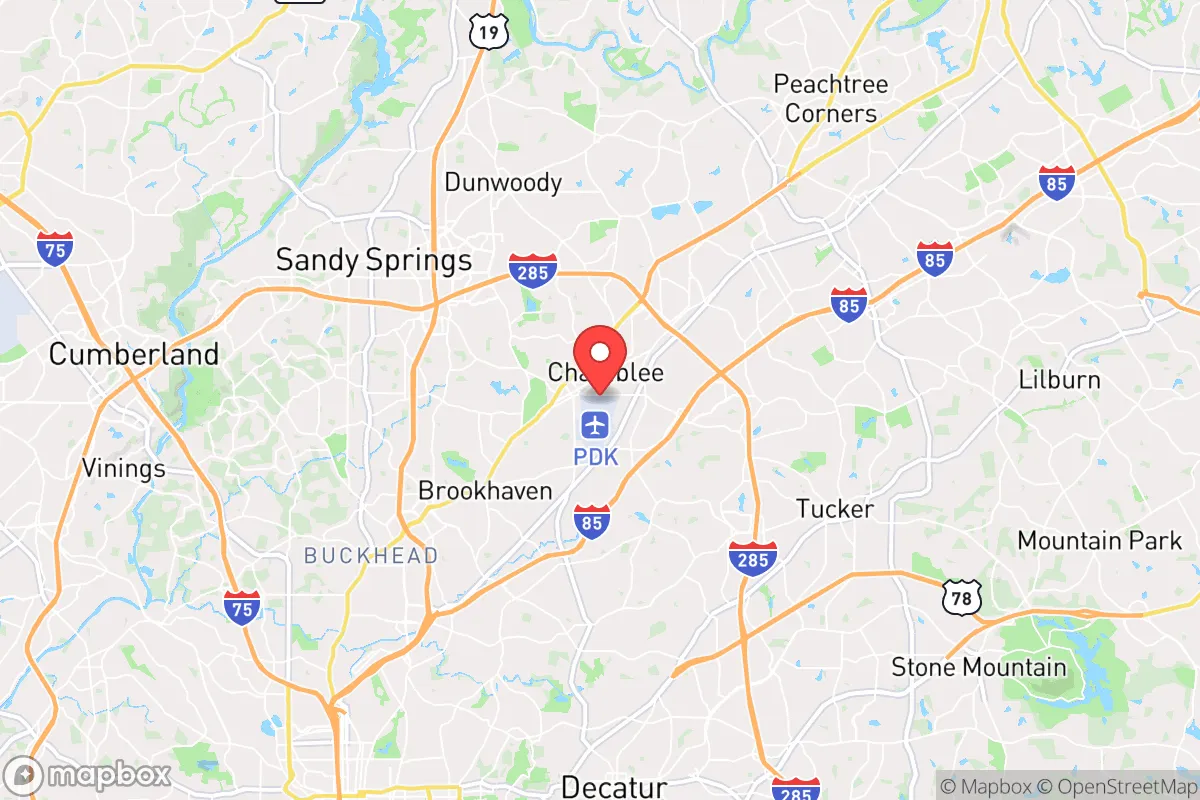
Drive ten minutes north to Dunwoody or Sandy Springs, and you’ll find a completely different political landscape. Those communities lean more moderate-to-conservative, with Cook PVIs around D+5 to R+3. Brookhaven, Chamblee’s immediate neighbor to the west, is also solidly blue but not quite as deep as Chamblee’s D+27. The contrast is stark: Chamblee’s rapid redevelopment—luxury apartments, MARTA transit-oriented density, and a flood of new residents from out of state—has accelerated its leftward drift. Meanwhile, the more established single-family-home neighborhoods in Dunwoody still vote for school board members who prioritize fiscal restraint. If you’re looking for a place where your vote on property taxes or Second Amendment issues might actually swing an election, Chamblee isn’t it anymore.
What this means for residents
For longtime residents, the biggest concern is how this political uniformity affects daily life. The city council has been quick to adopt progressive policies that feel like they came straight from a statehouse playbook: strict rental registration ordinances, zoning changes that prioritize high-density development over single-family lots, and a general willingness to spend taxpayer money on social programs and climate initiatives. Property taxes have climbed steadily as the city expands its budget, and there’s little political opposition to slow it down. If you value local control over your property rights or want a government that stays out of your business, you’ll find yourself on the losing side of most votes. The school board, too, has moved left, with curriculum debates that would have been unthinkable a decade ago now being treated as routine.
On the flip side, if you’re comfortable with a government that takes an active role in shaping the community—funding public art, expanding transit, and mandating affordable housing quotas—you’ll find plenty of allies. But the trade-off is real: personal freedoms around housing choices, business regulations, and even how you use your own land are increasingly subject to city hall’s vision. The trend line points toward more of the same, especially as Atlanta’s urban core continues to spill north along the I-85 corridor.
Culturally, Chamblee has become a place where the local politics mirror the national Democratic platform almost point-for-point. You’ll see pride flags on storefronts, “Hate Has No Home Here” signs in yards, and a general expectation that residents align with progressive social values. There’s little room for the old-school, live-and-let-live conservatism that used to define this area. If that sounds like your kind of community, you’ll fit right in. If not, you might find yourself feeling like a stranger in a town you’ve called home for decades—and wondering how much further it’s going to go.

State Political ClimatePolitical Climate in Georgia
State Political AnalysisPolitical Environment in the State
Georgia has shifted from a reliably conservative stronghold to a genuine battleground state over the past two decades, with its partisan lean narrowing from a solid +8-point Republican margin in 2004 to a razor-thin Democratic victory in 2020 and a near-tie in 2024. The state’s political identity is now defined by a tug-of-war between a rapidly growing, diversifying Atlanta metro and a deeply conservative rural and exurban hinterland, making it one of the most closely watched states in the country. For a conservative considering relocation, Georgia still offers low taxes and a business-friendly environment, but the trajectory is unmistakably toward greater political competition and, in some areas, progressive policy encroachment.
Urban vs. rural divide
The political map of Georgia is a study in stark contrasts. The Atlanta metropolitan area, encompassing Fulton, DeKalb, Cobb, and Gwinnett counties, is the engine of Democratic growth. Fulton County, home to Atlanta proper, delivered over 70% of its vote to Joe Biden in 2020, while DeKalb was even higher at nearly 85%. These urban and inner-suburban counties are now reliably blue, driven by a coalition of African American voters, young professionals, and transplants from other states. Meanwhile, the exurbs and rural areas remain deeply Republican. Forsyth County, just north of Atlanta, voted over 70% for Donald Trump in 2020, and Hall County (Gainesville) and Cherokee County are similarly conservative strongholds. The divide extends to the coast: Chatham County (Savannah) leans Democratic, while Glynn County (Brunswick) and Camden County are reliably red. The key battlegrounds are the fast-growing, diverse suburbs like Cobb and Gwinnett, which flipped from red to blue between 2016 and 2020 and are now the epicenter of Georgia’s political uncertainty.
Policy environment
Georgia’s policy environment remains broadly conservative, though with notable exceptions. The state has a flat income tax rate of 5.49% (down from 5.75% in 2024, with further cuts scheduled), and no estate or inheritance tax. Property taxes are relatively low, with a median effective rate around 0.87% of home value. The regulatory posture is business-friendly, with a right-to-work law and a relatively low minimum wage (tied to the federal $7.25). Education policy is a mixed bag: Georgia has a robust charter school system and a school choice program (the Georgia Special Needs Scholarship), but it also has a state Board of Education that has been increasingly assertive in curriculum decisions, including controversial restrictions on teaching about race and gender. Healthcare policy is a flashpoint: Georgia did not expand Medicaid under the Affordable Care Act, but the state has a limited waiver program (Georgia Pathways) that requires work or community engagement, which has seen low enrollment. Election laws have been a major focus, with the 2021 Election Integrity Act (SB 202) adding voter ID requirements for absentee ballots, limiting drop boxes, and restricting third-party ballot collection. For conservatives, this is a positive step; for progressives, it’s voter suppression. The state also has a permitless carry law (2022) and a heartbeat abortion ban (2019, with limited exceptions), which are likely to remain in place under the current legislature.
Trajectory & freedom
Georgia’s trajectory on personal freedom is a mixed picture, with clear gains in some areas and concerning erosion in others. On the positive side, the state has expanded gun rights significantly: the 2022 permitless carry law (HB 218) allows law-abiding citizens to carry a concealed firearm without a permit, a major win for Second Amendment advocates. Parental rights were strengthened with the 2022 Parents’ Bill of Rights (SB 377), which requires schools to notify parents of curriculum changes and allows them to opt their children out of certain materials. On the negative side, government overreach has grown in other areas. The state’s response to COVID-19 included a prolonged state of emergency and business closures, though less severe than in blue states. More concerning for conservatives is the increasing influence of local governments, particularly in Atlanta and its inner suburbs, which have imposed their own mask mandates, vaccine requirements, and zoning restrictions that can feel like a patchwork of progressive policies. Property rights are generally strong, but the state’s rapid growth has led to increased eminent domain battles, particularly around transportation projects. Taxation is trending in the right direction with the flat tax cuts, but the state’s budget has grown significantly, and there is persistent pressure for new revenue sources, including potential tolls and local sales tax increases.
Civil unrest & political movements
Georgia has been a focal point for political movements on both sides, with visible flashpoints that a new resident would notice. The 2020 election cycle saw massive protests in Atlanta following the murder of George Floyd, with some turning violent and leading to property damage in the city’s downtown and Buckhead neighborhoods. The “Stop the Steal” movement was also active, with rallies at the state capitol and ongoing election integrity concerns that led to the passage of SB 202. Immigration politics are a simmering issue: Georgia has a 2011 law (HB 87) that allows law enforcement to check immigration status during stops, but it has been partially blocked in court. There are no sanctuary cities in Georgia, but Atlanta and some suburbs have adopted “welcoming” policies that limit cooperation with federal immigration authorities. The state has seen a rise in organized activist groups, including the Georgia Gun Owners and the Georgia Republican Assembly on the right, and the Georgia NAACP and the New Georgia Project on the left. Election integrity remains a hot-button issue, with ongoing litigation over absentee ballot rules and the state’s new voting machines. A new resident would notice the political polarization in everyday life, from yard signs to local news coverage, particularly in the Atlanta metro area.
Projection
Over the next 5-10 years, Georgia is likely to become even more competitive, with the Atlanta metro’s growth continuing to drive Democratic gains. The state’s population is projected to grow by another 1-2 million people by 2030, with most of that growth concentrated in the Atlanta suburbs, particularly in Gwinnett, Cobb, and Forsyth counties. This demographic shift will likely make statewide races toss-ups for the foreseeable future, with the potential for Democrats to win the governorship or Senate seats in a favorable national environment. For conservatives, this means that policy victories will be harder to achieve and may be subject to reversal if Democrats gain control of the legislature or governor’s mansion. The state’s rural areas will remain deeply red, but their political influence will continue to wane as the metro area grows. A new resident moving to Georgia now should expect to live in a state that is politically divided, with the potential for significant policy swings depending on election outcomes. The freedom landscape will likely see continued battles over election laws, abortion, and education, with the outcome uncertain.
For a conservative considering a move to Georgia, the bottom line is that the state still offers a relatively low-tax, business-friendly environment with strong gun rights and a conservative-leaning legislature, but the political winds are shifting. The Atlanta metro is becoming increasingly progressive, and the state as a whole is a battleground. If you’re looking for a place where conservative values are deeply entrenched and unlikely to change, you’d be better off in a state like Tennessee or Alabama. But if you’re willing to engage in the fight and want to live in a state with economic opportunity and a growing population, Georgia is a place where your vote and your voice can make a real difference. Just be prepared for the culture war to be a constant presence in your daily life.
* Values derived from national, state, county, city and local statistics and may differ in a specific area. Last updated: 2026-04-30T13:03:22.000Z
Narrative content on this page is AI-generated and may contain mistakes. Verify any details that matter before acting on them.
ReloMaps may earn a commission from affiliate links at no extra cost to you.

