Photo: Wikipedia
Demographics of Charlottesville, VA
Affluence Level in Charlottesville, VA
A middle-class area roughly in line with national averages across income, home values, education, and employment.
People of Charlottesville, VA
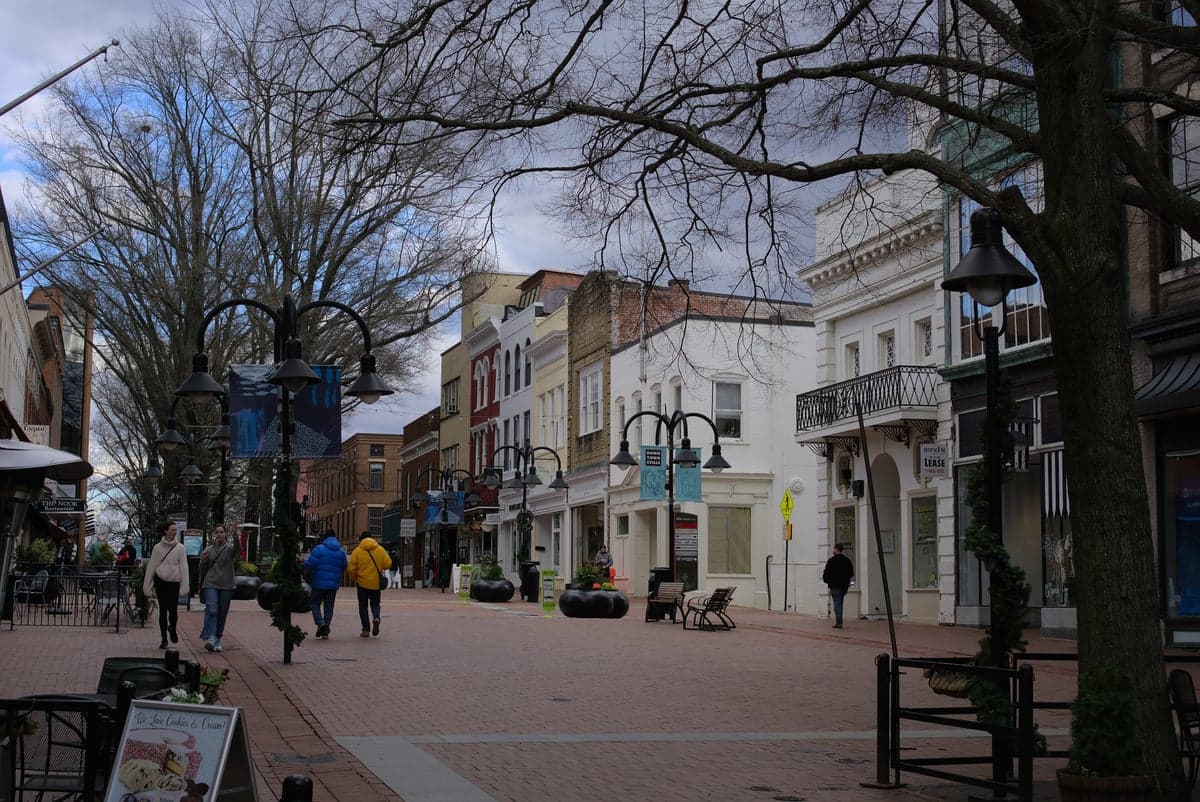
The people of Charlottesville, Virginia today number 45,863, forming a dense, highly educated urban core within a largely rural county. The city is notably white-collar, with 60.6% of adults holding a bachelor's degree or higher, a figure that far exceeds state and national averages and reflects the gravitational pull of the University of Virginia. Racially, the population is 64.4% white, 16.8% Black, 6.8% Hispanic, 5.4% East/Southeast Asian, and 1.6% Indian (subcontinent), creating a community that is simultaneously progressive-leaning, historically rooted, and increasingly diverse by income and origin.
How the city was settled and grew
Charlottesville was founded in 1762 as a trading post at the intersection of two key stagecoach routes, but its early growth was modest. The original white settlers were largely English and Scots-Irish planters drawn by the fertile Piedmont soil and the promise of tobacco wealth, with enslaved Africans forcibly brought to work the plantations. The city's first major population wave came after the 1819 founding of the University of Virginia, which drew faculty, students, and support staff. The historic Fifeville neighborhood became a center for the city's free Black community in the late 19th century, while Venable and Rugby developed as white, middle-class streetcar suburbs. The arrival of the railroad in the 1850s and later the growth of the woolen and shoe industries attracted a wave of German and Irish immigrants, though the city remained overwhelmingly native-born and biracial (white and Black) through the mid-20th century. The post-World War II era saw the expansion of UVA and the rise of the medical center, drawing professionals from across the South and Northeast, but the city's population remained relatively stable at around 30,000 until the 1960s.
Modern era (post-1965)
The 1965 Hart-Cellar Act had a limited direct effect on Charlottesville's foreign-born population, which remains low at just 5.9% today. However, the city's modern demographic story is one of domestic in-migration and suburbanization. The most significant shift has been the growth of the East/Southeast Asian community (5.4%) and the Indian subcontinent community (1.6%), both driven overwhelmingly by UVA's recruitment of graduate students, researchers, and medical professionals. These groups have concentrated in the Lewis Mountain and Barracks Road areas, near the university and the medical center. The Hispanic population (6.8%) has grown steadily since the 1990s, largely through construction and service-sector employment, with a visible cluster in the Cherry Avenue corridor. Meanwhile, the Black population, which was nearly 25% in 1970, has declined to 16.8% as middle-class Black families have moved to surrounding Albemarle County suburbs like Hollymead and Pantops. The white population has become more transient and highly educated, with many recent arrivals being UVA-affiliated professionals from outside Virginia, concentrated in the North Downtown and Woolen Mills neighborhoods.
The future
The population trajectory points toward continued growth driven by the university and the medical center, but at a slower pace than surrounding Albemarle County. The city is becoming more tribalized by education and income: the university-adjacent neighborhoods are increasingly dominated by highly mobile, affluent professionals, while the historic Black and working-class white populations are being pushed to the county by rising housing costs. The foreign-born share is likely to rise modestly, with the East/Southeast Asian and Indian communities growing through UVA's continued international recruitment, while the Hispanic population may plateau as construction and service jobs become harder to afford in the city. The Black population share is expected to stabilize or decline slightly as displacement continues. The city is not homogenizing—it is becoming more stratified, with distinct enclaves of privilege and poverty.
For a conservative-leaning individual or family considering a move, Charlottesville is a city of sharp contrasts: a world-class university town with a dense, walkable core, but also a place where housing costs are high, the political culture is overwhelmingly progressive, and the demographic story is one of increasing economic sorting. The people who thrive here are those who value intellectual and professional opportunity over low taxes or cultural homogeneity, and who are comfortable in a community that is both highly educated and deeply divided by class and race.

* Values derived from national, state, county, city and local statistics and may differ in a specific area. Last updated: 2026-05-01T16:35:26.000Z
Narrative content on this page is AI-generated and may contain mistakes. Verify any details that matter before acting on them.
ReloMaps may earn a commission from affiliate links at no extra cost to you.

