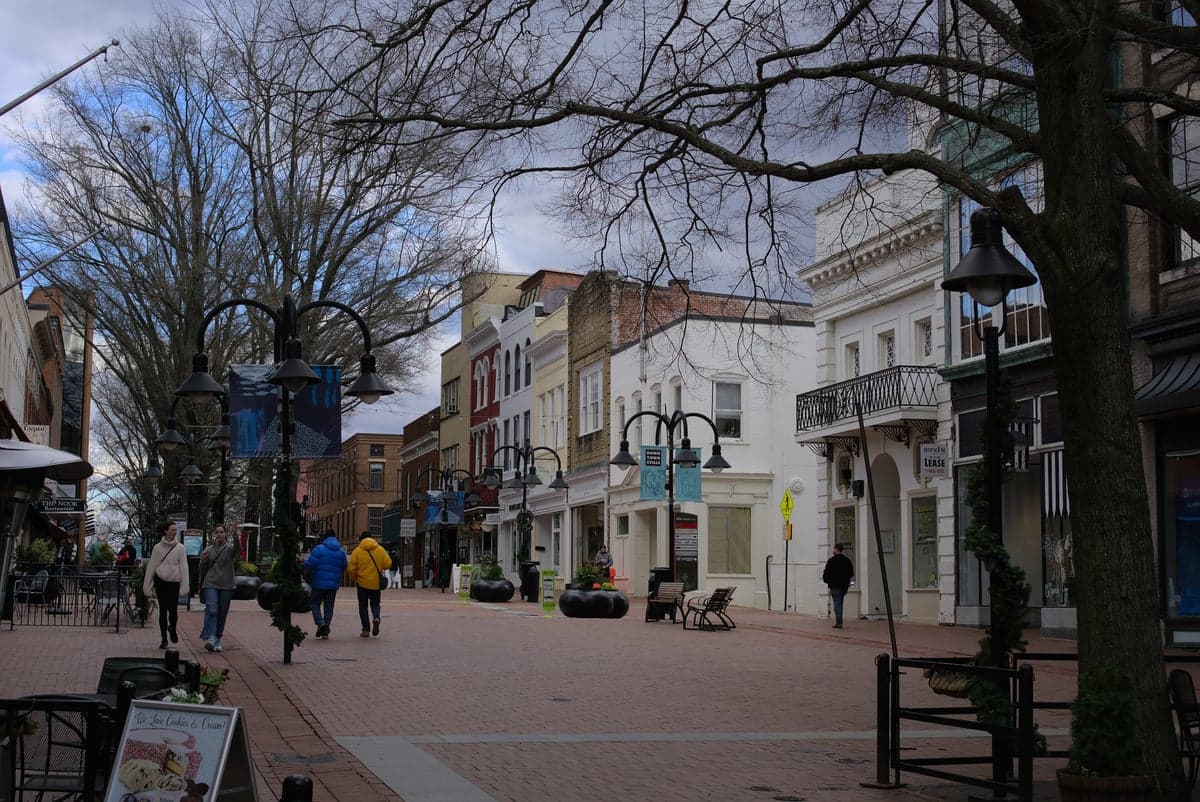
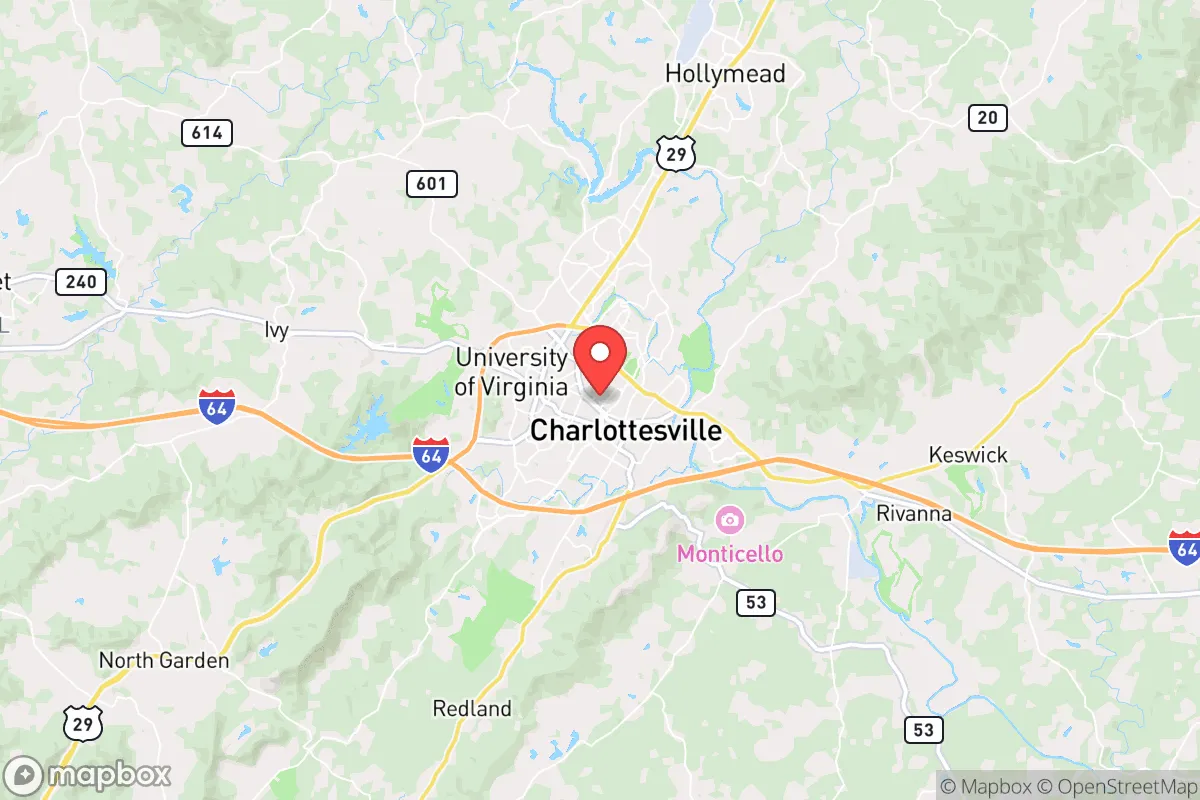
Photo: Wikipedia
Personal Sovereignty in Charlottesville, VA
Viable for self-reliance. Generally workable, though some barriers may limit total independence.
What does Personal Sovereignty tell us?
Personal Sovereignty measures your capacity for self-reliance and independence with minimal government friction. Higher scores mean fewer barriers between you and the way you want to live... but it assumes you have the space you need and good neighbors.
What does this tell us?
Personal Sovereignty measures your capacity for self-reliance and independence with minimal government friction. Higher scores mean fewer barriers between you and the way you want to live... but it assumes you have the space you need and good neighbors.
State Policy
Energy independence: Importer (20% of energy produced in-state)
Personal Liberty
Homesteading

Personal Liberty Analysis
Charlottesville, Virginia, presents a mixed picture for those prioritizing personal sovereignty. While the city itself leans heavily progressive and its local governance often reflects that tilt, the surrounding Albemarle County and the broader Commonwealth of Virginia offer a more complex legal landscape. For the survivalist or prepper mindset, the key takeaway is that Charlottesville is a place where you must be vigilant—your autonomy is not handed to you, but it can be carved out with careful planning and a willingness to operate within a framework that is increasingly hostile to unregulated freedom. The city's tax burden, gun laws, and zoning codes all demand scrutiny before you stake your claim here.
Tax burden and regulatory posture in Charlottesville and Albemarle County
Virginia is not a low-tax state overall, and Charlottesville sits near the higher end of the spectrum. The city's real property tax rate is $0.95 per $100 of assessed value, while Albemarle County's is slightly lower at $0.854. Combined with a state income tax that tops out at 5.75% and a sales tax of 5.3% (with an additional 1% in the city), the total burden is noticeable. For a prepper, the regulatory posture is more concerning than the raw numbers. Charlottesville has a reputation for aggressive code enforcement, particularly around property maintenance and land use. The city's zoning ordinance is dense and restrictive, with a strong emphasis on "urban" density and little tolerance for what might be considered "non-conforming" uses—like keeping livestock, running a home-based firearms business, or storing significant quantities of fuel or supplies. Albemarle County is somewhat more permissive, but still operates under a comprehensive plan that prioritizes "smart growth" and environmental constraints. The state-level regulatory environment is also worth noting: Virginia has a business-friendly reputation in some sectors, but it also has a robust state corporation commission and a Department of Environmental Quality that can make permitting for anything from a well to a septic system a multi-month ordeal. If you value minimal government interference in your property and income, Charlottesville is not a haven—it's a place where you'll need to budget for both taxes and the occasional bureaucratic headache.
Self-defense and gun law specifics in central Virginia
Virginia's gun laws have shifted significantly in recent years, and Charlottesville sits in a county that reflects that tension. The state is a "shall-issue" jurisdiction for concealed carry permits, meaning that if you meet the basic requirements (background check, training course), the sheriff must issue the permit. However, Virginia does not have permitless carry—you need a permit to carry a concealed handgun in public. Open carry of handguns is legal for those 18 and older, but local ordinances can restrict it in certain public buildings and parks. The city of Charlottesville itself has a history of local gun control efforts, including a 2019 attempt to ban firearms from public spaces (later struck down by a court). The practical reality is that while you can own and carry firearms here, you must be meticulous about where you do so. The state also has a "one handgun a month" law, which limits purchases to one handgun per 30-day period unless you have a valid concealed carry permit. For the prepper, this means building a collection takes time and planning. Magazine capacity is not restricted at the state level, but the political climate in Charlottesville means that any future restrictions are a live possibility. The local sheriff's office in Albemarle County is generally pro-Second Amendment, but the city police department operates under a more restrictive city council. If self-defense is a priority, you'll want to live outside the city limits and be prepared to travel to a gun-friendly range or gunsmith—options within Charlottesville are limited.
Self-reliance and homesteading viability in the region
True self-reliance in Charlottesville is a challenge, but not impossible if you choose your location wisely. Within the city limits, lot sizes are small—typically 0.1 to 0.25 acres—and zoning prohibits most agricultural uses. Raising chickens is allowed with a permit, but larger livestock like goats or pigs are not. The city also has strict noise ordinances that can complicate things like generators or power tools after hours. Albemarle County is a different story. Outside the urban ring, you can find parcels of 1 to 10 acres at prices ranging from $50,000 to $150,000 per acre, depending on proximity to town. The county allows for "agricultural" zoning, which permits livestock, orchards, and even small-scale commercial farming. However, off-grid living is heavily regulated. Virginia requires a permit for any well or septic system, and the county health department enforces strict setback requirements. Solar panels are allowed, but grid-tied systems are the norm—going fully off-grid with battery storage is possible but requires navigating building codes and electrical inspections. Rainwater collection is legal but limited to 250 gallons per property without a permit. For the prepper, the best bet is to buy land in the more rural parts of Albemarle County, like the areas near Crozet or Scottsville, where you can have a few acres, a well, and a septic system without constant oversight. But even there, the county's comprehensive plan discourages "rural sprawl," so don't expect to build a secluded bunker without some pushback from planning staff.
Personal liberties in Charlottesville: parental rights, medical autonomy, speech, and property
This is where Charlottesville's progressive tilt becomes most apparent and most concerning for those who value traditional freedoms. Parental rights are under active debate here. The city's school board has been at the center of controversies over curriculum transparency and gender policies, with some parents feeling that their authority is being sidelined. Virginia law does provide for parental opt-outs from certain instruction, but the process can be adversarial. Medical autonomy is similarly contested. Virginia has a state vaccine mandate for school attendance (with religious and medical exemptions), and during the COVID-19 pandemic, Charlottesville was one of the most aggressive localities in enforcing mask and vaccine requirements. The state also has a "right to try" law for terminally ill patients, but it's rarely used. For the prepper, the concern is that in a future public health emergency, local authorities may again impose restrictions that limit your ability to choose your own medical course. Free speech is protected by the First Amendment, but the city has a history of contentious public meetings and a social climate that can be hostile to dissenting views. Property rights are perhaps the biggest sore point. Charlottesville has a strong "eminent domain" authority and has used it for redevelopment projects. The city also has a rental inspection program that gives officials access to private property. For a property owner, this means that your land is never truly yours—the city can impose new regulations, fees, or even take it for a "public purpose" with compensation that may not reflect your investment. If you value absolute control over your property and family decisions, Charlottesville will feel like a constant negotiation with the state.
Overall, personal sovereignty in Charlottesville is a fragile thing. The city itself is a high-regulation, high-tax environment that prioritizes collective goals over individual autonomy. The surrounding county offers more breathing room, but still operates under Virginia's increasingly centralized state government. Compared to areas like rural West Virginia or Tennessee, where property rights are stronger, taxes are lower, and gun laws are more permissive, Charlottesville is a compromise. It's a place where you can live a self-reliant life if you are willing to fight for it—through zoning appeals, school board meetings, and careful legal compliance. For the survivalist or prepper who values community and access to resources, it might be worth the effort. For those who want maximum freedom with minimal government interference, the Shenandoah Valley or points south offer a better deal. Charlottesville is not a fortress of liberty, but it is a place where liberty can be defended—if you are prepared to do so.

* Values derived from national, state, county, city and local statistics and may differ in a specific area. Last updated: 2026-05-01T16:35:26.000Z
Narrative content on this page is AI-generated and may contain mistakes. Verify any details that matter before acting on them.
ReloMaps may earn a commission from affiliate links at no extra cost to you.

