Photo: Wikipedia
Demographics of Claremore, OK
Affluence Level in Claremore, OK
A below-average socioeconomic profile. Incomes, home values, and educational attainment trail the U.S., with higher poverty and unemployment.
People of Claremore, OK
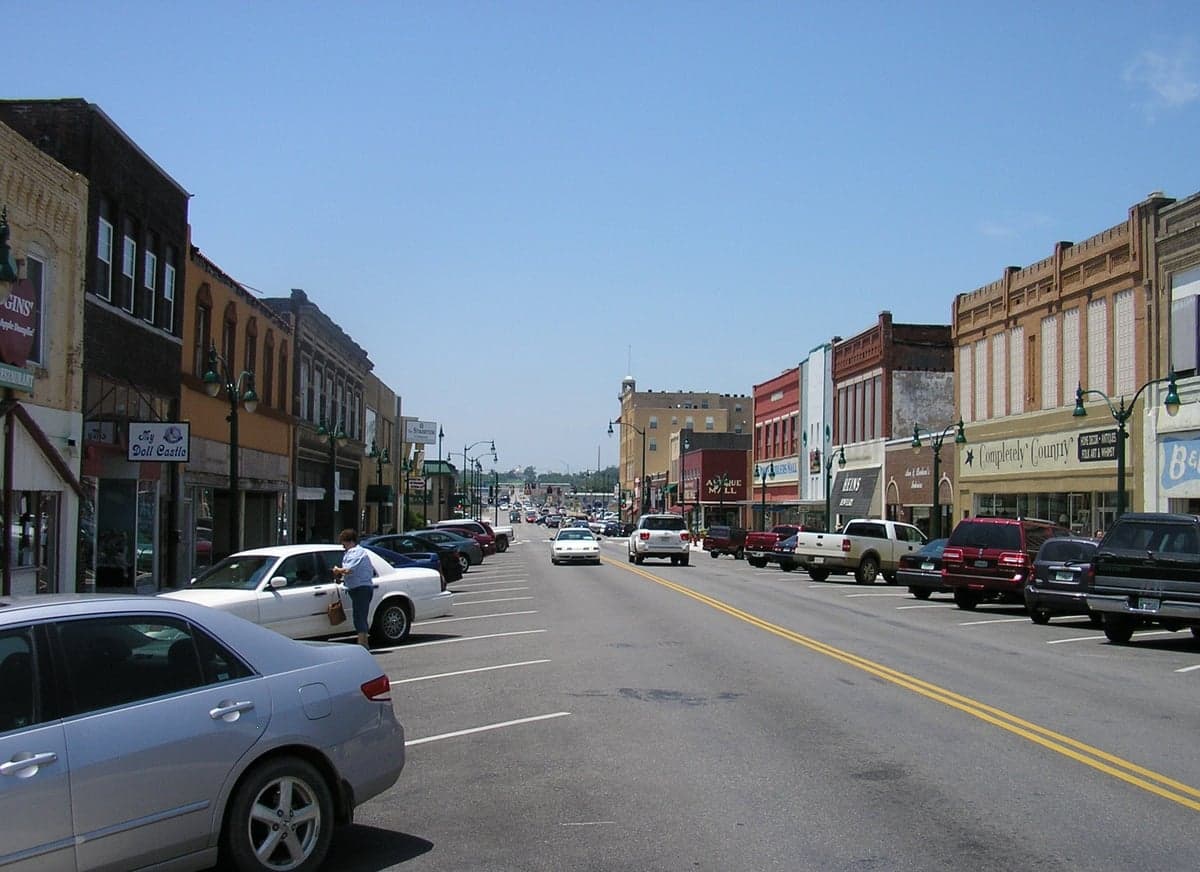
Claremore, Oklahoma, is a predominantly white, family-oriented community of 19,921 residents, where 64.2% of the population identifies as white alone. The city retains a strong small-town character rooted in its Cherokee heritage and oil-boom history, with a notably low foreign-born population of just 1.9%. Its demographic profile is more homogeneous than the national average, reflecting a population that has grown primarily through domestic in-migration from surrounding rural areas and other parts of Oklahoma, rather than international immigration.
How the city was settled and grew
Claremore’s human history begins with the Cherokee Nation, which was forcibly relocated to Indian Territory in the 1830s along the Trail of Tears. The area that became Claremore was part of the Cherokee Nation’s Cooweescoowee District, and the first permanent settlers were Cherokee families who established farms and small trading posts. The town was officially founded in 1882 when the St. Louis-San Francisco Railway (Frisco) laid tracks through the region, drawing a wave of white settlers from the Midwest and South. These early arrivals built homes in what is now Historic Downtown Claremore, centered around the railroad depot, and in the South of the Tracks neighborhood, which housed railroad workers and merchants. The discovery of oil in the nearby Glenn Pool field in 1905 triggered a second major wave, bringing speculators, roughnecks, and entrepreneurs. Many of these oil-boom families settled in the Will Rogers Heights area, named after the city’s most famous son, which became a middle-class enclave of bungalows and Craftsman homes. By the 1920s, Claremore’s population had swelled to over 3,000, with a mix of Cherokee citizens, white Oklahomans, and a small number of Black families who worked as domestic servants and laborers, concentrated in the East Side neighborhood near the railroad yards.
Modern era (post-1965)
After the 1965 Hart-Cellar Act, Claremore saw negligible international immigration. The foreign-born share has remained below 2% for decades, and the city’s growth has been driven almost entirely by domestic migration. The 1970s and 1980s brought an influx of white families from rural Rogers County and the Tulsa metropolitan area, drawn by affordable housing and the expansion of local employers like the Claremore Veterans Center and the Rogers State University campus. These newcomers settled in newer subdivisions such as Lynnwood Estates and Country Club Estates, which offered larger lots and modern amenities. The Hispanic population, now 6.4%, began to grow in the 1990s, primarily as labor for the poultry processing plants and construction trades in the region. Hispanic families concentrated in the West Side area, near the industrial corridor along Highway 66, where older, more affordable housing stock was available. The Black population has remained stable at 1.8%, with most families living in the historic East Side neighborhood or scattered across newer subdivisions. East and Southeast Asian communities (0.8%) and Indian subcontinent residents (0.1%) are very small, typically consisting of professionals employed at Rogers State University or the Claremore Regional Hospital, and they do not form distinct ethnic enclaves.
The future
Claremore’s population is projected to continue growing slowly, driven by spillover from the Tulsa metro area and the expansion of the Cherokee Nation’s economic footprint. The city is likely to remain predominantly white, with the Hispanic share gradually increasing to perhaps 8–10% over the next decade as families follow job opportunities in construction and services. The foreign-born population is expected to stay low, below 3%, as Claremore lacks the industrial diversity or refugee resettlement programs that attract international immigrants to larger Oklahoma cities. The city is not tribalizing into distinct ethnic enclaves; rather, it is homogenizing into a broad, white-majority suburban landscape, with Hispanic families integrating into existing neighborhoods like the West Side and Lynnwood Estates. The Cherokee Nation’s growing influence—through investments in healthcare, education, and cultural centers—may draw more Cherokee citizens back to the area, but this will likely be a modest trend. The college-educated share (22.5%) is below the national average, and without a major employer shift toward knowledge industries, the city will continue to attract families seeking lower costs and a slower pace rather than a diverse, cosmopolitan environment.
For a conservative-leaning individual or family considering a move, Claremore offers a stable, predominantly white community with a strong sense of local identity, low crime, and a cost of living that remains below the Oklahoma average. The city is becoming more suburban and less rural, but its demographic trajectory is one of gradual, modest growth rather than rapid transformation. New arrivals will find a place where the population is largely native-born, English-speaking, and rooted in the region’s Cherokee and oil-boom heritage, with few of the cultural or ethnic tensions found in larger, more diverse cities.

* Values derived from national, state, county, city and local statistics and may differ in a specific area. Last updated: 2026-04-21T09:09:34.000Z
Narrative content on this page is AI-generated and may contain mistakes. Verify any details that matter before acting on them.
ReloMaps may earn a commission from affiliate links at no extra cost to you.

