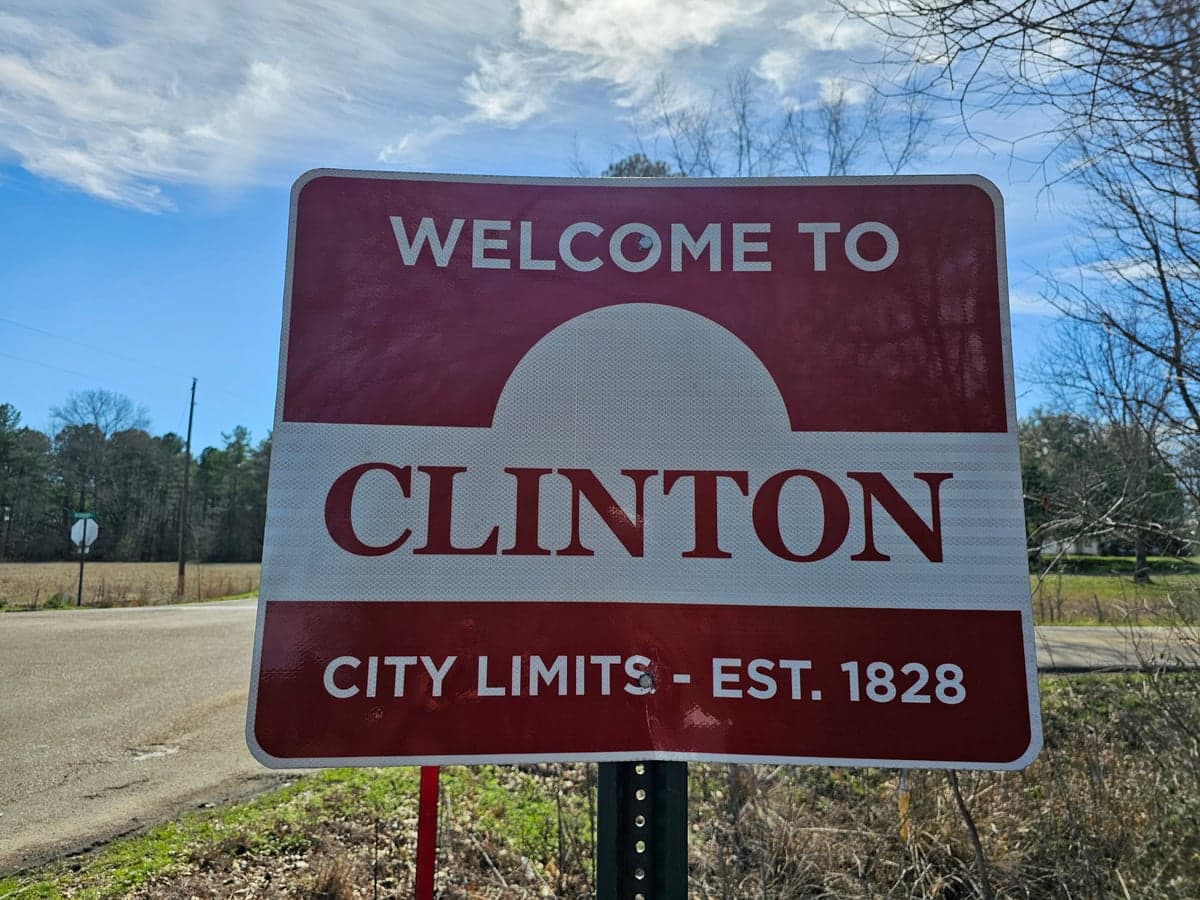
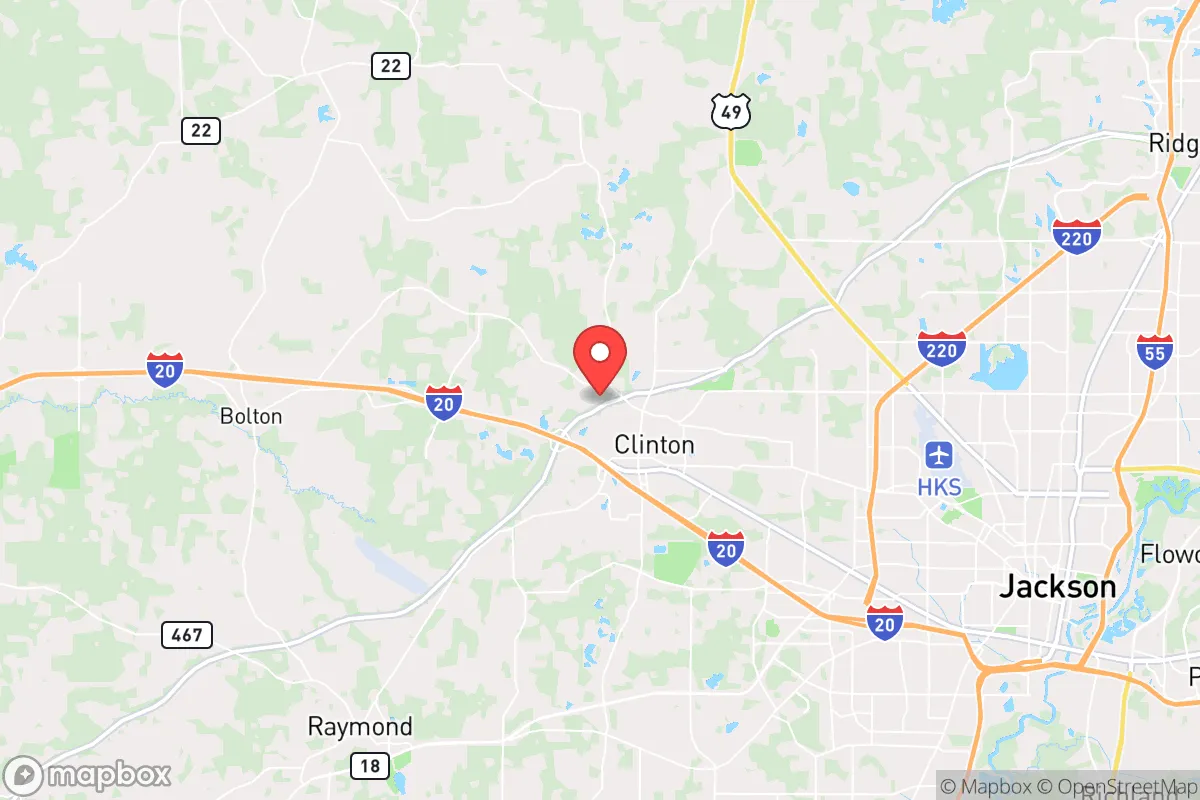
Photo: Wikipedia
Strategic Assessment of Clinton, MS
Workable tactical position. Some exposure to population density or targets, but generally defensible in a crisis.
What does the Strategic Assessment tell us?
Our Strategic Assessment grades tactical survivability of an area. Major population centers, military targets, fallout zones, natural disasters, and border exposure all drive risk — lower exposure means a more defensible position in a crisis.
This is heavily inspired by Joel Skousen's Strategic Relocation book. Highly recommended you checkout the book ($)What does this tell us?
Our Strategic Assessment grades tactical survivability of an area. Major population centers, military targets, fallout zones, natural disasters, and border exposure all drive risk — lower exposure means a more defensible position in a crisis.
This is heavily inspired by Joel Skousen's Strategic Relocation book. Highly recommended you checkout the book ($)Strategic Pillars

Key Distances
Regional Safe Places
Below is our recommended "safe zones" in Mississippi and the surrounding area based on our strategic heuristics. For most people, it's unrealistic to live in a “safe zone” full-time due to work, family or other personal reasons. They tend to be more rural. However, many of these areas are perfect for second homes and retreat properties that double as a vacation home or even a short-term rental.
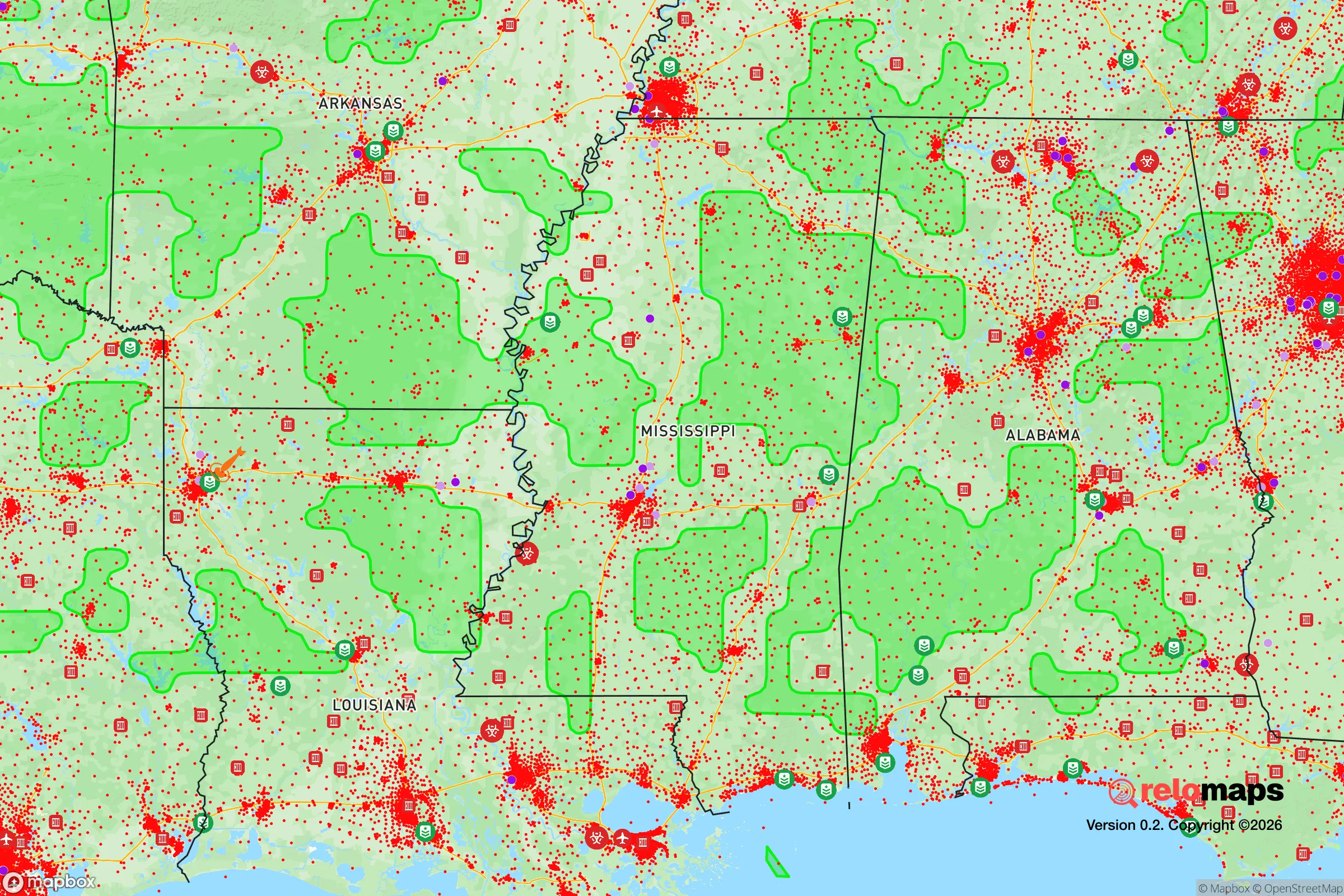
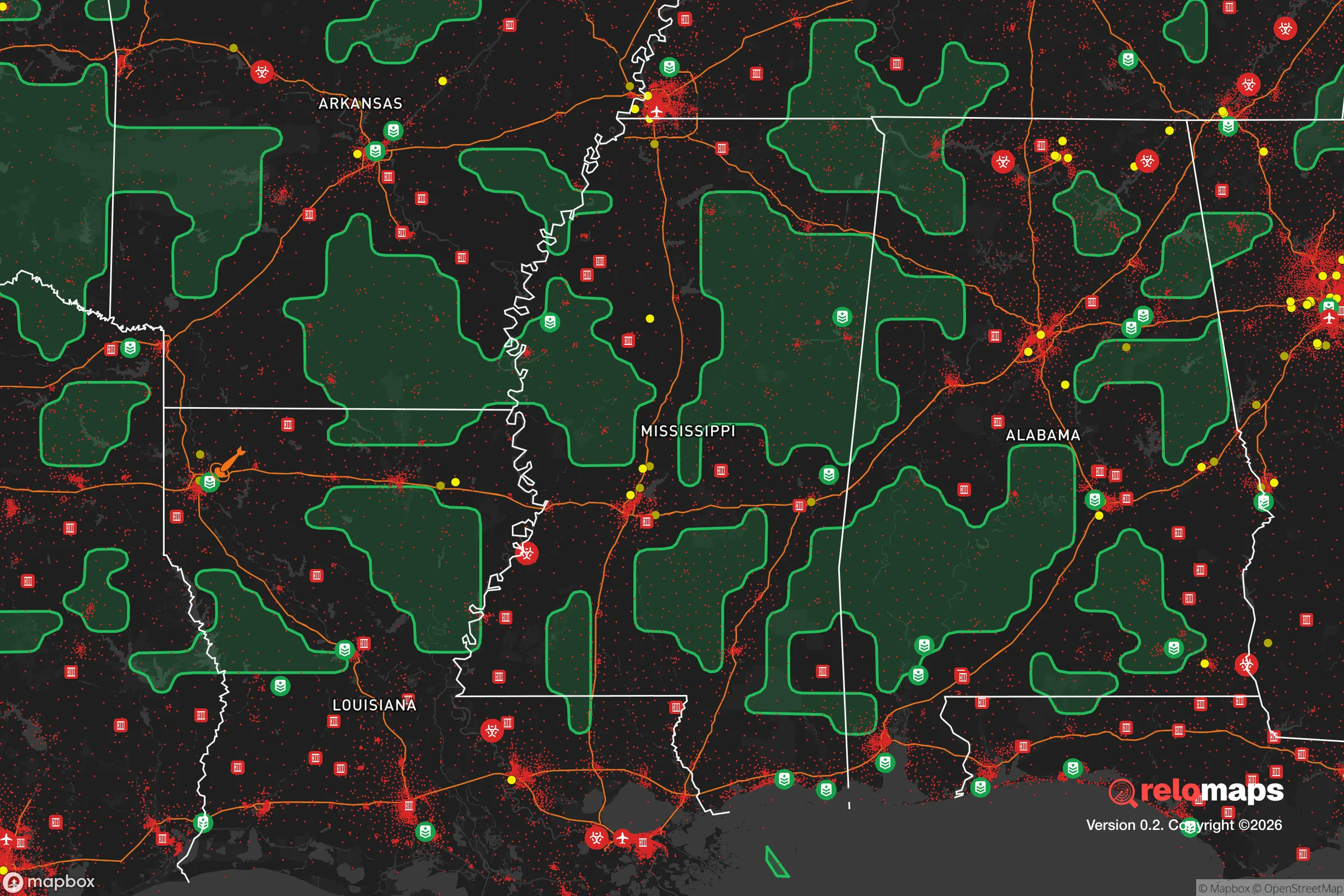


Important Note: For informational purposes only. This does not mean nothing bad ever happens in the green zones. Please use common sense. This is based on public data and modeled with AI. We tried to take a conservative approach but mistakes happen. We update this regularly as new information becomes available.
Solar Generator Recommendations
Backup power matters more here than in safer locations. We've picked three solar generators across budgets and capacity tiers — start with the budget unit if you only need a few essentials, or step up if you want to run a fridge and HVAC for days at a time.

Jackery Portable Power Station Explorer 300
Budget OptionPower on the Go: Weighing only 11 lbs, it's convenient to set up and store with book-sized foldable solar panels

BLUETTI Portable Power Station AC180
Designed for both indoor and outdoor scenarios, AC180 is highly capable as it has a robost capacity and continuous output power.

EF ECOFLOW DELTA Pro Ultra Power Station
Upgraded PickEcoFlow DELTA Pro Ultra is a whole-home energy system designed to grow with your family. Integrated with the Smart Home Panel 2, it scales to meet your evolving energy needs — keeping your home powered, intelligent, and secure through every stage of life.
We earn a commission, at no additional cost to you.
Strategic Assessment Analysis
Clinton, Mississippi, offers a surprisingly resilient strategic position for those prioritizing preparedness and self-sufficiency, sitting just west of Jackson but far enough from the immediate blast zones and urban chaos that would follow a major disruption. Its location along the I-20 corridor provides a critical evacuation route west toward Louisiana and Texas, while the Pearl River basin to the east creates a natural buffer against the worst of Jackson’s potential collapse. For a relocator thinking in terms of bug-out routes, supply chains, and community stability, Clinton’s mix of suburban infrastructure and rural adjacency makes it a viable base of operations—provided you understand the risks baked into its geography.
Geographic position and natural advantages for long-term security
Clinton sits on the bluffs overlooking the Pearl River floodplain, which gives it a natural elevation advantage over much of central Mississippi—important for both flood avoidance and defensible terrain. The city is roughly 15 miles west of downtown Jackson, placing it outside the likely inner ring of a major urban disaster while still close enough to monitor or intercept resources if needed. The surrounding Hinds County is dotted with hardwood forests, agricultural land, and small water bodies like the Ross Barnett Reservoir to the northeast, which could serve as a freshwater source in a grid-down scenario. The climate is humid subtropical, meaning year-round growing seasons for food production, though you’ll contend with heat, humidity, and the occasional tornado threat. For a prepper, the key advantage is the ability to tap into rural life without being isolated—Clinton’s population of roughly 28,000 means you can maintain a low profile while still having access to hardware stores, medical clinics, and a Walmart Supercenter on Springridge Road. The city’s water supply comes from the Sparta Aquifer, a deep groundwater source less vulnerable to surface contamination than the Pearl River, which is a plus for long-term water security.
Risks, exposures, and proximity to fallout-relevant landmarks
The most glaring risk is Clinton’s proximity to Jackson, a city that has already demonstrated systemic fragility—water system failures, crime spikes, and political dysfunction. In a mass casualty event or civil unrest scenario, Jackson’s population of 150,000 could surge westward along I-20, turning Clinton into a choke point. The city is also within 50 miles of the Entergy Grand Gulf Nuclear Station in Port Gibson, a boiling water reactor that, while well-maintained, represents a fallout hazard if compromised. The prevailing winds in central Mississippi generally blow from the south and southwest, meaning a plume from Grand Gulf would likely track northeast—away from Clinton in most scenarios, but not guaranteed. Additionally, the I-20 corridor itself is a target for infrastructure disruption; a single bridge failure or fuel spill could sever the main artery connecting Jackson to Vicksburg and points west. The nearby Jackson-Medgar Wiley Evers International Airport is a potential staging ground for federal response or, conversely, a target for disruption. For the survivalist, the takeaway is that Clinton is not a remote redoubt—it’s a suburban buffer zone that requires active monitoring of Jackson’s pulse and a pre-planned secondary route west toward the Mississippi River if things go sideways.
Practical resilience for a relocator: food, water, energy, and defensibility
For daily life and preparedness, Clinton offers a mixed bag. The city’s water infrastructure is municipally managed and generally reliable, but the 2022 Jackson water crisis showed how quickly a regional system can fail—Clinton was not directly affected, but the panic demonstrated the need for private well access or rainwater catchment. Many homes in the older neighborhoods near the historic district have basements or crawl spaces, which is rare in the South and provides a shelter option for tornadoes or civil unrest. The local power grid is served by Entergy Mississippi, which has a mixed reliability record during storms; a backup generator or solar array with battery storage is a wise investment. Food security is feasible: the Clinton Farmers Market operates seasonally, and the surrounding county has numerous small farms selling beef, poultry, and produce. The Mississippi State University Extension Service in nearby Raymond offers soil testing and agricultural resources for those serious about gardening. For defensibility, Clinton’s layout is suburban sprawl with cul-de-sacs and tree-lined streets—not a fortress, but the lack of dense urban blocks means you can secure a perimeter more easily than in a city. The local police department is responsive, but in a prolonged crisis, you’ll rely on neighborhood networks. The presence of Mississippi College and the surrounding academic community adds a layer of social stability, but also means a transient population that may not share your preparedness mindset.
The overall strategic picture for Clinton is that of a solid B-tier relocation option for the conservative prepper—not a mountain redoubt, but a workable base with real advantages if you’re willing to put in the work. You get the benefits of a small city with a functioning economy, decent schools, and a conservative-leaning population (Hinds County voted 60% for Trump in 2020, though Clinton itself is more moderate), while staying close enough to rural Mississippi to tap into hunting, fishing, and off-grid living. The downsides are the proximity to Jackson’s instability and the nuclear plant risk, but those are manageable with a good plan and a willingness to bug out west if needed. For a single individual or family looking to balance career access with preparedness, Clinton is worth a serious look—just don’t mistake it for a bug-out location. It’s a base camp, not a bunker, and that’s fine if you treat it as such.

* Values derived from national, state, county, city and local statistics and may differ in a specific area. Last updated: 2026-04-21T14:22:00.000Z
Narrative content on this page is AI-generated and may contain mistakes. Verify any details that matter before acting on them.
ReloMaps may earn a commission from affiliate links at no extra cost to you.

